



Antalya
Antalya is Turkey's largest resort city, spread along a cliff-top bay on the Mediterranean coast. Behind it rise the snow-capped Taurus Mountains, a backdrop that stays visible from the beach through most of the year. The old town, Kaleiçi, sits inside Roman and Byzantine-era walls and is now packed with restored Ottoman houses, cafes, and small hotels.
Most visitors come for beach holidays at the big coastal resorts nearby. But the city itself also works well for a few days on its own. It has a walkable historic core, a strong archaeological museum, and easy access to some of Turkey's best-preserved ancient ruins. It suits travelers who want beach time and history in the same trip, without choosing one or the other.

Antalya – Planning a Trip?
Build your day-by-day itinerary in the Tripomatic app.


When to visit
Spring (April–May) and autumn (September–October) are warm, dry, and comfortable for both the beach and sightseeing. Summer (July–August) turns very hot and humid, and the coast gets crowded with holidaymakers. Winters are mild but wet, and most beach clubs close for the season.
The Antalya Golden Orange Film Festival, Turkey's oldest film festival, usually runs in October and fills the city's cinemas and cultural venues.
Best time to visit: April, May, October, November
Outside July and August, afternoons stay comfortable enough for walking around Kaleiçi without needing to retreat indoors.
Top sights
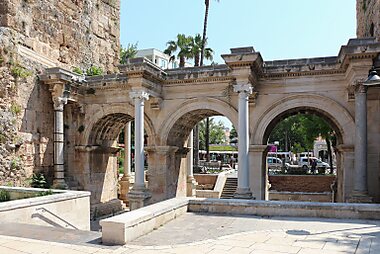
Hadrian's Gate is a Roman triumphal arch built for Emperor Hadrian's visit in 130 CE, and it still marks the entrance to Kaleiçi's old streets.
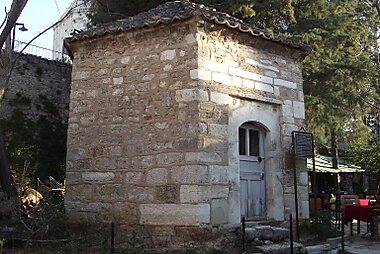
Inside the old town, Yivli Minare Mosque rises above the rooftops with its fluted, ribbed minaret, built during Seljuk rule in the 13th century.
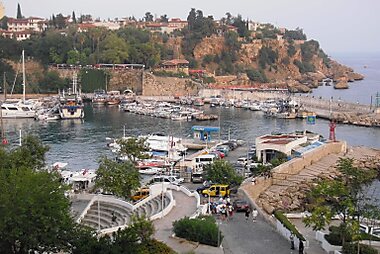
Antalya Old Harbor sits at the bottom of the cliffs below Kaleiçi, a small horseshoe-shaped marina lined with wooden gulets and cafes.
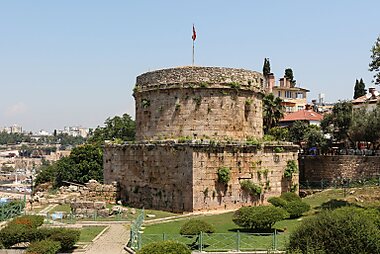
Hıdırlık Tower is a round watchtower on the cliff edge, one of the last surviving pieces of the old city walls.
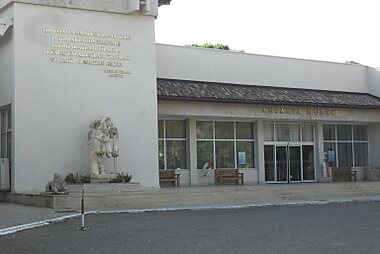
Antalya Archeological Museum holds one of Turkey's best collections of classical statues and mosaics, much of it excavated from nearby Perge.
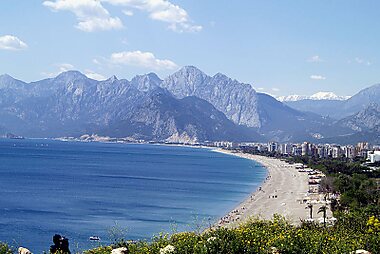
Konyaaltı Beach is the city's main pebble beach, a long curve of coastline with the Taurus Mountains rising straight behind it.
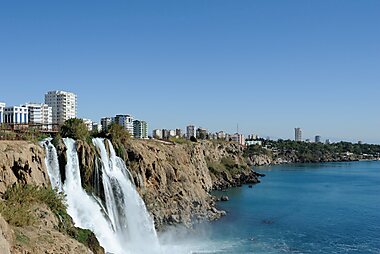
Lower Duden Waterfall drops straight off a cliff into the Mediterranean; boat tours pass beneath it for the view from the water.
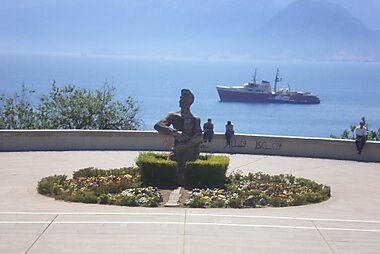
Karaalioğlu Park runs along the clifftop above the harbor, with benches and paths that give some of the best sunset views in the city.
Featured Lists


Antalya's Cultural Treasures
Antalya's cultural landscape is anchored by the Antalya Archeological Museum, which preserves artifacts from the Paleolithic era through the Ottoman period, including significant Roman sculptures from Perge. Within the historic Kaleiçi district, the Suna and İnan Kıraç Museum displays 19th-century ethnographical exhibits in a restored mansion. The collection also includes the Ataturk House & Museum, the Antalya Toy Museum’s international collection, and MiniCity’s 1:25 scale models of Turkish landmarks.
8 places

What to experience
- Take a Turkish hamam ritual at a historic bathhouse in Kaleiçi, such as Sefa Hamamı — steam room, scrub, and massage inside a centuries-old building.
- Join a sunset boat trip from the harbor along the cliffs below Kaleiçi, passing beneath the waterfall that drops straight into the sea.
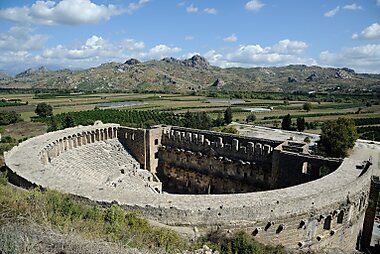
- Catch a summer performance at Aspendos Theater, where opera and ballet are still staged on the original 2,000-year-old stone seating about 50 minutes from the city.
Tours & Activities
Antalya — Map

 Open the interactive map
 Day trips
Antalya sits within reach of some of Turkey's best-preserved ancient ruins, plus a scatter of smaller resort towns along the coast. Close options first:
- Perge Theatre (≈25 min by car or dolmuş): a large Roman city with a colonnaded main street and a stadium. The theater alone still holds thousands of seats.
- Kemer (≈45 min by car): a smaller, quieter coastal resort town backed by pine-covered mountains. Good for a slower beach day and boat trips along the cliffs.
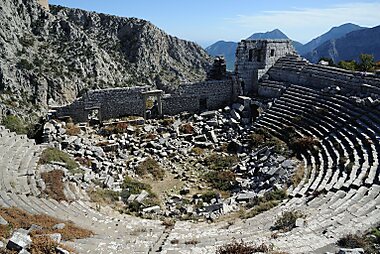
- Termessos (≈45 min by car): a mountaintop city that Alexander the Great's army never managed to conquer. Reach it by a steep trail through pine forest.
- Aspendos Theater (≈50 min by car): the best-preserved Roman theater in the world. It still seats several thousand spectators for summer opera and ballet performances.
- Side (≈1 hour by bus or car): a resort town built around Roman ruins. Temple columns stand right on the beach, making it a full day trip on its own.
Getting there
- By air: Antalya Airport (AYT) has scheduled flights from across Europe and the rest of Turkey, and sits about 13 km northeast of the city center. A taxi takes around 20–25 minutes; the Antray tram line also connects the airport area to downtown Antalya.
- By bus: the main coach terminal (Antalya Şehirlerarası Otobüs Terminali) has frequent long-distance buses to Istanbul, Izmir, and Ankara, plus coastal towns.
- Antalya has no mainline passenger rail connection to the rest of Turkey — arriving by air or bus is standard.
Getting around
- Public transit: buses and the Antray tram/light rail line cover the city and connect to the airport area. Buy an Antalyakart transit card at kiosks or vending machines near stops — most lines don't accept cash on board.
- Taxi / ride-hailing: yellow taxis are common and metered; BiTaksi is the main local ride-hailing app.
- On foot: Kaleiçi and the harbor are compact and walkable, but the city sprawls along the coast, so getting between beach districts usually means a bus, tram, or taxi.
Driving
- Is a car worth it? Not for the city itself — Kaleiçi is largely closed to cars, and beach neighborhoods are connected by tram or bus. A car pays off if you want to reach Termessos, Aspendos, or other day trips on your own schedule.
- Parking: paid street parking and multi-story car parks are common downtown and near the beaches; pay at the roadside machine or through a parking app.
- Restrictions: Kaleiçi's narrow lanes are closed to most private cars — leave the car at a car park on the edge of the old town and walk in.
Food & drink
Antalya piyazı is the dish most associated with the city. It's a white bean salad dressed with tahini, instead of the vinegar dressing used elsewhere in Turkey. Hibeş, a sesame-tahini dip usually eaten with fresh bread, is another local specialty worth seeking out.
The streets and small squares inside Kaleiçi cluster with restaurants and rooftop terraces overlooking the harbor — that's the easiest area to find a good meal. Prices tend to drop a street or two back from the main tourist strip along the harbor front.
Safety & health
Antalya is generally safe for tourists, and violent crime against visitors is rare. The main risks are typical resort-town scams:
- Inflated bills at a few tourist-strip restaurants without visible menu prices.
- Unlicensed drivers offering rides near the airport and bus terminal.
- Timeshare or tour touts around Kaleiçi and the harbor.
Agree on a taxi fare or confirm the meter is running before you get in, and stick to licensed yellow taxis.
History
Antalya was founded around 150 BCE by Attalos II, king of Pergamon, who gave the city its original name, Attaleia. The Romans later expanded it, and Emperor Hadrian's visit in 130 CE was marked with the triumphal arch now known as Hadrian's Gate.
Byzantine and Seljuk rulers each left their mark on the old town. Yivli Minare Mosque, built after the Seljuk conquest of the city in the 13th century, is the clearest surviving symbol of that era. Centuries later, Ottoman merchant families built the wooden houses that still line Kaleiçi's streets, many now restored as small hotels and cafes.
Country facts
Quick practical facts for Turkey at a glance:
- Currency
- Turkish Lira TRY ₺ · Card payments · Widely accepted
- Emergency numbers
- 112 Ambulance
- Electricity
- 230 V · 50 HzType C / Type F
- Languages
- Turkish
- Tap water
- Drink with caution
- Driving side
- Right
- Calling code
- +90


Antalya – Plan Your Days
Turn the places from this guide into a real itinerary, with smart routing, time estimates, and everything you need for a perfect trip.

