


Bologna
Bologna is Italy's food capital and one of its oldest university towns, but it draws far fewer visitors than Florence, Venice, or Rome. The historic center is a maze of orange-red buildings, medieval towers, and covered walkways that let you explore in any weather. The physicist Guglielmo Marconi, pioneer of radio, was born here.
The University of Bologna, founded in 1088, is the oldest in the Western world, and its students still fill the bars and squares at night. Locals call the city "la dotta, la rossa, la grassa" — the learned, the red, the fat — for its scholarship, its terracotta rooftops, and its food. Expect long lunches, rich pasta dishes, and a slower pace than Italy's bigger tourist cities.

Bologna – Planning a Trip?
Build your day-by-day itinerary in the Tripomatic app.
When to visit
Spring and autumn are mild and the best time to walk the city. Summer is hot and humid, and many locals leave in August, while winter is cold and damp but quiet, with fewer crowds at the main sights. Plan around Il Cinema Ritrovato if you can, a festival of restored classic films with free open-air screenings in Piazza Maggiore each summer, usually late June into early July.
Best time to visit: May, September, October
Top sights
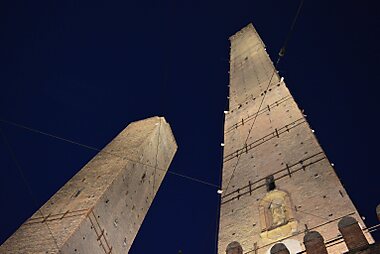

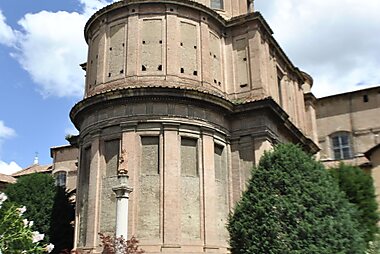
Two Towers are Bologna's two leaning medieval towers and the city's best-known landmark. Climb the taller Asinelli tower for a view over the terracotta rooftops.
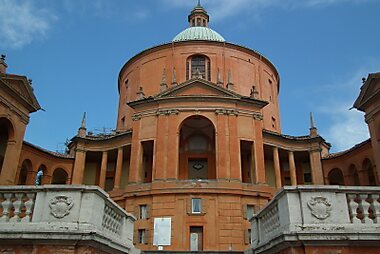
Portici di Bologna are a UNESCO World Heritage network of covered walkways that shelter more than 60 kilometers of the city's streets. The longest single stretch climbs from the center to the hilltop sanctuary of San Luca.
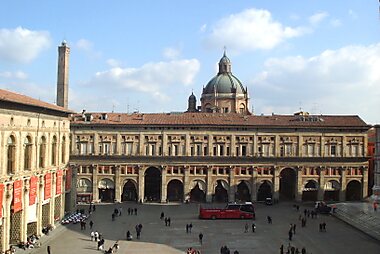
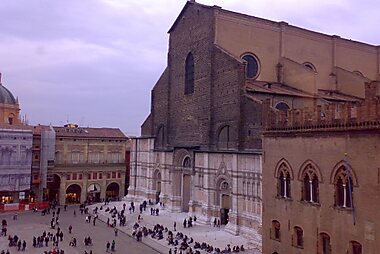
Piazza Maggiore is the city's grand central square, ringed by the Gothic Basilica of San Petronio and the medieval town hall.
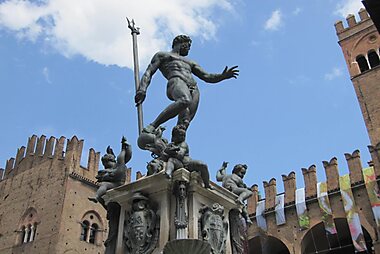
Fontana del Nettuno is a bronze and marble Renaissance fountain by Giambologna, just off the main square.
Archiginnasio Palace and Anatomical Theater was the seat of Europe's oldest university and holds a 17th-century wooden anatomy theater once used for public dissections.
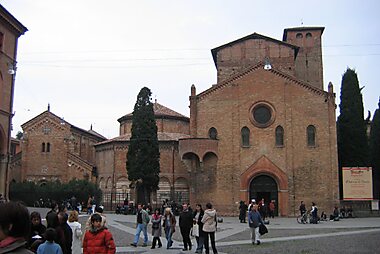
Basilica of Santo Stefano, known locally as the Seven Churches, is a cluster of linked medieval churches built up over centuries.
Sanctuary of the Madonna di San Luca sits on a hill above the city and marks the end of the world's longest portico, a 3.8-kilometer covered walkway built to shelter pilgrims.
Featured Lists


Culinary Landmarks
Bologna's culinary identity is centered around historic hubs like the medieval Mercato di Mezzo and the Mercato delle Erbe, the city's largest covered food hall. This selection features traditional delis specializing in cured meats alongside restaurants serving regional staples like handmade tortellini, ragù, and lasagna. From rustic trattorias in the historic center to modern pasta laboratories near the Two Towers, these locations represent the city's long-standing dedication to artisanal production and high-quality local ingredients.
9 placesAudio Guides – Bologna
Explore on foot with a self-guided audio tour that narrates each stop as you reach it.


Hear Bologna's audio tours
1 walk in Audio Guides by Tripomatic


What to experience
- Join the early-evening aperitivo crowd along Via del Pratello or in Piazza Verdi, where students and locals drink spritz and share snacks before dinner.
- Take a hands-on class in making tortellini or tagliatelle by hand, a skill Bologna's home cooks still pass down.
- Walk or cycle the tree-lined avenues that trace the route of Bologna's old medieval walls, now a green ring around the historic center.
- Catch a match at Stadio Renato Dall'Ara if Bologna FC is playing at home, for an evening among local football fans.
Tours & Activities
Bologna — Map

 Open the interactive map
 Day trips
Bologna's location on Italy's high-speed rail line makes several major cities and towns easy day trips.
- Modena — about 25 minutes by train. Home to the Ferrari and Maserati story, balsamic vinegar producers, and a Romanesque cathedral.
- Ferrara — about 30 minutes by train. A flat, easy-to-cycle Renaissance city with a moated castle and a well-preserved historic center.
- Florence — about 35 minutes by high-speed train. Italy's Renaissance capital, with the Uffizi and the Duomo, is closer to Bologna than many travelers expect.
- Parma — about an hour by train. Known for prosciutto and Parmigiano-Reggiano, with frescoes by Correggio in its cathedral.
- Ravenna — about 1 hour 15 minutes by train. Home to some of the best-preserved Byzantine mosaics in the world, a UNESCO World Heritage site.
Getting there
- By air: Bologna Guglielmo Marconi Airport (BLQ) is the main gateway, 6 kilometers northwest of the center. The Marconi Express monorail connects the airport to Bologna Centrale train station in 7 minutes.
- By train: Bologna Centrale is a major hub on Italy's high-speed rail network, with frequent connections to Milan (about 1 hour), Florence (about 35 minutes), and Rome (about 2 hours).
- By bus: Long-distance coaches, including FlixBus, arrive at the bus station next to Bologna Centrale, with links to smaller towns not served by rail.
Getting around
- Public transit: TPER operates the city's buses; there is no metro. Buy tickets in advance from tobacco shops or the TPER app, or tap a contactless bank card or phone directly on the reader when boarding. TPER
- Taxi: Metered taxis wait at ranks near Piazza Maggiore and the train station; ride-hailing app coverage is limited.
- On foot: The historic center is compact and mostly flat, and its covered porticoes make walking pleasant even in rain or summer heat.
Driving
- Is a car worth it?: No. The historic center is compact, walkable, and largely closed to non-resident traffic, so a car is only useful for day trips into the Apennines or countryside.
- Restrictions: A camera-enforced ZTL (limited traffic zone) covers most of the historic center; entering without a permit brings a fine.
- Parking: Park at one of the multi-story garages or park-and-ride lots on the edge of the center and walk or take a bus in.
Food & drink
Bologna gave the world tortellini, tagliatelle al ragù (the real version of what is sold abroad as "spaghetti bolognese"), and mortadella. Portions here are generous and meals unhurried, more so than in Italy's more touristy cities.
For the best concentration of food shops and casual eating, head to the Quadrilatero, the old market district of narrow streets just east of Piazza Maggiore, where delis, wine bars, and stalls sell food to eat standing up.
Safety & health
Bologna is a safe city for tourists, with petty crime the main concern rather than violent crime. Watch for pickpockets around Bologna Centrale station and on crowded buses, and be wary of unofficial "helpers" who offer to carry bags at the station.
Tap water is safe to drink throughout the city.
History
Bologna began as the Etruscan and later Roman city of Bononia, a key stop on the road north from Rome. In 1088 the University of Bologna was founded here, the oldest university in the Western world, and it shaped the city for centuries afterward. During the medieval period, wealthy families competed by building tall stone towers, and more than 100 once stood across the city; only a handful survive today, among them Two Towers.
Construction on Basilica of San Petronio began in 1390 with plans to make it larger than St. Peter's Basilica in Rome; the Church later blocked the expansion, leaving its facade famously unfinished. Bologna was also a center of anti-fascist resistance during the Second World War, and the city center still carries memorials to the partisans who fought here.
Country facts
Quick practical facts for Italy at a glance:
- Currency
- Euro EUR € · Card payments · Widely accepted
- Emergency numbers
- 112
- Electricity
- 230 V · 50 HzType C / Type F / Type L
- Languages
- Italian
- Tap water
- Safe to drink
- Driving side
- Right
- Calling code
- +39


Bologna – Plan Your Days
Turn the places from this guide into a real itinerary, with smart routing, time estimates, and everything you need for a perfect trip.




