


Erfurt
Erfurt is the capital of Thuringia. Its medieval old town has narrow lanes, half-timbered houses and a large cathedral hill.
Wealth from the medieval trade in woad dye built the city. Martin Luther studied here, and its medieval Jewish sites are a UNESCO World Heritage site. Erfurt suits a relaxed stay of one or two nights. It is also a good base for Weimar, Eisenach and the Thuringian Forest.

Erfurt – Planning a Trip?
Build your day-by-day itinerary in the Tripomatic app.


When to visit
Late spring and early autumn are the most comfortable times. Summer is warm, and winters are cold with frost and some snow.
The Christmas market on the Domplatz runs from late November into December. It fills the square below the cathedral and is the main reason to visit in winter.
Best time to visit: June, August, September
Top sights
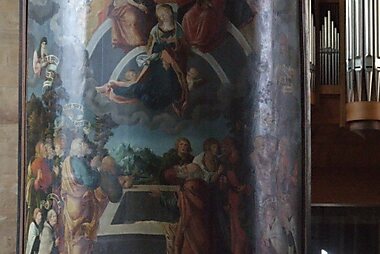
- Erfurter Dom stands on the Domberg above the Domplatz. The hill also holds St Severus' Church, so you can see both on one walk.
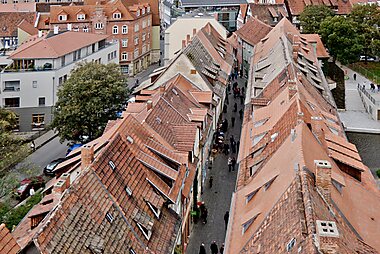
- Krämerbrücke is a bridge lined with half-timbered houses. The ground floors hold craft workshops, galleries and cafés.
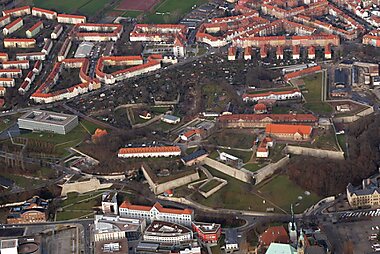
- Zitadelle Petersberg is a large baroque fortress on a hill above the old town. The walls give wide views over the roofs and spires.
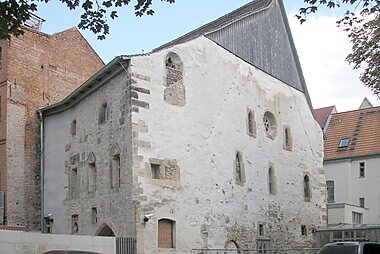
- Alte Synagoge Erfurt is a medieval synagogue that is now a museum. It shows the Erfurt Treasure, a hoard of medieval coins and silver.
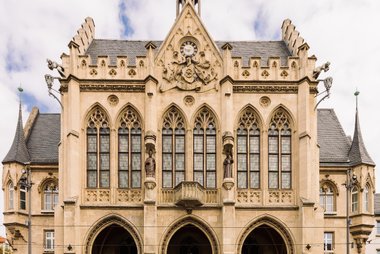
- Rathaus Erfurt is a neo-Gothic town hall on the Fischmarkt.
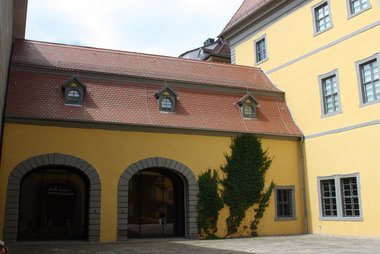
- Angermuseum Erfurt is an art museum in a baroque building. Its collection runs from medieval art to the modern period.
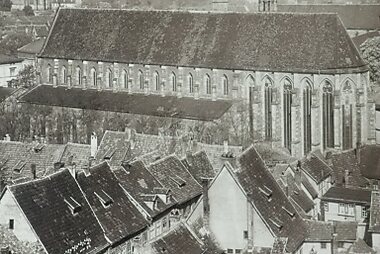
- Barfüßerkirche is a former Franciscan church. It now belongs to the Angermuseum.
- Predigerkirche is a former Dominican church in the old town.
Featured Lists


What to experience
- Watch open-air theatre at the DomStufen-Festival in summer. The stage is set on the wide steps below the cathedral.
- Join a guided visit to the medieval mikveh, the Jewish ritual bath near the Krämerbrücke.
- Spend an afternoon at the egapark, a large garden park west of the centre.
Tours & Activities
Erfurt — Map

 Open the interactive map
Day trips
Erfurt sits in the middle of Thuringia.
- Weimar is a short regional train ride away. It is the town of Goethe and Schiller and the birthplace of the Bauhaus school.
- Gotha has a large baroque palace and a pleasant old town.
- Arnstadt is a small old town where Bach worked as a young organist.
- Eisenach is about 1 hour by train. Wartburg Castle above the town is a UNESCO World Heritage site and the place where Luther translated the New Testament.
- Jena is a university town in a river valley.
Where to explore
Other places in Thuringia that work as a longer stay or a second stop:
- Thuringian Forest is a wooded hill range for hiking and, in winter, skiing.
- Suhl is a town on the edge of the forest.
- Saalfeld is a small historic town in the south-east of the state.
Getting there
- By train: Erfurt Hauptbahnhof is a hub for fast ICE trains. Munich, Dresden and Leipzig are also on direct lines. Book on Deutsche Bahn.
- By air: Erfurt-Weimar Airport (ERF) is close to the centre and linked by tram. Services are limited, mostly holiday flights. Most visitors fly to Frankfurt (FRA) or Leipzig/Halle (LEJ) and continue by train.
Getting around
- On foot: The old town is compact. The main sights are within walking distance of each other. Streets are cobbled in many places, so wear comfortable shoes.
- Trams and buses: Trams run from the station through the centre and out to the airport.
- Cycling: Cycling is practical on the flat areas of the city. The Domberg and Petersberg are steep.
Driving
- Is a car worth it?: Not for the city. The old town is best explored on foot. A car helps for the Thuringian Forest and for sights outside the towns.
Food & drink
Thuringian cooking is hearty. Look for Thuringian bratwurst, grilled over charcoal, and Klöße, the local potato dumplings, served with roast meat and gravy.
Cafés and restaurants cluster around the Fischmarkt, the Wenigemarkt and the Krämerbrücke. Many have outdoor tables in summer.
Safety & health
Erfurt is safe for visitors. Pickpockets can work in crowds at the Christmas market and around the main station.
History
Erfurt was first mentioned in the 8th century. It grew rich in the Middle Ages from the trade in woad, a plant used for blue dye.
The stone Krämerbrücke was completed in 1325.
The Jewish community was an important part of medieval Erfurt. A hoard found in 1998 is thought to date from the persecution of 1349. It is now shown in the Alte Synagoge Erfurt.
The university was founded in 1379. Martin Luther studied here and entered the Augustinian monastery in 1505. Its church, the Augustinerkirche, still stands.
In 1665 work began on the Zitadelle Petersberg. The army used it until 1963. In 1891 the Social Democratic Party agreed its Erfurt Programme in the city.
Country facts
Quick practical facts for Germany at a glance:
- Currency
- Euro EUR € · Card payments · Commonly accepted
- Emergency numbers
- 112 Ambulance · Fire brigade
- Electricity
- 230 V · 50 HzType C / Type F
- Languages
- German
- Tap water
- Safe to drink
- Driving side
- Right
- Calling code
- +49


Erfurt – Plan Your Days
Turn the places from this guide into a real itinerary, with smart routing, time estimates, and everything you need for a perfect trip.


Related destinations

Data: © OpenStreetMap contributors, Wikidata, Wikipedia, Tripomatic, Official websites, geoBoundaries (CC BY 4.0). Tours by GetYourGuide. We earn commission from bookings. Travel guide generated with AI.
Plan your trip with Tripomatic
- AI-Powered PlanningGet a ready-made day in one tap, let AI spread your shortlist across your trip, or plan everything by chatting.
- Travel AlertsOfficial advisories, severe weather, strikes, and natural hazards for the places on each day of your trip.
- Public Holidays & EventsSee holidays, festivals, and closures on the days of your trip, and what they mean for your plans.
- Cost EstimationAI-powered trip cost breakdowns so you know what to budget before you go.
- Tours & TicketsBook tours, skip-the-line tickets, and activities directly in your plan.