


Geneva
Geneva sits at the southwestern tip of Lake Geneva, where the Rhône river begins its journey to the Mediterranean. French is the local language, and the city has a distinctly international feel: it hosts the United Nations' European headquarters and dozens of other international organizations, so diplomats and researchers mix daily with local residents. The compact old town, with cobbled streets around St. Peter Cathedral, sits an easy walk from the lakefront and its towering fountain.
Geneva suits a traveler who wants a calm, walkable city with several major museums, lake views, and easy access to the Alps, rather than a nonstop nightlife scene. Two to three nights are enough to see the highlights and take a short trip out to the mountains or a neighboring lakeside town.
Philosopher Jean-Jacques Rousseau was born here in 1712, and reformer John Calvin made the city a center of the Protestant Reformation; both left a lasting mark on Geneva's civic character.

Geneva – Planning a Trip?
Build your day-by-day itinerary in the Tripomatic app.
When to visit
Spring and early autumn are mild and the best time to walk around the lake. Summer is warm with occasional thunderstorms, and winter is cold and often foggy near the water.
Plan around Swiss National Day on August 1, when Geneva marks the occasion with a fireworks display over Lake Geneva and bonfires around the city.
Best time to visit: July, September
July and August bring the warmest, sunniest weather, while November and December are the greyest months. Winter days are often grey and damp, so pack layers if visiting between December and February.
Top sights

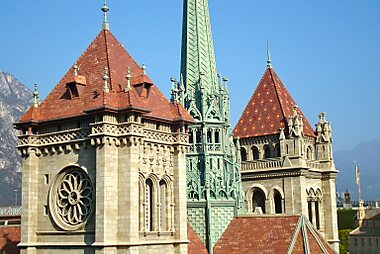

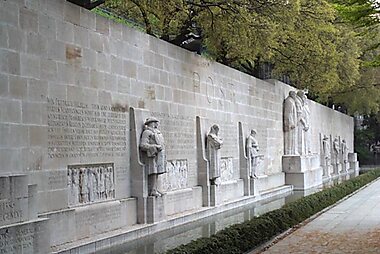
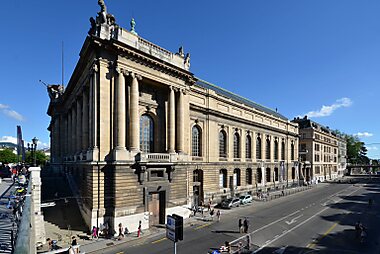
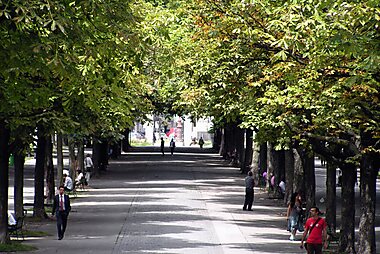
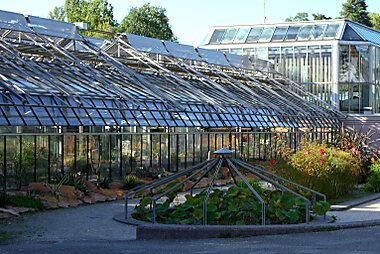
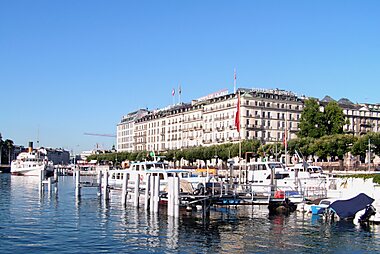
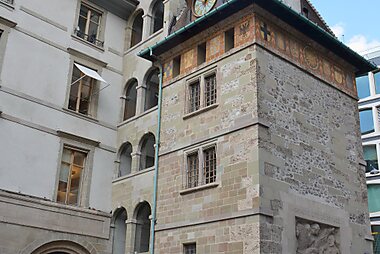
Geneva's top sights mix lakefront landmarks, Reformation history, and major museums.
Jet d'Eau is the city's most recognizable symbol, a fountain that shoots a jet of water 140 meters into the air over the lake.
The old town climbs to St. Peter Cathedral, where John Calvin preached during the Reformation; climb the towers for a rooftop view over the city.
Just below the old town, Reformer's Wall is a 100-meter monument to the leaders of the Protestant Reformation, built into the old city walls.
North of the old town, Palace of Nations is the European headquarters of the United Nations, and tours take visitors through its grand assembly halls.
Across the avenue, Broken Chair is a giant wooden sculpture of a chair with a broken leg, built as a protest against landmines.
On the lakefront, English Garden holds Geneva's flower clock, first planted in 1955.
Museum of Art and History is Geneva's largest art museum, with collections spanning archaeology, fine art, and applied arts.
For something distinctly local, Patek Philippe Museum traces the history of watchmaking through pieces from one of Geneva's own watch houses.
Featured Lists


Audio Guides – Geneva
Explore on foot with a self-guided audio tour that narrates each stop as you reach it.


Hear Geneva's audio tours
1 walk in Audio Guides by Tripomatic


What to experience
Geneva's best experiences happen on and around the lake, though one standout lies just beyond it.
- Ride tram 18 directly to CERN, the world's largest particle physics laboratory, based in a northwestern suburb of Geneva on the France–Switzerland border; its visitor center and guided tours are open to the public, though tours require advance reservation.
- Swim or relax at Bains des Pâquis, a lakeside bathing spot locals use year-round, including a winter sauna dip.
- Take a paddle-steamer cruise on Lake Geneva with the historic CGN Belle Époque steamers, some dating back over a century.
- Join the crowds along the lakefront for the Swiss National Day fireworks on August 1.
- In December, follow the torchlit procession of L'Escalade, which reenacts the city's defense against a night attack in 1602, and break a chocolate cauldron shaped like the ones used to boil the invaders' soup.
- Browse the Plainpalais flea market, held Wednesday and Saturday mornings on the Plaine de Plainpalais.
Tours & Activities
Geneva — Map

 Open the interactive map
 Day trips
Geneva sits right on the lake and close to the French border, so several worthwhile trips fit into a single day.
- Nyon — about 15 minutes by train. A lakeside town with a Roman-era museum, a medieval château, and a lively Saturday market.
- Yvoire (France) — about 1.5 hours by lake boat. A small walled village covered in flowers, on the French shore of the lake.
- Lausanne — about 40 minutes by train. Switzerland's Olympic capital, with the Olympic Museum and a Gothic cathedral above the old town.
- Chamonix (France) — about 1.5 hours by bus or car. Cable cars climb to viewpoints high above the glaciers of Mont Blanc, western Europe's tallest mountain.
- Annecy (France) — about 45 minutes by car, or 1.5 hours by train. Canals and a turquoise lake ringed by the Alps.
Getting there
- By air: Geneva Airport (GVA) sits 4 km from the city center and has scheduled flights across Europe and beyond. A direct train connects the airport to Cornavin station in about 6 minutes; a single ticket costs a few francs, and arriving passengers can pick up a free public transport ticket.
- By train: Geneva's main station, Cornavin, has direct high-speed trains to Paris (just over 3 hours by TGV) and Lyon, plus frequent regional trains around Lake Geneva and across Switzerland.
- By bus: Long-distance coaches connect Geneva to nearby French and Swiss cities from the bus terminal next to Cornavin station.
Getting around
- Public transit: Trams, buses, and a few boat shuttles cross the city, run by Transports Publics Genevois (TPG). Buy a ticket from a machine at the stop or the TPG app before boarding — the machines accept contactless bank cards — then validate it before you ride. Transports Publics Genevois
- Taxi / ride-hailing: Uber operates alongside local taxis.
- On foot / cycling: The city center is compact and flat, so walking covers most sights easily. A citywide bike-share system also works well along the lakefront.
Driving
- Is a car worth it?: Skip it for the city itself — public transit and walking cover every sight, and central streets are narrow and slow. A car only helps for day trips beyond the rail and boat network.
- Parking: Park-and-ride (P+R) lots at the edge of the city connect to trams and cost far less than parking in the center; central parking garages charge roughly CHF 3–4 per hour.
- Restrictions: Several old-town streets are closed to private cars; watch for pedestrian-only signs.
Food & drink
Geneva's food scene mixes French and Swiss influences, with an international range reflecting its many foreign residents. Cheese and chocolate specialties from across Switzerland appear on menus everywhere, alongside French classics like filets de perche (small lake fish, fried and served with fries).
For a meal out, head to Carouge, a district of independent restaurants and cafés with a village feel, or to the terraces around the old town's Bourg-de-Four square. Tipping follows the country default: service is included by law, so rounding up is a courtesy, not an expectation.
Safety & health
Geneva is generally very safe for tourists, with low rates of violent crime. The main risks are pickpocketing on crowded trams and around the train station, and bag-snatching on the lakefront during summer events — keep valuables in a front pocket or zipped bag in crowds.
Tap water is safe to drink across the city. Not every public fountain in the old town is a drinking fountain, though — look for ones marked as safe, or drink from the tap indoors.
History
Geneva's history turns on two very different revolutions. In 1536, the city adopted the Protestant Reformation, and reformer John Calvin arrived shortly after to build a strict religious republic centered on St. Peter Cathedral. The foundation stone of Reformer's Wall was laid in 1909, on the 400th anniversary of Calvin's birth, though the monument was not finished until 1917; it honors the Reformation's other leaders alongside Calvin.
Three centuries later, Geneva became a center for international diplomacy. Local businessman Henry Dunant founded the Red Cross here in 1863 after witnessing a bloody battlefield in Italy, and the Geneva Conventions on the treatment of war victims still carry the city's name. In 1920 the League of Nations chose Geneva as its headquarters, and after World War II the United Nations inherited the same role; both operated from what is now Palace of Nations.
Country facts
Quick practical facts for Switzerland at a glance:
- Currency
- Swiss Franc CHF CHF · Card payments · Widely accepted
- Emergency numbers
- 112
- Electricity
- 230 V · 50 HzType C / Type J
- Languages
- German, French, Italian, Romansh
- Tap water
- Safe to drink
- Driving side
- Right
- Calling code
- +41


Geneva – Plan Your Days
Turn the places from this guide into a real itinerary, with smart routing, time estimates, and everything you need for a perfect trip.




