



Granada
Granada sits where the Sierra Nevada mountains meet the fertile Vega plain. Its skyline is dominated by one building: the Alhambra, the last great palace-fortress of Muslim Spain. Granada was the capital of the Nasrid emirate, the final Islamic kingdom on the Iberian peninsula, for over 250 years. That history is still visible today — in the hillside lanes of the old Moorish quarter, in the cave dwellings carved into the hill above the river, and in the Renaissance cathedral the Catholic Monarchs built to mark their conquest in 1492.
The city suits travelers who want dense, walkable history rather than a beach or a nightlife scene, though it also has a lively student population and a strong tapas culture. Plan for at least two full days: one for the Alhambra complex alone, and one to wander the old town below it. The poet Federico García Lorca was born just outside Granada and is closely tied to the city's cultural identity.

Granada – Planning a Trip?
Build your day-by-day itinerary in the Tripomatic app.


When to visit
Spring (April–May) and autumn (September–October) bring mild days and the clearest views of the Sierra Nevada from the city's viewpoints. Summer is hot and dry, with July and August regularly passing 33 °C, while winter is cool with occasional snow on the surrounding peaks, visible from the streets below.
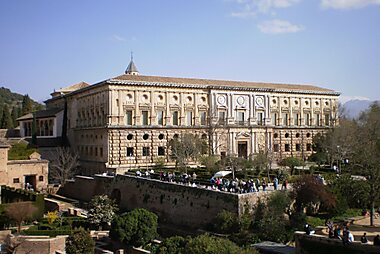
The International Festival of Music and Dance of Granada, held across June and July in venues including the Alhambra's own Palace of Charles V, is the city's headline cultural event and draws visitors specifically to time a trip around it.
Best time to visit: April, May, June, July, September, October
Afternoons in July and August can feel harsher than the numbers suggest — the Alhambra's stone courtyards offer little shade, so early-morning or late-afternoon visits are far more comfortable than midday in high summer.
Top sights
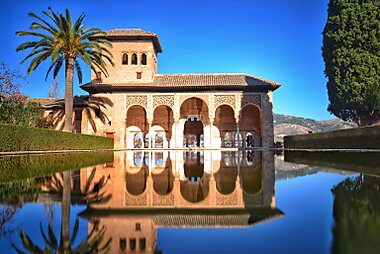
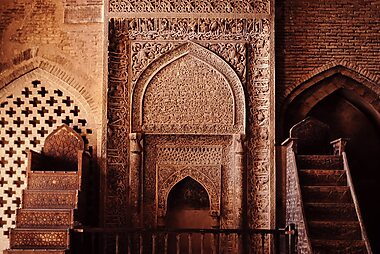
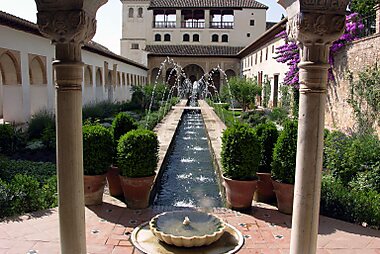
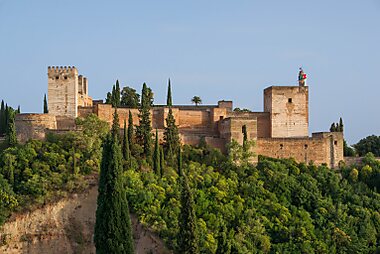
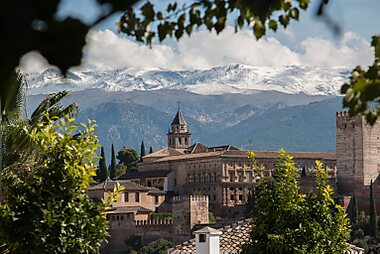
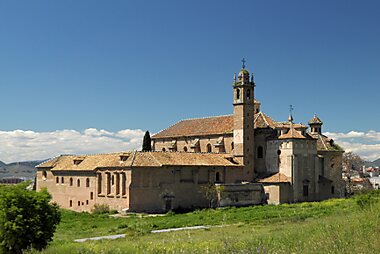
Alhambra is Granada's essential visit: a fortified hilltop complex that took shape over centuries as the residence of the Nasrid emirs. Book tickets well in advance — daily entry is capped and popular dates sell out weeks ahead.
Inside the complex, Palace of the Nasrids are the ornamental heart of the site, a sequence of courtyards and halls including the Court of the Lions, covered in carved stucco and tilework. Entry to the palaces is timed, so check the slot printed on your ticket. The older Alcazaba sits at the western tip of the hill, its watchtower giving the first wide view over the city and the Albayzín opposite.
Just east, the Generalife and its adjoining Generalife were the emirs' summer retreat, a series of shaded patios and water channels that stay noticeably cooler than the main palaces in summer.
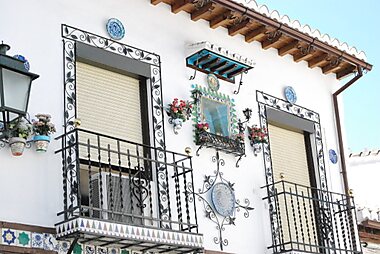
Across the river gorge, the Albayzín is Granada's old Moorish quarter, a maze of narrow whitewashed lanes that has kept its medieval street plan. The San Nicolás Viewpoint inside it is the classic spot for a wide view back across to the Alhambra, especially near sunset.
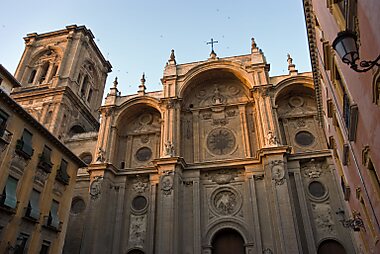
Down in the modern center, the Renaissance-Baroque Catedral de Granada was built on the site of the city's main mosque after 1492, and the adjoining Royal Chapel holds the tombs of Ferdinand and Isabella, the monarchs who completed the Reconquest here.
Featured Lists

Granada Essentials
Granada showcases a unique convergence of Islamic and Christian heritage. The city is dominated by the Alhambra complex, featuring the intricate Nasrid Palaces, the Generalife Gardens, and the Alcazaba fortress. Below, the medieval Albayzín district preserves Moorish urban planning, while the Sacromonte neighborhood is known for its traditional cave dwellings. The city center holds the Renaissance Granada Cathedral and the Royal Chapel, the burial site of the Catholic Monarchs. Narrow streets like Calle Calderería and Alcaicería offer a glimpse into the city's historic silk market and tea-drinking traditions.
16 places
Editor's Choice: Granada Highlights
Granada's landscape is defined by the Alhambra, a UNESCO-listed Moorish palace and fortress complex overlooking the city. The historic Albaicín and Sacromonte districts feature traditional cave dwellings and viewpoints like San Nicolás and San Miguel Alto, which offer panoramas of the Sierra Nevada mountains. Calle Elvira serves as a central artery of Moorish heritage, while the Museo Cuevas del Sacromonte explores local ethnography. Modern additions include the Science Park, an extensive interactive museum and science center.
7 places


Best Viewpoints
Granada's unique topography offers diverse perspectives of the Alhambra palace complex and the Sierra Nevada mountain range. This selection spans the historic Albaicín neighborhood, featuring the iconic San Nicolás and the higher, more secluded San Miguel Alto. It includes the Torre de la Vela, the highest point of the Alcazaba fortress, and the medieval Muralla de San Miguel, providing panoramic views across the city's Moorish quarter and the fertile Vega of Granada.
6 places
What to experience
- Order a drink, get a free tapa. Granada is one of the last Spanish cities where most bars still serve a small free tapa with every drink you order — round after round brings a different dish, and it's a genuine local custom rather than a tourist gimmick.
- Watch the sunset over the Alhambra from Mirador de San Nicolás, often accompanied by street musicians playing flamenco guitar as the floodlights come on across the valley.
- See a flamenco zambra in a Sacromonte cave. The caves of Sacromonte have hosted this style of flamenco, performed in intimate whitewashed rooms rather than a theater, for generations.
- Walk the Carrera del Darro at dusk, the cobbled path along the river gorge below the Alhambra, when the walls above are lit and the day-trip crowds have thinned.
Tours & Activities
Granada — Map

 Open the interactive map
 Day trips
Granada's location between the Sierra Nevada and the Mediterranean coast makes it a strong base for day trips, from mountain villages a short drive away to major cities that need a longer outing.
- Guadix — around 45 minutes by car or bus. A town of cave houses still lived in today, cut into the soft rock hills; the troglodyte quarter and its cave museum are unlike anything in Granada itself.
- Sierra Nevada — about 45 minutes to an hour by car or seasonal bus to the Pradollano ski station. Skiing in winter, hiking and mountain-bike trails in summer, and the highest paved road in continental Europe toward Pico Veleta.
- The Alpujarras villages — roughly 1 to 1.5 hours by car to villages like Pampaneira, Bubión, and Capileira, stacked on the southern slopes of the Sierra Nevada with flat-roofed, Berber-style architecture unique in Spain.
- Ronda — about 1.5 to 2 hours by car; by train it takes longer, around 2.5 hours with a change at Antequera. One of Andalusia's most dramatic towns, split by a deep gorge and crossed by the 18th-century Puente Nuevo.
- Córdoba — roughly 1.5 to 2 hours by train or car. Home to the Mezquita, the former Great Mosque turned cathedral, and one of Spain's best-preserved old Jewish quarters.
Getting there
- By air: Federico García Lorca Granada-Jaén Airport is about 15 km west of the city, with mostly domestic and a growing number of European routes. An airport bus meets arriving flights and runs into the center in roughly 45 minutes; a taxi takes about 20–25 minutes. Travelers on long-haul or budget routes often fly into Málaga instead and continue to Granada by bus or car, a journey of around 1.5 hours.
- By train: Granada's train station has high-speed AVE service to Madrid (around 3 hours) and regional connections to Sevilla, Córdoba, and the coast at Málaga and Almería.
- By bus: The Estación de Autobuses de Granada has frequent long-distance coaches to Málaga, Córdoba, Sevilla, and Madrid, often cheaper and only slightly slower than the train.
Getting around
- Public transit: City buses, run by the local operator, cover the center and outer neighborhoods; contactless bank card or phone payment works directly on board, so a transit card isn't necessary for a short stay. Small minibus lines climb the steep streets of the Albayzín and Sacromonte that regular buses can't reach.
- Taxi / ride-hailing: Cabify operates alongside local taxi ranks; coverage from international ride-hailing apps is more limited than in larger Spanish cities.
- On foot: The historic center, Alhambra hill, and Albayzín are all walkable, but expect steep cobbled streets throughout — comfortable shoes matter more here than in most Spanish cities. Cycling is not very practical because of the hills.
Driving
- Is a car worth it?: Skip it for the city itself — the historic center is compact and hilly, and much of it sits inside a camera-monitored restricted traffic zone for residents and authorized vehicles. Rent one only for exploring the Alpujarras, Sierra Nevada, or the coast.
- Parking: Use one of the underground car parks near the center (Puerta Real, San Agustín) rather than searching for street parking; on-street "zona azul" spaces are metered and time-limited.
- Restrictions: The Albayzín and the Alhambra hill have restricted traffic zones open mainly to residents and permit holders — plan to park below and walk up rather than driving in.
Food & drink
Granada's signature habit is the free tapa: order a beer or wine and a small dish arrives with it, unasked, and often improves as you order more rounds. This is standard practice across most bars in the center, not just a tourist neighborhood custom.
For a concentrated stretch of tapas bars, head to the streets around Calle Navas and Campo del Príncipe in the Realejo quarter, or Calle Elvira near the Albayzín, both dense with small bars doing the round-of-drinks-and-tapas routine rather than sit-down restaurant service. The Alcaicería district, the old Nasrid-era silk market, is worth a walk for its narrow lanes even if the shops today lean toward souvenirs.
Safety & health
Granada is a safe city for travelers by any normal measure; violent crime against tourists is rare. The main risks are pickpocketing in crowded spots — the Alhambra ticket queues, the cathedral area, and packed buses — and occasional street sellers or unofficial "guides" near the Alcaicería and Sacromonte pushing bracelets or spontaneous tours. A polite decline is enough. Tap water is safe to drink throughout the city.
History
Granada became the capital of a new Islamic emirate in 1238, the last of its kind on the Iberian peninsula, ruled by the Nasrid dynasty for over two and a half centuries while the rest of Muslim Spain fell to Christian kingdoms further north. The dynasty built Alhambra as both fortress and palace, adding to it steadily until 1492, when Boabdil, the last Nasrid emir, surrendered the city to the Catholic Monarchs Ferdinand and Isabella — the final act of the centuries-long Reconquista.
The new Christian rulers built the Royal Chapel as their own mausoleum directly beside the former main mosque, which they replaced with the Catedral de Granada. Rather than raze the Alhambra, later monarchs added to it: Charles V commissioned the Renaissance-style Palace of Charles V inside the complex in the 1520s, a stark contrast to the Nasrid palaces beside it.
By the 19th century the Alhambra had fallen into disrepair and squatter occupation until the American writer Washington Irving lived there in 1829 and published Tales of the Alhambra, which helped spark the restoration campaign that shaped the site as it survives today. In the 20th century, poet Federico García Lorca, born near Granada, was executed close to the city at the outbreak of the Spanish Civil War in 1936, a killing that remains one of the era's most-cited cultural losses.
Country facts
Quick practical facts for Spain at a glance:
- Currency
- Euro EUR € · Card payments · Widely accepted
- Emergency numbers
- 112
- Electricity
- 230 V · 50 HzType C / Type F
- Languages
- Spanish
- Tap water
- Safe to drink
- Driving side
- Right
- Calling code
- +34


Granada – Plan Your Days
Turn the places from this guide into a real itinerary, with smart routing, time estimates, and everything you need for a perfect trip.




