


Málaga
Once known mainly as the airport you flew into on the way to the Costa del Sol beach resorts, Málaga has become a destination in its own right. It is one of the oldest continuously inhabited cities in Europe, founded by Phoenician traders around 770 BC, and its old town still layers a Roman theatre, a Moorish fortress, and a Renaissance cathedral within a few minutes' walk of each other.
In the last two decades Málaga has added a dense cluster of art museums to that historic core, anchored by the birthplace of Pablo Picasso. The actor Antonio Banderas, also a native of the city, has helped fund the revival of the Soho arts district. The result suits a traveler who wants beach time, good food, and real history without giving up city-break comforts — most of the historic center is flat, walkable, and easy to cover in two or three nights.

Málaga – Planning a Trip?
Build your day-by-day itinerary in the Tripomatic app.
When to visit
Spring and autumn are mild and sunny, the easiest months for walking the old town. Summer is hot and dry, best enjoyed with a beach afternoon built into the day. Winter stays mild by European standards, with rain the main disruption.
Plan around the Feria de Málaga in mid-August if you can: a nine-day street fair with flamenco dress, fairground rides, and all-night dancing that takes over the whole city. Book accommodation well ahead if your trip lands during it.
Best time to visit: March, April, May, June, July, August, September, October, November
Expect scorching, near-rainless days in July and August, and save the rooftop terraces and rooftop pools for the afternoon heat.
Top sights
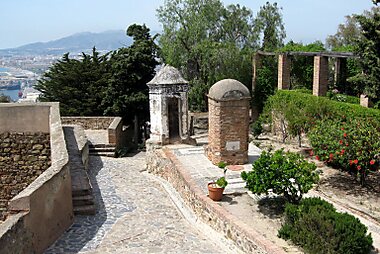

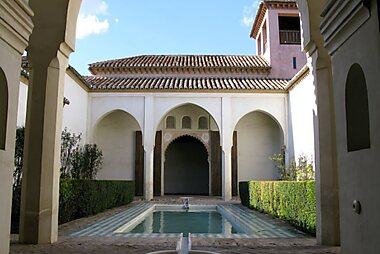


Alcazaba de Málaga is the city's Moorish fortress, an 11th-century citadel with terraced gardens and views over the port. A walkway connects it directly to Castillo de Gibralfaro, the hilltop castle above it, which offers the best panorama of the city and the bay.
At the foot of the Alcazaba, Roman Theatre shows the remains of a 1st-century Roman theatre, rediscovered only in 1951 and now viewed from wooden walkways.
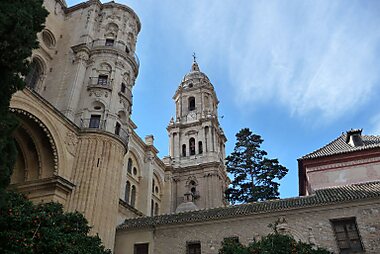
Catedral de Málaga took over 250 years to build, which is why its second tower was never finished — locals call it "la Manquita", the one-armed lady. Its rooftop terraces can be visited on a guided tour.
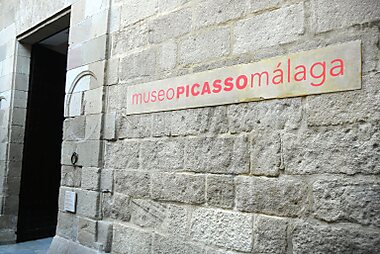
Picasso Museum, housed in a 16th-century Renaissance palace, holds over 200 of the artist's works spanning his whole career.
For contemporary art, Centre Pompidou Málaga is the first branch the Paris institution ever opened abroad, recognizable by its multicolored glass cube.
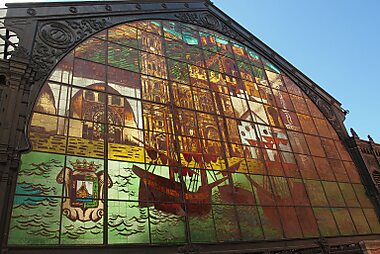
Mercado de Atarazanas is a 19th-century iron-and-glass market hall built over the site of the old Nasrid shipyards, worth a visit for the stained-glass entrance alone as much as for the fish and tapas stalls inside.
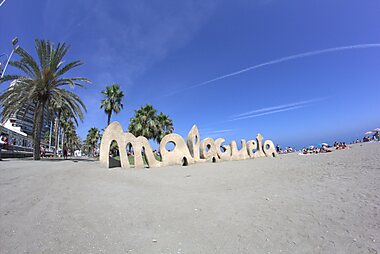
Finish at Malagueta Beach, the city's main urban beach, a short walk from the old town and lined with seafood restaurants.
Featured Lists


Audio Guides – Málaga
Explore on foot with a self-guided audio tour that narrates each stop as you reach it.


Hear Málaga's audio tours
1 walk in Audio Guides by Tripomatic


What to experience
- Watch a Semana Santa procession: during the week before Easter, elaborate religious floats called tronos are carried through the streets by teams of bearers, accompanied by marching bands and incense — one of the most elaborate versions of this tradition in Spain.
- Join the Feria de Málaga: for nine days in mid-August, the city fills with flamenco dresses, fairground rides, and open-air dancing that runs long into the night.
- Watch the sunset from Muelle Uno: the waterfront promenade next to the port fills up in the evening, with the marina, a Ferris wheel, and the silhouette of Gibralfaro castle behind it.
Tours & Activities
Málaga — Map

 Open the interactive map
 Day trips
Málaga makes a good base for day trips along the coast and into the hills. Here are the best options, roughly closest first:
- Nerja and Frigiliana (≈1 hour by car or bus): Nerja has the dramatic clifftop Balcón de Europa viewpoint and a network of limestone caves outside town; Frigiliana is a whitewashed hill village a short drive further on, regularly rated one of the prettiest in Andalusia.
- Antequera (≈50 minutes by car): home to a UNESCO-listed group of prehistoric dolmens and the dramatic karst rock formations of the El Torcal natural park.
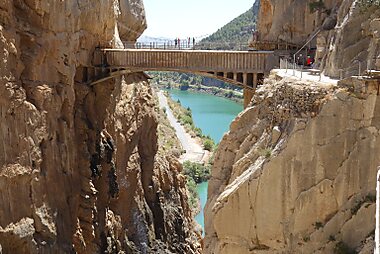
- Caminito del Rey (≈1 hour by car, near Antequera): a one-way walkway pinned to the walls of a narrow gorge, with sections of footbridge up to 105 meters above the canyon floor. Advance online booking is required, and children under 8 are not admitted.
- Marbella (≈1 hour by car or bus): a polished resort town with an old town of narrow whitewashed streets, plus the yacht harbor at Puerto Banús nearby.
- Ronda (≈1.5–2 hours by car or train): perched on either side of a deep gorge, connected by the 18th-century Puente Nuevo bridge, with one of Spain's oldest bullrings.
- Granada (≈2 hours by car or bus): the Alhambra palace and the Albaicín quarter make this a longer but worthwhile trip if you have a spare full day.
Where to explore
Málaga sits at the center of the Costa del Sol, with dozens of smaller towns within easy reach for a night away or a longer stay.
Along the coast: Torremolinos and Marbella are the region's best-known beach resorts, while Nerja anchors the quieter eastern coast.
In the hills: Ronda and Antequera are historic inland towns, each built around dramatic natural landmarks — a gorge in one case, karst rock formations in the other. Frigiliana is a small whitewashed village worth combining with a Nerja trip.
Getting there
- By air: Málaga-Costa del Sol Airport is one of Spain's busiest, with direct flights from across Europe. It sits about 8 km southwest of the center; the Cercanías C1 suburban train reaches the main train station in around 8 minutes, and city buses also run the route. A taxi takes about 15–20 minutes.
- By train: Málaga María Zambrano station has high-speed AVE service to Madrid (around 2.5 hours) and regional connections to Córdoba, Seville, and Granada.
- By bus: The bus station sits next to the train station, with long-distance coaches to Ronda, Marbella, Granada, and other towns across Andalusia.
Getting around
- Public transit: Buses (EMT Málaga) cover the whole city, and a small two-line metro connects the center to the university and outlying districts. Tap a contactless bank card or phone directly on the bus; a rechargeable transit card is also available for frequent use. EMT Málaga
- Taxi / ride-hailing: Uber and Cabify both operate alongside metered taxis.
- On foot / cycling: The old town and seafront are flat and easy to walk. A public bike-share system and dedicated seafront bike lanes make cycling practical along the coast, though the surrounding hills get steep quickly.
Driving
- Is a car worth it?: No — the historic center is compact and walkable, and street parking there is scarce. A car earns its keep only if you plan to explore several Costa del Sol towns or inland villages in one trip.
- Parking: Use one of the signposted underground car parks near the center (Plaza de la Marina, Cervantes, or the Alcazaba) rather than hunting for street parking. On-street blue-zone parking (SARE) requires paying at a nearby meter or via app during posted hours.
- Restrictions: Parts of the old town are pedestrianized or restricted to residents; follow posted signs rather than assuming a street is open to through traffic.
Food & drink
Look for espetos, sardines skewered on a cane and grilled over an open wood fire — the dish the whole Costa del Sol is known for. The best versions come from the beachfront chiringuitos in the Pedregalejo and El Palo neighborhoods, old fishing villages now absorbed into the city. Pescaíto frito, a mix of lightly floured and fried small fish, is the other local staple, and Málaga's own sweet wine, made from moscatel and Pedro Ximénez grapes, is worth trying at one of the traditional bodegas near the cathedral.
For a concentrated taste of the city's food, head to Mercado de Atarazanas, where market stalls sell tapas and fresh seafood alongside the produce vendors — go around midday, before the lunch crowd peaks.
Safety & health
Málaga is a safe city for tourists by any European standard. The main risk is petty theft — pickpocketing on crowded buses, in the historic center, and on the beach, where bags and phones left unattended can disappear quickly. Keep valuables in a front pocket or zipped bag in busy areas like Mercado de Atarazanas and around Monumento a la Constitución Española, and don't leave belongings unwatched while swimming.
History
Phoenician traders founded a settlement here around 770 BC, making Málaga one of the oldest continuously inhabited cities in Europe. Little survives from that era, but the Romans left Roman Theatre, built in the 1st century and rediscovered only in 1951 under later Moorish and colonial-era buildings.
Moorish rule, beginning in the 8th century, left the city's most visible landmarks: Alcazaba de Málaga, a palace-fortress begun in the 11th century, and Castillo de Gibralfaro above it, built in the 14th century to defend the harbor. Málaga fell to the Catholic Monarchs in 1487 after a long siege, one of the final acts of the Reconquista before Granada itself surrendered five years later. Catedral de Málaga was built over the following two and a half centuries on the site of the city's main mosque.
In the 20th century Málaga became a gateway for mass tourism on the Costa del Sol, but its own old town was long overshadowed by the beach resorts around it. That changed after 2003, when Picasso Museum opened, honoring the artist born in the city in 1881 with a collection spanning his whole career, and kicking off a wave of museum openings — including Centre Pompidou Málaga in 2015 — that turned the historic center into a cultural destination in its own right.
Country facts
Quick practical facts for Spain at a glance:
- Currency
- Euro EUR € · Card payments · Widely accepted
- Emergency numbers
- 112
- Electricity
- 230 V · 50 HzType C / Type F
- Languages
- Spanish
- Tap water
- Safe to drink
- Driving side
- Right
- Calling code
- +34


Málaga – Plan Your Days
Turn the places from this guide into a real itinerary, with smart routing, time estimates, and everything you need for a perfect trip.




