Tripomatic

Madrid

District ·🇪🇸 Spain

Spain's capital sits almost exactly in the geographic center of the country, on a high plateau that makes summers scorching and winters crisp. It has none of the canals or seafront of Barcelona. Instead it offers wide boulevards, grand plazas, and three major art museums within a short walk of each other. Madrid rewards travelers who like to walk, eat late, and stay out later.

This is a city built for a first visit of three to five nights: compact enough to cover the historic center on foot, with a metro system that reaches everywhere else. It suits travelers who want art, architecture, and food in equal measure, rather than a single headline attraction. Painters Diego Velázquez and Francisco Goya both worked for the Spanish royal court here. Their work anchors the Prado's collection today.

Madrid

Planning a Trip to Madrid?

Build your day-by-day itinerary in the Tripomatic app.

When to visit

Spring (April–June) and autumn (September–October) are mild and the best time to visit. Summer is hot and dry, with July and August afternoons regularly topping 35 °C, while winter is cold but mostly dry, with the occasional light snow.

Plan around San Isidro in mid-May if you can: Madrid's patron-saint festival fills the city with free concerts, traditional dress, and street parties for over a week, centered on the Pradera de San Isidro park.

Best time to visit Madrid: May, June, July, September, October

Select a month

Typical weather in January

Poor
  • 9° (feels like 7°) · extremes -4°–14°
  • 1° at night
  • 7 rainy days
  • 10 sunny days
  • Dry air
  • Calm winds

Typical weather in February

Poor
  • 11° (feels like 8°) · extremes -4°–16°
  • 1° at night
  • 8 rainy days
  • 10 sunny days
  • Dry air
  • Calm winds

Typical weather in March

Fair
  • 14° (feels like 12°) · extremes -2°–21°
  • 3° at night
  • 9 rainy days
  • 11 sunny days
  • Dry air
  • Calm winds

Typical weather in April

Good
  • 17° (feels like 15°) · extremes 2°–23°
  • 6° at night
  • 9 rainy days
  • 11 sunny days
  • Dry air
  • Calm winds

Typical weather in May

Great
  • 20° (feels like 19°) · extremes 4°–28°
  • 9° at night
  • 8 rainy days
  • 13 sunny days
  • Dry air
  • Calm winds

Typical weather in June

Great
  • 26° · extremes 9°–33°
  • 14° at night
  • 4 rainy days
  • 19 sunny days
  • Dry air
  • Calm winds

Typical weather in July

Great
  • 31° · extremes 13°–36°
  • 17° at night
  • 1 rainy day
  • 27 sunny days
  • Dry air
  • Calm winds

Typical weather in August

Good
  • 32° · extremes 14°–36°
  • 18° at night
  • 1 rainy day
  • 26 sunny days
  • Dry air
  • Calm winds

Typical weather in September

Great
  • 26° · extremes 8°–33°
  • 14° at night
  • 4 rainy days
  • 17 sunny days
  • Dry air
  • Calm winds

Typical weather in October

Great
  • 19° (feels like 18°) · extremes 3°–26°
  • 9° at night
  • 7 rainy days
  • 12 sunny days
  • Dry air
  • Calm winds

Typical weather in November

Fair
  • 13° (feels like 11°) · extremes -1°–18°
  • 5° at night
  • 10 rainy days
  • 10 sunny days
  • Dry air
  • Calm winds

Typical weather in December

Poor
  • 9° (feels like 7°) · extremes -3°–14°
  • 1° at night
  • 8 rainy days
  • 11 sunny days
  • Dry air
  • Calm winds

Climate data: Open-Meteo Climate API (EC_Earth3P_HR) · 1991–2020

Top sights

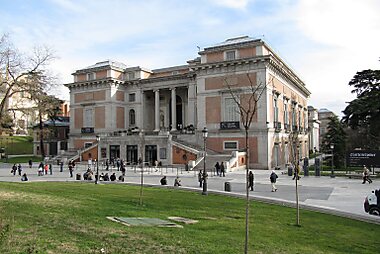
  • Prado Museum holds Spain's national art collection, with rooms of Velázquez, Goya, and El Greco. It alone justifies a trip.
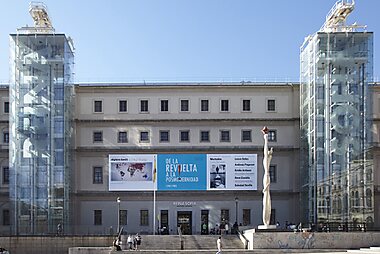
  • Museo Nacional Centro de Arte Reina Sofía houses Picasso's Guernica, his response to the bombing of a Basque town during the Spanish Civil War.
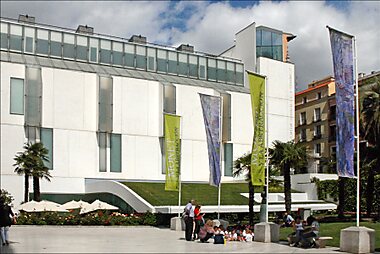
  • Museo Thyssen-Bornemisza is a private collection spanning seven centuries of European painting. Together with the Prado and Reina Sofía it forms Madrid's "Golden Triangle of Art."
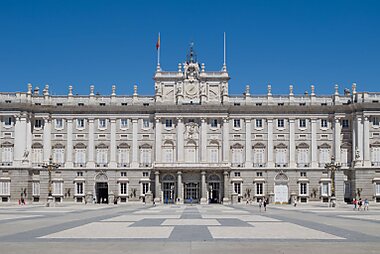
  • Royal Palace of Madrid is the official residence of the Spanish royal family, though they no longer live there. Walk through the state rooms and armory, then cross the square outside.
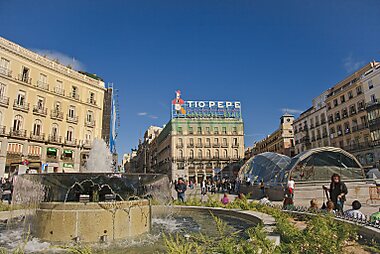
  • Puerta del Sol marks kilometre zero for Spain's entire road network. Madrileños gather here on New Year's Eve.
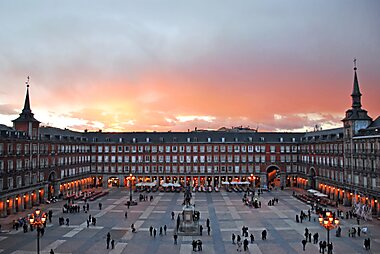
  • Plaza Mayor is a 17th-century square lined with cafés and street performers, a short walk from Puerta del Sol.
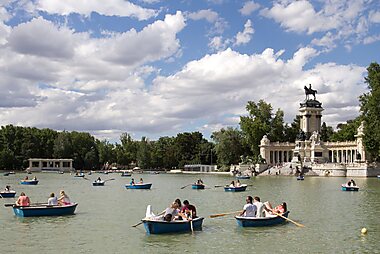
  • El Retiro Park is Madrid's largest green space, with a rowable lake and a glass-and-iron palace built for a 19th-century exhibition. Locals use it every day, not just on weekends.
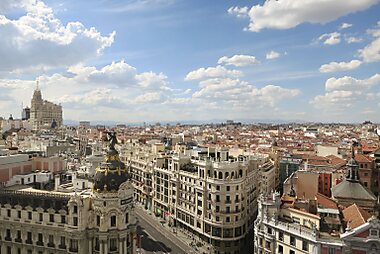
  • Gran Vía is the city's grand early-20th-century avenue, lined with theatres and Beaux-Arts facades that light up at night.

Explore Madrid

Madrid Must-Sees

Madrid Must-Sees

Madrid’s landscape is defined by the Golden Triangle of Art, comprising the Prado, Reina Sofía, and Thyssen-Bornemisza museums. The city’s imperial history is anchored by the Palacio Real and the medieval Plaza de la Villa, while the 19th-century Retiro Park houses the glass-and-iron Crystal Palace. Iconic landmarks like the Metropolis Building and Gran Vía showcase Beaux-Arts and modern architecture. Local traditions thrive at the centuries-old Sobrino de Botín restaurant, the historic Chocolatería San Ginés, and the sprawling El Rastro flea market.

16 places
Historic Monuments

Historic Monuments

Madrid’s architectural evolution is displayed through these twenty landmarks, spanning from the medieval structures of Plaza de la Villa to the 20th-century rationalism of the Segovia Viaduct. The collection includes neoclassical triumphs like the Puerta de Alcalá, the Beaux-Arts Metropolis Building, and the UNESCO-listed El Retiro Park. Visitors can explore the city’s royal legacy at the Plaza de Oriente and Sabatini Gardens, or admire intricate religious heritage at the baroque Church of San Ginés and the Renaissance Convent of Las Descalzas Reales.

20 places
Top Museums in Madrid

Top Museums in Madrid

Madrid's artistic core is anchored by the Golden Triangle of Art, featuring the Prado’s classical European masterpieces, the Reina Sofía’s 20th-century Spanish works, and the Thyssen-Bornemisza’s private collection spanning eight centuries. Beyond these, the city preserves diverse history through the National Archaeological Museum’s ancient treasures and the Naval Museum’s maritime archives. Unique exhibition spaces include the 19th-century iron-and-glass Crystal Palace and the preserved 1919 Chamberí metro station. Specialized institutions like the Sorolla and Cerralbo museums offer intimate looks into Spanish fine arts and 19th-century aristocratic life.

20 places
Historic Churches of Madrid

Historic Churches of Madrid

Madrid’s ecclesiastical history is preserved in its diverse architectural styles, from the 16th-century Gothic-Renaissance of San Jerónimo el Real to the 18th-century Italianate Baroque of St. Michael's Basilica. This selection includes the royal Convent of Las Descalzas Reales, home to significant Renaissance art, and San Antonio de los Alemanes, famous for its entirely frescoed interior. These landmarks, including the collegiate church of San Isidro, represent centuries of religious devotion and the evolution of Spanish artistic movements from Mudéjar foundations to the Neo-Byzantine domes of the early 20th century.

8 places
Madrid's Palaces and Castles

Madrid's Palaces and Castles

Madrid's architectural landscape is defined by its regal history, showcased through diverse structures ranging from the massive 18th-century Royal Palace to the delicate 19th-century glass-and-iron Crystal Palace. This collection includes neoclassical seats of government like the Congress of Deputies, fortified estates such as Castillo de Viñuelas, and private residences turned art galleries like the Liria Palace and Thyssen-Bornemisza Museum. These landmarks highlight the evolution of Spanish design, featuring neo-gothic details, ornate interiors, and expansive grounds that once served as royal hunting lodges.

10 places
Parks and Gardens

Parks and Gardens

Madrid’s diverse green spaces range from the UNESCO-listed El Retiro Park, featuring historic monuments and sculptures, to the Royal Botanical Garden with over 5,500 species. The city offers formal neoclassical designs at the Sabatini Gardens and secluded 18th-century retreats like the Jardín del Príncipe de Anglona. Highlights include the English-style Moorish Garden, the whimsical landscapes of El Capricho Park, and the memorial Forest of Remembrance. For panoramic views, the Teleférico cable car spans the Casa de Campo, while Atocha Station houses a unique indoor tropical greenhouse.

11 places
Best Shopping in Madrid

Best Shopping in Madrid

Madrid’s retail scene spans historic boulevards and specialized local markets. Gran Vía offers major international brands within early 20th-century architecture, while Calle de Fuencarral provides a pedestrianized corridor for trendy fashion. Traditional commerce thrives at the El Rastro flea market and Mercado de la Cebada. For a modern experience, Torre Titania and ABC Serrano house upscale retailers in striking buildings. Local gastronomy and fresh produce are centered in neighborhood hubs like the Chamberí and Chamartín markets, alongside the expansive Moda Shopping mall in the financial district.

10 places
Spanish & Regional Flavors

Spanish & Regional Flavors

Madrid’s culinary landscape ranges from the Guinness-certified oldest restaurant, Sobrino de Botín, to historic food halls like Cebada and San Anton markets. This selection showcases traditional Castilian roasting techniques, specialized Iberian ham at Museo del Jamón, and refined Michelin-starred dining at Santceloni. The collection extends to regional game specialties in El Pardo and Andalusian-inspired fusion by chef Dani García, representing a broad spectrum of Spanish gastronomy from rustic traditions to contemporary techniques.

9 places
Theatres and Art Centers

Theatres and Art Centers

Madrid’s performing arts and exhibition scene spans centuries of architectural history. This collection features the 19th-century ferrovitreous Crystal Palace and neoclassical Velázquez Palace, both located in El Retiro Park and hosting contemporary art. The historic Royal Theatre, dating to 1850, serves as the city’s premier opera house. Modern additions include the Teatros del Canal, a contemporary complex for dance and drama, and La Neomudéjar, an avant-garde arts center housed in a former railway warehouse.

5 places
Sports & Stadiums

Sports & Stadiums

Madrid’s sporting landscape features elite professional venues and high-performance training centers. This selection includes the modern Metropolitano Stadium, home of Atlético Madrid, and the extensive Ciudad Real Madrid complex in Valdebebas. Beyond football, the list covers the multi-sport facilities of Golf La Moraleja and the public recreation grounds of the Tercer Depósito, a sports park constructed over a historic water reservoir featuring running tracks and padel courts.

5 places

What to experience

Madrid's rhythm runs late, and the best experiences here are things you do after dark or on a Sunday morning, not sights you photograph.

  • Browse the stalls at Rastro Market on a Sunday morning, when the Rastro neighborhood turns into Madrid's oldest flea market — arrive early for the best finds and to beat the crowds.
  • Watch the sun set over the Sierra de Guadarrama from the terrace at The Temple of Debod, an Egyptian temple gifted to Spain in 1968 and now a popular free viewpoint.
  • Join a tapas crawl through the narrow bars of Cava Baja and La Latina, hopping between counters for a plate of jamón or a glass of vermouth at each stop rather than sitting down for a full meal.
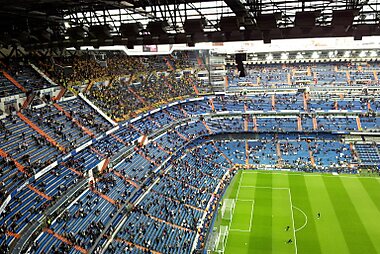
  • Catch a home match at Santiago Bernabéu Stadium — even without match tickets, a stadium tour gives a sense of the atmosphere Real Madrid fans bring to a European night.
  • See a flamenco show at one of the small tablaos near the city center; book ahead, since the best rooms hold only a few dozen seats.

Tours & Activities

Map of Madrid

Day trips

Madrid's location in the center of Spain puts several worthwhile day trips within easy reach by train.

  • Toledo — about 30 minutes by high-speed train. A walled hill town that was Spain's capital before Madrid, with a huge Gothic cathedral and centuries of Christian, Muslim, and Jewish history layered into its streets.
  • Segovia — about 30 minutes by high-speed train. Famous for its intact Roman aqueduct and a turreted Alcázar castle said to have inspired Walt Disney.
  • Aranjuez — about 45 minutes by train. A small riverside town built around an 18th-century royal palace and formal gardens, once a spring retreat for the Spanish court.
  • San Lorenzo de El Escorial — about 1 hour by train or bus. Home to El Escorial, the vast granite monastery-palace Philip II built as a royal mausoleum.
  • Chinchón — about 1 hour by car or bus. A small wine town built around a circular, balconied plaza that still hosts bullfights during its annual fiesta.

Where to explore

Alcalá de Henares makes an easy half-day trip from central Madrid, about 35 minutes by train. This UNESCO World Heritage university town was the birthplace of Miguel de Cervantes, and its historic quarter of cloistered courtyards and porticoed streets is still walkable in an afternoon.

Getting there

  • By air: Adolfo Suárez Madrid–Barajas Airport is Spain's busiest, about 13 km northeast of the center. Metro line 8 runs to the city center in about 20–30 minutes; a fixed-fare taxi to the center costs around 30–35 €.
  • By train: Estación de Atocha is the hub for southern and high-speed routes (Seville, Toledo, Barcelona), while Chamartín station in the north handles routes to northern Spain and France.
  • By bus: Estación Sur de Autobuses, next to Méndez Álvaro metro station, is the main long-distance coach terminal, with connections across Spain and neighboring countries.

Getting around

  • Metro: Madrid's metro network has 13 lines reaching almost every corner of the city. Buy a rechargeable Tarjeta Multi card at any station vending machine and load it with a 10-trip pass or a tourist travel pass valid for unlimited rides over several days. See the Consorcio Regional de Transportes for routes and fares.
  • Bus: The EMT bus network fills in where the metro doesn't reach, using the same Tarjeta Multi card.
  • Taxi: Madrid's official white taxis are metered and easy to hail on the street; ride-hailing apps also operate widely.
  • On foot: The historic center is compact and mostly flat near the main sights, though a few streets climb noticeably toward Gran Vía and the Royal Palace.

Driving

  • Is a car worth it? No — skip it for the city itself; the metro and walking cover everything in the center, and traffic and parking are more hassle than they're worth. A car only makes sense as a base for exploring the wider region.
  • Parking: Street parking in the center is metered under the SER zone (pay by app or machine, generally free at night and on Sundays); underground car parks near the main sights cost roughly 25–30 € a day.
  • Restrictions: Madrid Central, the low-emission zone covering the historic core, restricts access for older, more polluting vehicles — check your rental car's environmental sticker before driving in.

Food & drink

Madrid's food culture is built around small plates eaten standing at a bar, not long sit-down meals. Look for cocido madrileño (a slow-cooked chickpea stew, often served in courses), bocadillo de calamares (a fried squid sandwich, a Plaza Mayor institution), and patatas bravas.

For a single distinctive stop, Botín holds the Guinness record for the world's oldest continuously operating restaurant. It still roasts suckling pig in a wood-fired oven dating to 1725. For everyday grazing, head to Mercado de San Miguel, a restored 1916 iron-and-glass market packed with tapas counters, or to the streets of La Latina and Cava Baja, where bars each specialize in one dish and locals move from door to door.

Breakfast
Churros  Churros con ChocolateFried dough sticks served with a thick, dark hot chocolate for dipping — a classic Spanish breakfast or late-night snack.
Lunch
Paella ValencianaA saffron-scented rice dish cooked in a wide, shallow pan. The traditional Valencian version uses chicken, rabbit, and green beans — best eaten at midday.
GazpachoA cold, blended soup of raw tomatoes, cucumber, pepper, garlic, olive oil, and vinegar, originally from Andalusia. Served as a drink or a starter, especially in summer.
Dinner
Pulpo a la GallegaBoiled octopus sliced onto a wooden board and dressed with olive oil, coarse salt, and smoked paprika — a signature dish of Galicia.
Snacks & street food
Jamón IbéricoDry-cured ham from acorn-fed Iberian pigs, sliced paper-thin and eaten on its own or with bread. The finest grade, jamón ibérico de bellota, is one of Spain's most prized products.
Tortilla EspañolaA thick potato and egg omelette, served warm or at room temperature, found in virtually every bar in Spain. Often eaten as a tapa or a quick meal.
Patatas BravasFried potato chunks served with a spicy tomato sauce or aioli — one of the most common tapas across the country.
PintxosSmall snacks anchored to slices of bread with a toothpick, the Basque Country's answer to tapas. Found in bar counters across San Sebastián and Bilbao, often with elaborate toppings.
CroquetasCrispy breaded cylinders with a creamy béchamel filling, typically made with jamón, bacalà (salt cod), or mushrooms.
Drinks
Rioja Wine  Vino de RiojaSpain's best-known wine region produces full-bodied reds from Tempranillo grapes, aged in oak. The crianza, reserva, and gran reserva labels indicate increasing age and complexity.

Safety & health

Madrid is one of Europe's safer capitals for tourists, and violent crime against visitors is rare. The main risk is pickpocketing on the metro, at Puerta del Sol, and around crowded tourist sites — keep bags zipped and in front of you, especially on metro line 1 and around Sol.

History

Madrid's origins are modest: a 9th-century Muslim fortress called Mayrit gave the city its name and first walls. It stayed a minor market town for centuries. Philip II moved the royal court here in 1561, partly because Madrid sat close to his monastery-palace at El Escorial. Charles III, still called the "best mayor of Madrid," rebuilt the city in the late 18th century. He commissioned Puerta de Alcala as a ceremonial gateway and laid out the Paseo del Prado, whose museum later became the Prado.

The Royal Palace of Madrid rose on the site of a medieval fortress that burned down in 1734. Its neighbor, Almudena Cathedral, looks centuries older than it is. Construction only finished in 1993, after more than 100 years of stalled building. During the Spanish Civil War, Gran Vía took direct shelling as the front line ran through what is now a university campus at the city's edge. After Franco's death in 1975, the city became the center of la Movida Madrileña, an explosion of music, film, and nightlife that reshaped Spanish culture through the 1980s.

Country facts

Quick practical facts for Spain at a glance:

Currency
Euro EUR € · Card payments · Widely accepted
Emergency numbers
112
Electricity
Type C / Type F
230 V · 50 Hz
Languages
Spanish
Tap water
Safe to drink
Driving side
Right
Calling code
+34
Learn more about Spain
Prado Museum
Walk
Royal Palace
Walk
Reina Sofía Museum

Plan Your Days in Madrid

Turn the places from this guide into a real itinerary, with smart routing, time estimates, and everything you need for a perfect trip.


3M+ downloads · 4.6 stars · 15 years of trip planning
QR code
Scan to download the app

Related destinations