



Guadeloupe
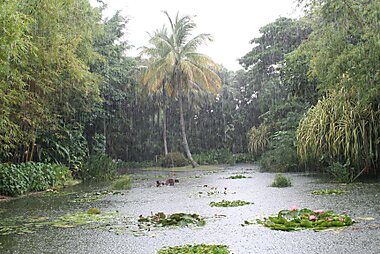
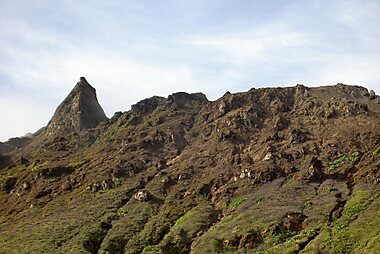
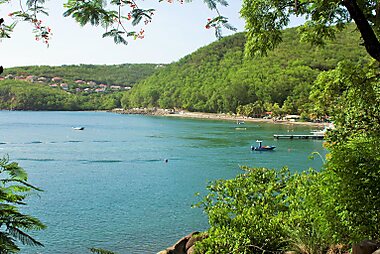
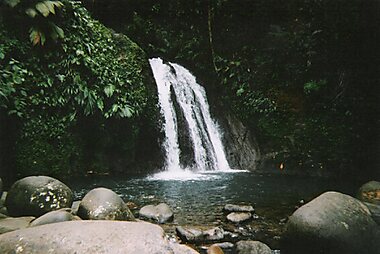
Guadeloupe is a French Caribbean archipelago shaped like a butterfly, its two main wings joined by a narrow strait. Basse-Terre, the western wing, is a mountainous rainforest built around the active volcano La Grande Soufrière, with waterfalls, hot springs, and hiking trails through Guadeloupe's national park. Grande-Terre, the eastern wing, is flatter and drier, ringed by white-sand beaches and coral reef. Beyond the two main islands, the archipelago includes the fishing village of Terre-de-Haut in the Îles des Saintes, the sugarcane island of Marie-Galante, and the remote cliffs of La Désirade.
Guadeloupe's history runs through its landscape as much as its museums. In 1802, Louis Delgrès led a last stand against Napoleon's troops at Fort Delgrès rather than accept the return of slavery. Abolition finally came in 1848, a history told at Mémorial ACTe in Pointe-à-Pitre. As part of France, Guadeloupe uses the euro and French infrastructure while keeping a distinct Creole language, food, and music. It suits travelers who want beach time balanced with hiking, diving, and genuine local culture, rather than an all-inclusive resort island.





Guadeloupe – Planning a Trip?
Build your day-by-day itinerary in the Tripomatic app.
Money & payments
Guadeloupe uses the euro, and payment works exactly as in mainland France.
ATMs are common in Pointe-à-Pitre, Basse-Terre, and every larger town, but thin out on Grand-Bourg and La Désirade — withdraw cash before taking the ferry. Small roadside food stands, rum distillery tastings, and Saturday markets often expect cash.


Featured Lists


Best Beaches in Guadeloupe
Guadeloupe’s coastline offers a diverse range of shorelines across its butterfly-shaped islands. On Basse-Terre, beaches like Grande-Anse and La Perle feature golden volcanic sand and backdrops of lush rainforest. Grande-Terre is characterized by calm, turquoise lagoons protected by coral reefs, such as Bois Jolan and La Caravelle. Further south, the archipelago of Les Saintes provides sheltered coves like Pompierre. These sites range from surf-heavy Atlantic spots to secluded naturist areas and shallow waters suitable for snorkeling.
15 places


Historic Ruins & Windmills
Guadeloupe's landscape is dotted with remnants of its colonial past, from the stone windmills of Marie-Galante to the coastal fortifications of the Saintes. This collection features the ruins of the Petit Canal prison, the industrial heritage of the Murat and Bézard mills, and the 18th-century Sucrerie Roussel-Trianon. These sites provide insight into the island's sugar production history and military defenses, including battery ruins and pottery works that once fueled the regional economy.
10 places
Tours & Activities
Guadeloupe — Map

Tipping
Restaurant bills legally include service, so tipping is a bonus rather than an expectation. Rounding up or leaving a few euros for good service is appreciated in restaurants and taxis; bar tabs are not tipped. Guides on half-day excursions, such as a hike up La Grande Soufrière or a boat trip to Réserve Cousteau, welcome a small tip.
service is included by law; round up or add ~5% for good service
round up to the nearest euro
1-2 EUR per bag for porters
5-10 EUR for a half-day tour
Electricity
Sockets and voltage match mainland France, so an adapter bought for a French trip works here too. Most phone and camera chargers handle the voltage without one.
Language
French is the official language, and it is what signs, menus, and official information use. Alongside it, most Guadeloupeans speak Guadeloupean Creole at home and with friends; visitors will hear it everywhere but are not expected to understand it. English is limited outside hotels and the main tourist towns, so a few French phrases go a long way.
Staying connected
Guadeloupe is part of the European Union, so an EU mobile plan works here without roaming charges, the same as in mainland France. Prepaid SIM and eSIM options from Orange, SFR, or Bouygues Télécom are available at the airport and in any town center, with no special ID registration. Coverage is reliable on the main islands but can thin out on remote parts of La Désirade and Grand-Bourg.
Safety & emergencies
Guadeloupe is generally safe for visitors, and violent crime against tourists is rare. The main risk is opportunistic theft from parked rental cars and unattended beach bags, so keep valuables out of sight. Strong currents and sudden swells affect some Atlantic-facing beaches on Grande-Terre and La Désirade; swim where lifeguards or clear signage indicate it is safe. Hurricane season runs from June to November, and La Grande Soufrière is monitored but occasionally closes trails — check local advisories before hiking.
Health
Tap water is safe to drink across the main islands. Pharmacies, marked with a green cross, are common in every town and can advise on minor ailments; a rotating duty system covers nights and Sundays, posted on each pharmacy's door. No special vaccinations are required for entry, though routine immunizations should be up to date, and mosquito repellent is worth packing for the rainier months. Guadeloupe's main hospitals are in Pointe-à-Pitre and Basse-Terre, with smaller clinics elsewhere.
Visas & entry
As part of France, Guadeloupe follows French entry rules rather than a separate Caribbean visa regime. It sits outside the Schengen Area, though, so an ordinary Schengen short-stay visa does not automatically cover it. Citizens of the EU, UK, US, Canada, and most of Latin America can enter for short stays without a visa. Travelers who need a visa for France should check requirements for French overseas territories specifically, and should be ready to show an onward or return ticket and proof of accommodation at the border.
Visa and entry requirements change frequently. Verify current requirements with the official immigration authority or your country's embassy before travel.
Etiquette
Greet shopkeepers, market vendors, and hotel staff with "bonjour" before starting a conversation — skipping it reads as rude, as it does in mainland France. Beachwear belongs on the beach; cover up before entering shops, restaurants, or churches, and Guadeloupeans generally dress smart-casual for evenings out. Ask before photographing people, especially at markets and religious processions, and be reflective rather than casual around sites tied to slavery, such as Fort Delgrès and Mémorial ACTe.
Holidays & opening hours
Public holidays bring most shops, banks, and government offices to a stop; larger supermarkets and restaurants in tourist areas usually stay open regardless.
Many small shops and bakeries close for a long lunch break and on Sunday afternoons, so plan grocery runs and errands for the morning.
Getting around
- By air: Guadeloupe Pôle Caraïbes International Airport, near Les Abymes, receives international and mainland-France flights. A small regional airport on Marie-Galante handles a few short inter-island hops.
- By ferry: Ferries from Pointe-à-Pitre, Trois-Rivières, and Saint-François reach Terre-de-Haut, Grand-Bourg, and La Désirade, and remain the most common way to visit all three outer islands.
- By bus: The Karu'lis network covers Pointe-à-Pitre and the surrounding towns; a separate network links towns across the main islands, but service outside the urban area is infrequent.
- By taxi: Metered within towns, but drivers often quote a flat rate for longer or inter-town trips — agree the fare before starting.
Driving
- Key rules: Roads on Basse-Terre's volcano and rainforest interior are narrow and winding. Allow extra time, and use pull-outs to let oncoming traffic pass.
- Getting to the outer islands: Terre-de-Haut in the Îles des Saintes restricts visitor cars; most people explore by golf cart, scooter, or bicycle rented on arrival.
- Parking: Free street parking is common outside town centers; paid parking appears near beaches and ferry docks in peak season.
- Fuel: Stations are mostly self-service with card payment at the pump, though some rural stations still have attendants.
Food & drink
Breakfast is light — coffee and a baguette or pastry — while lunch is the main meal, often stewed meat or fish with rice, red beans, and plantain. Dinner tends to be lighter, especially outside restaurants aimed at visitors. Sunday lunch is a longer, family affair, often built around a big pot of colombo or court-bouillon. Rum runs through Guadeloupean food culture as much as any dish. Sugarcane grows across both wings of the archipelago, feeding small rhum agricole distilleries that offer free tastings, including Distillerie Bielle on Grand-Bourg and Distillerie Reimonenq on Basse-Terre. The classic way to drink it is a ti punch, mixed at the table from raw cane rum, cane syrup, and lime.
Markets and roadside stands are where Guadeloupean street food shows up: fried accras and bokit sandwiches for a quick lunch, and tourment d'amour pastries for something sweet. Restaurants range from simple beach shacks serving grilled fish to formal Creole dining rooms.
Where to explore
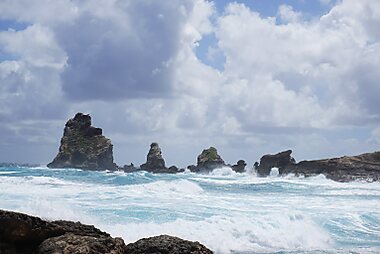
Grande-Terre, the flatter eastern wing, has Guadeloupe's main beaches and its two largest towns. Pointe-à-Pitre is the commercial hub, home to Mémorial ACTe and the Cathédrale Saint-Pierre-et-Saint-Paul; nearby Les Abymes is the archipelago's most populous town. Le Gosier and Sainte-Anne are the main resort towns — Le Gosier pairs Fort Fleur d'Épée with Aquarium de la Guadeloupe, while La Caravelle is among Sainte-Anne's beaches. At the island's eastern tip, Pointe des Châteaux is a windswept limestone headland with sweeping ocean views.
Basse-Terre, the mountainous western wing, holds the volcano La Grande Soufrière, the waterfalls at Deuxième Chute du Carbet and Cascade aux Écrevisses, and Guadeloupe's rainforest interior. Basse-Terre, the archipelago's capital, sits at the foot of the volcano around Fort Delgrès. On the west coast, Bouillante is the gateway to Réserve Cousteau, a protected marine reserve popular with divers, and Deshaies pairs Deshaies Botanic Garden with Plage de Grande-Anse, one of the archipelago's best beaches.
Beyond the two main wings, three smaller islands round out Guadeloupe. Terre-de-Haut, the main village of the Îles des Saintes, is a car-limited fishing town overlooked by Fort Napoléon. Flat, rural Grand-Bourg is the largest town on Marie-Galante, an island still worked by traditional windmill-powered sugar and rum estates. Furthest out, La Désirade is a quiet, sparsely populated island of dry cliffs and empty beaches.


Guadeloupe – Plan Your Days
Turn the places from this guide into a real itinerary, with smart routing, time estimates, and everything you need for a perfect trip.




