Tripomatic

Palma

City · Mallorca, 🇪🇸 Spain

Palma is the capital of Mallorca and the main gateway to the island. It combines a historic old town, a large Gothic cathedral on the seafront and a busy harbor.

The city works as a city break or as a base for beaches and mountains. The old town is easy to walk, and the sea is always close.

Printable tourist map

Palma

Palma – Planning a Trip?

Build your day-by-day itinerary in the Tripomatic app.

When to visit

April to June and September to October are the best months, with warm days and fewer crowds. July and August are hot and busy. Winters are mild, with some rain.

A good event to time a trip around is Sant Sebastià in mid-January, with bonfires and concerts in the squares.

Best time to visit: April, May, June, July, August, September, October

Select a month

Typical weather in January

Good
  • 14° (feels like 11°) · extremes 7°–17°
  • 11° at night
  • 8 rainy days
  • 11 sunny days
  • 5 hours of sunshine per day
  • Dry air
  • Light breeze
  • 15°C · too cold to swim
  • UV index 2 · low

Typical weather in February

Good
  • 14° (feels like 11°) · extremes 6°–17°
  • 10° at night
  • 7 rainy days
  • 11 sunny days
  • 6 hours of sunshine per day
  • Dry air
  • Light breeze
  • 14°C · too cold to swim
  • UV index 3 · moderate

Typical weather in March

Good
  • 16° (feels like 13°) · extremes 8°–19°
  • 12° at night
  • 6 rainy days
  • 16 sunny days
  • 7 hours of sunshine per day
  • Dry air
  • Light breeze
  • 14°C · too cold to swim
  • UV index 4 · moderate

Typical weather in April

Great
  • 18° (feels like 16°) · extremes 11°–22°
  • 14° at night
  • 6 rainy days
  • 17 sunny days
  • 9 hours of sunshine per day
  • Dry air
  • Light breeze
  • 16°C · too cold to swim
  • UV index 6 · high

Typical weather in May

Great
  • 22° (feels like 21°) · extremes 14°–26°
  • 17° at night
  • 5 rainy days
  • 20 sunny days
  • 10 hours of sunshine per day
  • Comfortable humidity
  • Light breeze
  • 18°C · cool for a dip
  • UV index 7 · high

Typical weather in June

Great
  • 27° · extremes 17°–31°
  • 21° at night
  • 3 rainy days
  • 23 sunny days
  • 12 hours of sunshine per day
  • Humid air
  • Calm winds
  • 22°C · cool for a dip
  • UV index 8 · very high

Typical weather in July

Great
  • 29° (feels like 31°) · extremes 21°–33°
  • 24° at night
  • 1 rainy day
  • 25 sunny days
  • 12 hours of sunshine per day
  • Muggy, humid air
  • Calm winds
  • 26°C · warm for swimming
  • UV index 8 · very high

Typical weather in August

Great
  • 30° (feels like 32°) · extremes 22°–33°
  • 24° at night
  • 2 rainy days
  • 23 sunny days
  • 10 hours of sunshine per day
  • Muggy, humid air
  • Calm winds
  • 27°C · warm for swimming
  • UV index 8 · very high

Typical weather in September

Great
  • 26° (feels like 27°) · extremes 19°–30°
  • 22° at night
  • 7 rainy days
  • 16 sunny days
  • 8 hours of sunshine per day
  • Muggy, humid air
  • Light breeze
  • 25°C · warm for swimming
  • UV index 6 · high

Typical weather in October

Great
  • 23° (feels like 22°) · extremes 15°–27°
  • 19° at night
  • 8 rainy days
  • 13 sunny days
  • 7 hours of sunshine per day
  • Comfortable humidity
  • Light breeze
  • 23°C · cool for a dip
  • UV index 4 · moderate

Typical weather in November

Good
  • 18° (feels like 15°) · extremes 10°–22°
  • 15° at night
  • 10 rainy days
  • 9 sunny days
  • 5 hours of sunshine per day
  • Dry air
  • Light breeze
  • 19°C · cool for a dip
  • UV index 2 · low

Typical weather in December

Good
  • 15° (feels like 12°) · extremes 8°–18°
  • 12° at night
  • 8 rainy days
  • 9 sunny days
  • 5 hours of sunshine per day
  • Dry air
  • Light breeze
  • 16°C · too cold to swim
  • UV index 1 · low

Climate data: NASA POWER + Copernicus ERA5-Land and ERA5 · 1996–2025

Top sights

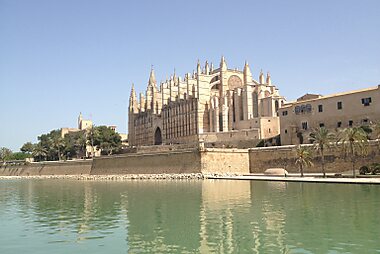
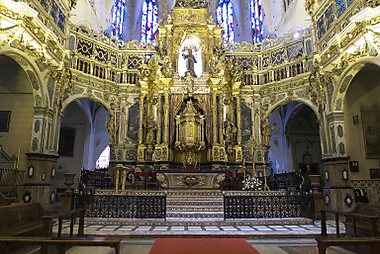
  • Palma Cathedral is the huge Gothic cathedral on the seafront. Its large rose window is one of the biggest in Europe, and the interior includes work by Gaudí.
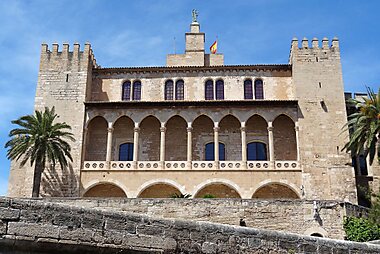
  • Almudaina Palace is a royal palace next to the cathedral, with Moorish origins.
  • Bellver Castle is a round 14th-century castle on a hill, with views over the bay and the city.
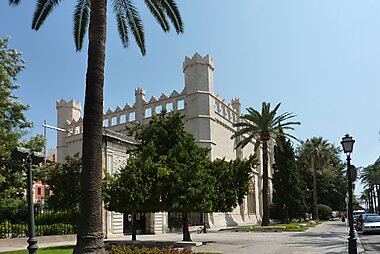
  • Sa Llotja is a Gothic merchants' exchange from the 15th century, used today for exhibitions.
  • Sant Francesc is a church and cloister that holds the tomb of the philosopher Ramon Llull.
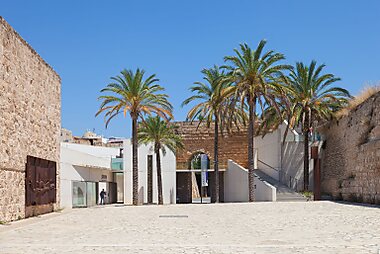
  • Es Baluard Museum of Contemporary Art of Palma is a museum of modern and contemporary art in an old fortress by the sea.
  • The Parc de la Mar is a park with a lake between the cathedral and the sea.

Featured Lists

What to experience

  • Take a boat trip on the Bay of Palma in summer. Many short trips leave from the harbor.
  • Walk or cycle the seafront path from the cathedral toward the east at sunset.

Tours & Activities

Palma — Map

Palma — Map

Day trips

  • Valldemossa (about 18 km, 30 minutes by bus or car): a mountain village where the composer Chopin spent the winter of 1838 to 1839.
  • Sóller (about 30 km, 45 minutes by car or about 1 hour by historic train): a town in a valley of orange trees, with a port nearby.
  • l'Alcúdia (about 50 km, 55 minutes by car): a walled town with a long sandy beach.
  • Pollença (about 55 km, 1 hour by car): an old town with a calvary stairway and a nearby bay.

Where to explore

Other places on Mallorca:

Getting there

  • By air: Palma de Mallorca Airport (PMI) is about 8 km east of the center. Buses and taxis run to the center, and the trip takes about 15 to 25 minutes.
  • By ferry: Ferries sail from Barcelona and Valencia to the port of Palma.
  • There is no train link from the mainland.

Getting around

  • On foot: The old town and the harbor area are compact and flat. Walking is the best way to see the sights.
  • City bus: City buses cover the wider city, including the area around Bellver Castle.
  • Cycling: A seafront path runs along the bay, and cycling is popular.

Driving

  • Is a car worth it?: Not for the city. A car is useful for exploring the island.
  • Parking: Use an underground car park at the edge of the old town.
  • Restrictions: Much of the old town is closed to ordinary traffic.

Food & drink

Mallorca is known for ensaïmada, a soft spiral pastry dusted with sugar, and for sobrassada, a soft cured sausage. Try tumbet, a baked vegetable dish, and rice stews.

Go to the Mercat de l'Olivar for market food and snacks, and to the Santa Catalina district for restaurants and bars.

Breakfast
Churros  Churros con ChocolateFried dough sticks served with a thick, dark hot chocolate for dipping — a classic Spanish breakfast or late-night snack.
Lunch
Paella ValencianaA saffron-scented rice dish cooked in a wide, shallow pan. The traditional Valencian version uses chicken, rabbit, and green beans — best eaten at midday.
GazpachoA cold, blended soup of raw tomatoes, cucumber, pepper, garlic, olive oil, and vinegar, originally from Andalusia. Served as a drink or a starter, especially in summer.
Dinner
Pulpo a la GallegaBoiled octopus sliced onto a wooden board and dressed with olive oil, coarse salt, and smoked paprika — a signature dish of Galicia.
Snacks & street food
Jamón IbéricoDry-cured ham from acorn-fed Iberian pigs, sliced paper-thin and eaten on its own or with bread. The finest grade, jamón ibérico de bellota, is one of Spain's most prized products.
Tortilla EspañolaA thick potato and egg omelette, served warm or at room temperature, found in virtually every bar in Spain. Often eaten as a tapa or a quick meal.
Patatas BravasFried potato chunks served with a spicy tomato sauce or aioli — one of the most common tapas across the country.
PintxosSmall snacks anchored to slices of bread with a toothpick, the Basque Country's answer to tapas. Found in bar counters across San Sebastián and Bilbao, often with elaborate toppings.
CroquetasCrispy breaded cylinders with a creamy béchamel filling, typically made with jamón, bacalà (salt cod), or mushrooms.
Drinks
Rioja Wine  Vino de RiojaSpain's best-known wine region produces full-bodied reds from Tempranillo grapes, aged in oak. The crianza, reserva, and gran reserva labels indicate increasing age and complexity.

Safety & health

Palma is a safe city. Watch for pickpockets in crowded areas and on the beach in summer. In July and August the sun is very strong, so use sun protection.

History

The Romans founded a town here, and the Moors ruled it for centuries. King James I of Aragon took the city in 1229, and Palma Cathedral was begun soon after on the site of the main mosque.

In the 14th century the kings of Mallorca built Bellver Castle. In the 15th century the city grew rich from trade, and Sa Llotja was built for merchants.

Country facts

Quick practical facts for Spain at a glance:

Currency
Euro EUR € · Card payments · Widely accepted
Emergency numbers
112
Electricity
Type C / Type F
230 V · 50 Hz
Languages
Spanish
Tap water
Safe to drink
Driving side
Right
Calling code
+34
Learn more
Palma Cathedral
Drive
Bellver Castle
Drive
Almudaina Palace

Palma – Plan Your Days

Turn the places from this guide into a real itinerary, with smart routing, time estimates, and everything you need for a perfect trip.


3M+ downloads · 4.6 stars · 15 years of trip planning
QR code
Scan to download the app

Related destinations

Data: © OpenStreetMap contributors, Wikidata, Wikipedia, Tripomatic, Official websites, geoBoundaries (CC BY 4.0). Travel guide generated with AI.