



Skagen
Skagen sits at the northern tip of Jutland, where Denmark narrows to a strip of sand between two seas. It is a working fishing town, with trawlers still unloading their catch at the harbour every morning. Its low, ochre-painted houses and wide skies give the town a quiet, unhurried feel.
In the late 1800s, the sharp northern light drew a group of painters known as the Skagen Painters, including P.S. Krøyer and Michael and Anna Ancher. Their work is now on display in the town's own museums. Skagen suits a slow two- or three-night stay built around art, beaches, and the point where two seas collide.

Skagen – Planning a Trip?
Build your day-by-day itinerary in the Tripomatic app.


When to visit
Summers (June to August) are mild and bright, ideal for the beaches and the walk out to Grenen. Spring and autumn are quieter and cooler, good for birdwatching as migrating flocks pass overhead. Winters are cold, windy, and dark.
Plan around the Skagen Festival, Denmark's oldest music festival, held on the first weekend of July with concerts across the town.
The soft, long midsummer light that fills these evenings is the same light that first drew the Skagen Painters here.
Top sights


- Grenen is the reason most people come to Skagen: a narrow sandbar at Denmark's northernmost point, where the Baltic and North Seas meet in visibly clashing waves. Cars stop short of the point — the final stretch is on foot or by tractor bus across the dunes.
- Skagens Museum holds the largest collection of paintings by the Skagen Painters, the artists who made this town famous for its light in the late 1800s.
- Anchers Hus was the home and studio of painters Michael and Anna Ancher, kept much as they left it, with Anna's own paintings still on the walls.
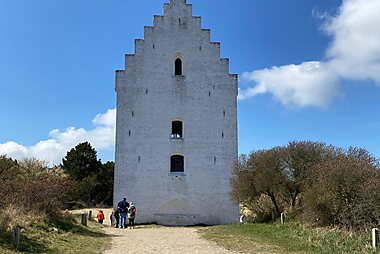
- Den Tilsandede Kirke, a 14th-century church tower, is all that remains above ground after drifting dunes buried the rest of the building in the 18th century.
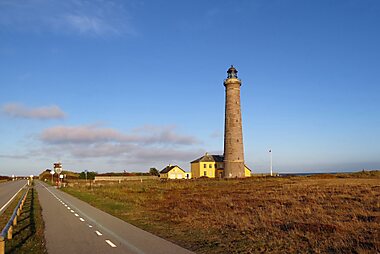
- Skagen Fyr, Skagen's grey lighthouse, has guided ships around the tip of Jutland since 1858; climb it for a view over both seas at once.
- Hvide Fyr came first, in 1747, before drifting sand and a taller replacement made it redundant a century later — it still stands north of town.
- Skagen Odde Naturcenter, designed by Jørn Utzon of Sydney Opera House fame, explains the shifting sand, wind, and light that shape this stretch of coast.
- Drachmann's Grave sits alone in the dunes near Grenen, its copper portal designed by fellow painter P.S. Krøyer for the poet who asked to be buried there.
Featured Lists

Skagen Essentials
Located at Denmark's northernmost tip, Skagen is defined by its unique natural light and maritime heritage. This selection highlights the town's transformation from a fishing village to a world-renowned artistic hub. Key sites include the 14th-century sand-covered church, the iconic red harbor warehouses, and museums dedicated to the Skagen Painters. The list also features significant maritime landmarks, including the 1627 bascule light and the Skagen Odde Nature Centre, which focuses on the region's shifting sands and coastal geography.
10 places
Museums & Galleries in Skagen
Skagen's cultural landscape is defined by the 19th-century Skagen Painters, whose works are centered at Skagens Museum and the preserved home of Michael and Anna Ancher. Beyond fine art, the town features specialized collections including Scandinavia’s only teddy bear museum and the Kystmuseet, an open-air maritime museum documenting local fishing and rescue history. Architecture also plays a key role, with the Skagen Odde Nature Centre focusing on the region's unique natural elements—sand, water, wind, and light—within a facility designed by Jørn Utzon.
5 placesSkagen Landmarks
Explore the architectural and maritime heritage of Denmark’s northernmost town. This selection includes the 14th-century Sand-Covered Church, partially buried by migrating dunes, and the historic White Lighthouse. Visitors can climb the Skagen Water Tower for panoramic views or visit Flagbakken, a high dune known for birdwatching. These landmarks illustrate Skagen's historical struggle with sand migration and its strategic importance as a seafaring hub at the meeting point of the Skagerrak and Kattegat seas.
5 placesWhat to experience
- Standing where two seas meet: walk out onto the sandbar beyond Grenen and watch the currents of the Baltic and North Sea crash into each other from opposite directions. Swimming here is prohibited, but wading in ankle-deep from each side at once is a local ritual.
- Watching the morning fish auction: Skagen's harbour, Denmark's largest fishing port, still runs a working fish auction; arrive early to watch trawlers unload before the catch reaches the smokehouses.
- Chasing the Skagen light: come to the beach in the last hour before sunset, when the low northern light turns the sky and sand gold — the same effect that drew the Skagen Painters here in the 1800s.
Tours & Activities
Skagen — Map

Day trips
Skagen sits far from Denmark's cities, but a few good trips are within reach.
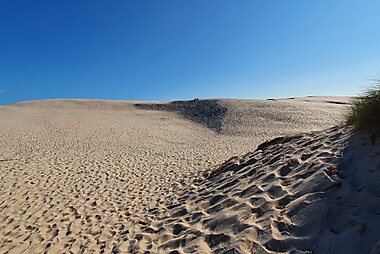
- Råbjerg Mile — about 20 minutes by car or bike, south of town. Northern Europe's largest migrating dune, moving up to 18 metres a year; walking its ridge is worth the trip on its own.
- Frederikshavn — about 35 minutes by car or train. A working port town with ferries to Sweden and Norway, a cannon museum, and a hilltop coastal fort.
- Hirtshals — about 55 minutes by car. Home to the Nordsøen Oceanarium, Denmark's largest aquarium, whose main tank is the largest in Northern Europe.
- Læsø — about 2 hours door to door via the ferry from Frederikshavn. A quiet island known for seaweed-thatched roofs and salt production, best treated as a full day out.
Getting there
- By air: the nearest airport with scheduled flights is Aalborg Airport (AAL), about 110 km south; from there it is roughly 1 hour 15 minutes by car, or a train-and-bus combination via Frederikshavn. Copenhagen Airport (CPH) is Denmark's main international gateway, around 7 hours away by train with at least one change.
- By train: Skagen's own station is the northern end of the Skagensbanen line, with regular trains to and from Frederikshavn, which connects onward to Aalborg and Copenhagen.
- By ferry: Frederikshavn has ferry links to Gothenburg in Sweden and Oslo in Norway, useful for combining Skagen with a wider Scandinavian trip.
Getting around
- Public transit: Skagen itself is small enough to skip local buses, but regional buses connect to Frederikshavn and a seasonal shuttle runs out to Grenen. Pay by contactless card on board, or plan journeys with Rejseplanen.
- On foot and by bike: the old town is walkable in under an hour. Cycling is the easiest way to reach the beaches and Grenen — the land is flat, and rental bikes are widely available.
Driving
- Car needed?: not for the town itself — everything in Skagen is walkable or a short bike ride — but a car helps for Grenen, Råbjerg Mile, and trips further south.
- Parking: free parking is plentiful at the edge of town and near Grenen's car park; the final stretch to the point is closed to cars, reachable on foot (roughly 1–2 km) or by the seasonal tractor bus.
- Restrictions: none beyond the car-free final stretch to Grenen — no low-emission or congestion zone in town.
Food & drink
Skagen's harbour is Denmark's largest fishing port, and the town lends its name to Skagensalat, a creamy shrimp salad served on toast — though the dish itself was created by a Swedish chef in the 1950s, inspired by the North Sea shrimp landed here.
For the freshest catch, head to the smokehouses (røgeri) clustered around the harbour, where whole fish are smoked on site and served straight from the counter with rye bread — a more distinctive choice than a sit-down seafood restaurant.
Safety & health
Skagen is a very safe, low-crime town; the usual care with bags and valuables at the harbour and on busy summer weekends is enough.
The one real hazard is the water at Grenen, where the currents of two seas collide. Swimming beyond the shoreline here is officially prohibited due to dangerous currents, even for strong swimmers — wade in from the beach, but do not go further.
History
Skagen's history is tied to the sea. For centuries it was one of Denmark's most important fishing ports — today its harbour still lands more fish than any other in the country — and its position where two seas meet made it both valuable and treacherous for passing ships, hence the string of lighthouses still guarding the coast, including Skagen Fyr and its 1747 predecessor, Hvide Fyr.
Drifting sand shaped the town as much as the sea did. By the late 18th century, dunes had swallowed most of Den Tilsandede Kirke, leaving only its tower standing above the sand.
In the 1870s, a group of painters began arriving for the unusual quality of the light. P.S. Krøyer, Michael Ancher, and Anna Ancher were the best known; their work, now held at Skagens Museum and Anchers Hus, turned Skagen into one of Scandinavia's best-known artist colonies. The poet and painter Holger Drachmann, part of the same circle, asked to be buried in the dunes near Grenen; Drachmann's Grave still sits alone among the marram grass.
Country facts
Quick practical facts for Denmark at a glance:
- Currency
- Danish Krone DKK kr · Card payments · Widely accepted
- Emergency numbers
- 112
- Electricity
- 230 V · 50 HzType C / Type E / Type F / Type K
- Languages
- Danish
- Tap water
- Safe to drink
- Driving side
- Right
- Calling code
- +45


Skagen – Plan Your Days
Turn the places from this guide into a real itinerary, with smart routing, time estimates, and everything you need for a perfect trip.




