



Sofia
Sofia is Bulgaria's capital and largest city, built at the foot of Vitosha mountain on a site people have lived on for more than seven thousand years. Roman ruins, Ottoman-era buildings, and Soviet-era monuments stand within a few blocks of glass office towers and quiet parks.
Sofia suits travelers who want history and city life without the crowds of Prague or Budapest. Food and transport are cheap, the centre is compact and walkable, and a mountain is visible from most of the city.

Sofia – Planning a Trip?
Build your day-by-day itinerary in the Tripomatic app.


When to visit
Spring and autumn are mild and the best seasons for walking around the centre. Summers are hot and mostly dry; winters are cold, with regular snow.
Plan around Sofia's Christmas markets in December, when stalls, an ice rink, and light displays fill the City Garden next to the National Theatre for most of the month.
Best time to visit: June, September, October
Afternoons in high summer get hot, so save sightseeing for morning or early evening.
Top sights


Alexander Nevsky Cathedral is the largest structure on the skyline, with gold domes and room for five thousand worshippers. The crypt below holds one of the world's largest collections of Orthodox icons.
Next door, the small brick St George Rotunda is the oldest building still standing in the city. It was built as part of a Roman complex in the 4th century and later covered inside with layered medieval frescoes.
A few steps away, St Sofia Church gave the whole city its name in the 14th century. It sits above an ancient Roman street, visible today through glass panels in the surrounding square.
On the western edge of town, Boyana Church is a UNESCO World Heritage Site. Its frescoes, painted in 1259, are among the best-preserved medieval murals in Southeast Europe.
In the centre, Banya Bashi Mosque is one of the few working Ottoman-era mosques left in the Balkans. It stands a short walk from an Orthodox cathedral and Sofia Synagogue, the largest synagogue in Southeast Europe, built in a Moorish style inspired by a Vienna landmark.
For an evening stroll, Vitosha Boulevard is the city's main pedestrian shopping street, lined with cafes and boutiques leading toward the mountain.
The neoclassical Ivan Vazov National Theatre is home to Bulgaria's national theatre company and is worth a look even without seeing a show.
Featured Lists


What to experience
- Fill a bottle at the free mineral-water taps next to Central Sofia Mineral Baths. Sofia sits on natural hot springs, and locals queue here with empty bottles every day.
- Ride the cable car up Vitosha for a half-day hike in summer or a few runs on skis in winter, then be back in the centre for dinner.
- Join one of the city's free walking tours to see the centre's history through a local guide's stories, then tip what you think it was worth.
- Spend an evening at a mehana (a traditional tavern) with live folk music and a horo circle dance — visitors are usually welcome to join in.
Tours & Activities
Sofia — Map

 Open the interactive map
 Day trips
Sofia sits close to mountains, a monastery, and one of Bulgaria's best-preserved historic towns, making it an easy base for day trips.
- Vitosha — about 30–40 minutes by city bus and cable car. Hiking trails in summer and ski runs in winter, closer to a capital city centre than almost anywhere else in Europe.
- Koprivshtitsa — about 1.5 hours by car (roughly 3 hours by bus). A hillside town of colourful 19th-century houses, and the town where the 1876 uprising against Ottoman rule began.
- Plovdiv — about 2 hours by train, or under 2 hours by highway bus. One of Europe's oldest continuously inhabited cities, with a Roman theatre still used for concerts today.
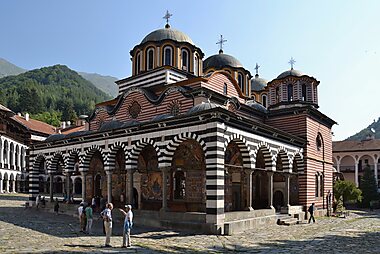
- Rila Monastery — about 2 hours by car or organised tour; limited by regular public transport. Bulgaria's largest Orthodox monastery, a UNESCO World Heritage Site known for its striped stone arches.
- Bansko — about 2.5 hours by bus. A ski resort town at the foot of Pirin mountain, also popular for hiking once the snow melts.
Where to explore
Just outside the built-up city, Vitosha forms Sofia's mountain backdrop and its most popular local escape, with hiking trails in summer and ski runs a short bus ride from the city in winter.
Getting there
- By air: Sofia Airport is about 10 km from the centre and the only airport most travelers use. Metro Line 1 runs directly from the airport to the city centre in about 20–25 minutes; a taxi takes a similar time and costs roughly 12–15 €.
- By train: Sofia's Central Railway Station has domestic services to Plovdiv, Varna, and Burgas, plus international routes toward Serbia, North Macedonia, Romania, and Turkey — check ahead, as some cross-border routes replace part of the journey with a bus.
- By bus: The Central Bus Station, next to the train station, runs frequent coaches to other Bulgarian cities and international routes across the Balkans.
Getting around
- Public transit: Metro, trams, buses, and trolleybuses share one ticketing system. Buy a paper ticket from a kiosk or vending machine, or tap a contactless bank card directly at metro turnstiles and on many buses and trams. See the Sofia Urban Mobility Center for routes and fares.
- Taxi / ride-hailing: Book through an app such as Bolt rather than hailing a car on the street — it fixes the price upfront and avoids the overcharging some street taxis are known for.
- On foot / cycling: The centre is flat and compact enough to see on foot. Cycling is possible but traffic is heavy and dedicated bike lanes are limited.
Driving
- Is a car worth it?: Skip it for the city centre — traffic is heavy and parking is limited. A car only helps for reaching towns and mountains outside Sofia at your own pace.
- Parking: The centre uses a paid Blue Zone (short stay) and Green Zone (longer stay) system on weekdays, paid by SMS, app, or a nearby machine.
- Restrictions: Central Sofia limits some older, high-emission vehicles from entering part of the city centre; a standard rental car is normally unaffected, but check before driving an older vehicle in.
Food & drink
For fresh produce, spices, and cheap street food, head to the Ladies' Market (Zhenski pazar), a few streets from Banya Bashi Mosque.
Mehanas (traditional taverns) around the centre serve Bulgarian staples like shopska salad, kebapche, and rakia, often with live folk music in the evening. Rounding up the bill or leaving about 10% for good service is common, though not required.
Safety & health
Sofia is a safe city for tourists by international standards; violent crime against visitors is rare. The main risks are pickpocketing on crowded trams and around busy markets, and street taxis overcharging tourists who don't book through an app.
Tap water in Sofia is safe to drink and comes largely from mountain springs.
History
Sofia's history stretches back over seven thousand years, among the oldest continuously inhabited sites in Europe. Thracians and then Romans built the city of Serdica here; ruins of its amphitheatre and the ancient street beneath St Sofia Church are still visible today.
The city took its current name from that same church in the 14th century, during the medieval Second Bulgarian Empire. Nearly five centuries of Ottoman rule followed, leaving buildings such as Banya Bashi Mosque still standing in the centre.
After Bulgaria's liberation in 1878, Sofia was chosen as the young nation's capital and rebuilt with grand European-style boulevards and monuments, including Alexander Nevsky Cathedral, raised as a memorial to the Russian soldiers who died freeing Bulgaria from Ottoman rule.
Country facts
Quick practical facts for Bulgaria at a glance:
- Currency
- Euro EUR € · Card payments · Widely accepted
- Emergency numbers
- 112
- Electricity
- 230 V · 50 HzType C / Type F
- Languages
- Bulgarian
- Tap water
- Safe to drink
- Driving side
- Right
- Calling code
- +359


Sofia – Plan Your Days
Turn the places from this guide into a real itinerary, with smart routing, time estimates, and everything you need for a perfect trip.


Related destinations


Data: © OpenStreetMap contributors, Wikidata, Wikipedia, Tripomatic, Official websites, geoBoundaries (CC BY 4.0). Tours by GetYourGuide. We earn commission from bookings. Travel guide generated with AI.