


Cracovia
Kraków was the royal capital of Poland for over 500 years, and it still looks the part. The Old Town survived the Second World War largely intact, so its medieval streets, Gothic churches, and Renaissance courtyards are the real thing, not reconstructions. It rewards a few unhurried days. Wander the largest medieval square in Europe. Climb the hill where Polish kings were crowned. Cross the river into a quarter that was Kraków's Jewish heart for five centuries.
The city suits travelers who want dense, walkable history alongside a lively student and café culture. Kraków is home to one of Europe's oldest universities. Its Old Town squares and Kazimierz district stay busy well into the evening. It also works well as a base for day trips: a UNESCO salt mine and the Auschwitz-Birkenau memorial are both within easy reach.

Cracovia – Planifici o călătorie?
Creează-ți itinerarul zi de zi în aplicația Tripomatic.
Când să vizitezi
Spring and autumn are mild and good for walking, summer is warm with occasional storms, and winter is cold with a real chance of snow. Christmas is a highlight: the Main Market Square hosts one of Poland's best Christmas markets from late November through December, with wooden stalls, mulled wine, and the city's famous illuminated nativity scenes (szopki) on display.
Cea mai bună perioadă de vizitare: august, septembrie
July and August are the warmest and busiest months; June and September offer similar sightseeing weather with smaller crowds.
Obiective turistice de top


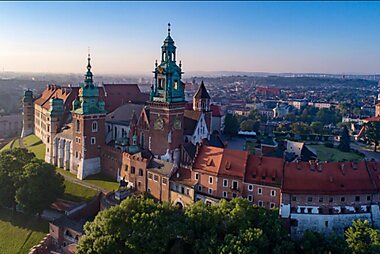
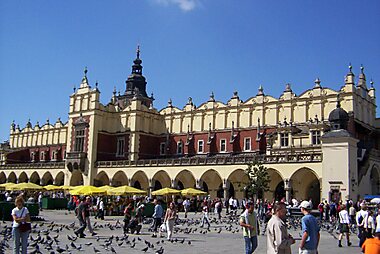
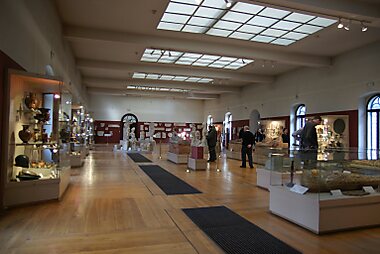
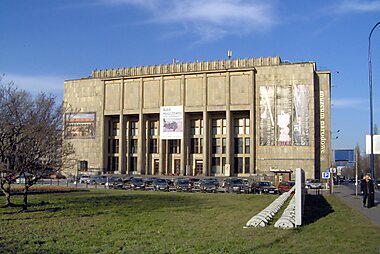
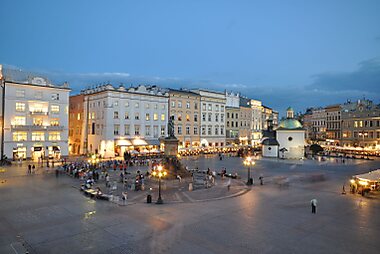
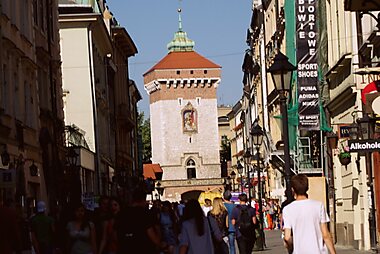
Main Market Square is the natural starting point: a 13th-century square so large it swallows crowds easily, ringed by cafés and dominated by two landmarks. Cloth Hall splits the square in two, its Renaissance arcades still selling amber and souvenirs on the ground floor and a 19th-century Polish art collection upstairs.
St. Mary's Basilica rises beside it, a brick Gothic church famous for its carved wooden altarpiece and the trumpet call sounded from its tower every hour, historically cut short mid-note.
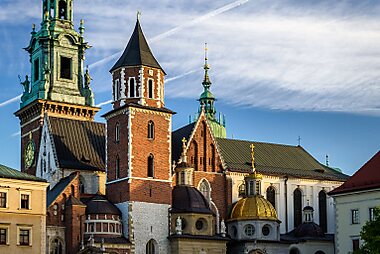
A short walk south, Wawel Castle was the residence and coronation site of Polish kings for centuries, and its state rooms and treasury are still open to visitors. Next to it, Royal Archcathedral Basilica of Saints Stanislaus and Wenceslaus holds the tombs of Polish monarchs and national heroes and remains the country's most important church.
At the northern edge of the Old Town, Saint Florian's Gate is the last surviving gate of the medieval city walls, marking the start of the Royal Route that kings once processed along toward Wawel.
Below the square itself, Rynek Underground is an archaeological museum built around the remains of the medieval marketplace, discovered during a renovation in 2005.
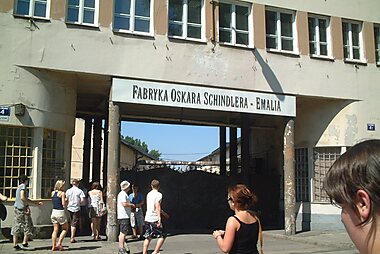
Across the river in the former industrial district of Zabłocie, Schindler's Factory tells the story of Kraków under Nazi occupation through the factory where Oskar Schindler sheltered over a thousand Jewish workers.
Liste recomandate


Comori ascunse ale Cracoviei
Această colecție evidențiază reperele importante ale Cracoviei, departe de aglomerația din centru. Aceasta include istoria medievală a grădinilor Parcului Planty de lângă Barbacană și Monumentul ecvestru Grunwald din Piața Matejko. Mai la est, lista include Abația Cisterciană din Mogiła, datând din secolul al XIII-lea, și legendarul Tumul al Wandei, un sit funerar antic. Muzeul Nowa Huta oferă o perspectivă asupra arhitecturii și istoriei realiste socialiste a orașului, în timp ce istorica Biserică Sf. Florian rămâne un sit religios cheie în cartierul Kleparz.
6 locuri


Memorials & Monuments
This collection showcases Kraków’s significant memorials and monuments, including sites reflecting the Holocaust such as Schindler's Factory and the Płaszów Concentration Camp. It also features historic mounds like Kościuszko and Piłsudski’s Mounds, iconic statues including the Grunwald Monument and Wawel Dragon, and remnants of Jewish heritage like the Fragment of Jewish Ghetto Wall.
10 locuri
Ghiduri audio – Cracovia
Explorează pe jos cu un tur audio autoghidat care povestește despre fiecare oprire pe măsură ce ajungi la ea.

Best of Kraków
110 min2.8 km10 opriri
Walk Kraków's Royal Route from its medieval city gate to the royal stronghold on Wawel Hill. This best-of tour crosses the vast Main Market Square, visits one of Poland's greatest art museums, ducks into the city's grandest Gothic and Baroque churches, and passes the country's oldest university before climbing to the castle and cathedral where Polish kings were crowned. Start at St. Florian's Gate, on the northern edge of the Old Town, an easy walk from the main train station.

Krakow with Kids: Dragon Legends of Wawel
110 min2.9 km9 opriri
A treasure-hunt walk for families, from Krakow's medieval city gate down the old Royal Road to Wawel Hill. Follow the trail of the city's dragon and founding legends: a fortress gate built after a great invasion, a trumpeter's broken warning call, a saint's miracle, the king who built his castle on the hill, the giant bones that guard the cathedral door, and the clever trick that finally beat the terrible dragon. Every stop has a puzzle to solve on the spot. Starts at the Barbican and St. Florian's Gate.

Ascultă tururile audio din Cracovia
2 plimbări în Audio Guides by Tripomatic


Ce merită experimentat
Kraków's rituals are as much about atmosphere as sights — a few things to build a day around.
- Listen for the hejnał mariacki, the trumpet call played live from St. Mary's tower on the hour, every hour, cut off mid-note in memory of a medieval trumpeter struck by an arrow.
- Take an evening walk along the Vistula boulevards below Wawel Hill, where the Wawel Dragon statue breathes real fire every few minutes after dark, a small ritual that draws a crowd of kids and adults alike.
- Spend an evening in Kazimierz, Kraków's former Jewish quarter, browsing the vintage shops and courtyard bars around Plac Nowy, where a late-night zapiekanka (open-faced baguette pizza) from one of the square's kiosks is a local rite of passage.
- Take a boat trip on the Vistula River in summer, gliding past Wawel Hill for a different angle on the castle skyline.
- Browse the flower stalls and antique-book stands that fill the Main Market Square outside festival season, a low-key counterpart to the winter Christmas market.
Tururi și activități
Cracovia — Hartă

Excursii de o zi
Kraków makes an easy base for day trips, from a quick underground detour to one of the most important historical sites in Europe.
- Wieliczka Salt Mine (≈20–30 min by train or minibus) — Wieliczka Salt Mine sits just outside the city. Its UNESCO-listed chambers have chapels, statues, and a chandelier carved entirely from salt, worked continuously since the 13th century.
- Ojców National Park (≈40 min by car, ≈1 hour by bus) — the park around Ojców is Poland's smallest national park, a limestone valley dotted with cave systems and the ruined Pieskowa Skała castle; a good half-day escape into nature.
- Auschwitz-Birkenau Memorial and Museum (≈1.5 hours by bus or train) — Auschwitz-Birkenau State Museum preserves the site of the former Nazi concentration and extermination camp as a memorial and museum. It is a heavy but widely considered essential visit; booking an entry slot in advance is strongly recommended.
- Zakopane and the Tatra Mountains (≈2 hours by car, bus, or train) — Zakopane, Poland's mountain resort town, sits at the foot of the Tatra Mountains, with wooden highlander architecture, hiking trails, and a cable car up Kasprowy Wierch; worth the longer trip in clear weather.
Cum ajungi
- By air: John Paul II International Airport Kraków–Balice is the gateway, about 15 km west of the center. A direct train (Kraków Airport – Kraków Główny line) runs to the main station in around 20 minutes; taxis and ride-hailing take about 25–30 minutes depending on traffic.
- By train: Kraków Główny station has frequent connections to Warsaw (around 2.5 hours by express train) and other major Polish cities, plus international links toward Vienna and Prague.
- By bus: The main bus terminal sits next to Kraków Główny station and serves long-distance domestic and international coach routes, a useful budget alternative to the train.
Cum te deplasezi
- Public transit: An extensive tram and bus network covers the city; trams are usually the fastest way to cross town. Tickets can be bought with a contactless bank card or phone tap directly on board at the validator, so there is no need to plan ahead or find a kiosk.
- Taxi / ride-hailing: Bolt and Uber both operate widely and are generally cheaper and more reliable than hailing a street taxi.
- On foot: The Old Town and Kazimierz are compact and best explored on foot; most top sights sit within a 20-minute walk of the Main Market Square.
Condusul
- Is a car worth it?: Skip it for the city itself — the Old Town is compact, largely pedestrianized, and well served by trams. A car becomes useful only if combining several day trips outside the reach of public transport.
- Parking: Paid parking zones cover the city center; pay by app or at roadside machines. Park-and-ride lots near tram terminals are a cheaper option for anyone driving in.
- Restrictions: A low-emission zone restricting older, high-emission vehicles covers the city center; check current rules before driving in if renting an older car.
Mâncare și băutură
Kraków's food culture mixes hearty Polish classics with a strong café tradition. Look for pierogi (dumplings, sweet or savory), żurek (sour rye soup), and obwarzanek krakowski, the braided ring-shaped bread sold from street carts across the Old Town.
For a genuinely distinctive spot, Milkbar Tomasza is a long-running milk bar, a Communist-era canteen style serving cheap, home-style Polish food that both locals and travelers still queue for. For a wider spread, head to the food stalls and kiosks around Plac Nowy in Kazimierz, especially in the evening, where zapiekanka and other street food are the main draw.
Siguranță și sănătate
Kraków is a safe city for tourists by any reasonable standard, with violent crime against visitors rare. The main risks are pickpocketing in crowded tourist spots like the Main Market Square and on busy trams, and overpriced or unlicensed taxis waiting outside the airport and train station — use a licensed rank or a ride-hailing app instead. Tap water is safe to drink throughout the city.
Istorie
Kraków was the capital of the Kingdom of Poland for over 500 years, and Wawel Castle was both royal residence and the site where most Polish monarchs were crowned and buried. The capital moved to Warsaw in 1596, but Kraków kept its role as a spiritual and academic center.
Collegium Maius is part of the Jagiellonian University, founded in 1364. It is one of the oldest universities in Central Europe, and its alumni include the astronomer Nicolaus Copernicus. Kraków's Old Town survived the Second World War with little physical destruction, unlike Warsaw. That is why so much of its historic fabric is original rather than rebuilt.
The war's darkest chapter played out in Kazimierz and the wartime Kraków Ghetto. Most of the city's Jewish population, once a large and integral part of Kraków's life, was deported from there to camps including nearby Auschwitz-Birkenau. Schindler's Factory and the synagogues of Kazimierz, including Remuh Synagogue and Cemetery, preserve that history today.
Date despre țară
Quick practical facts for Poland at a glance:
- Monedă
- zlot PLN zł · Plăți cu cardul · Acceptate pe scară largă
- Numere de urgență
- 112
- Electricitate
- 230 V · 50 HzTip C / Tip E
- Limbi vorbite
- poloneză
- Apă de la robinet
- Sigură de băut
- Sens de circulație
- Pe dreapta
- Prefix telefonic
- +48


Cracovia – Planifică-ți zilele
Transformă locurile din acest ghid într-un itinerar real, cu trasee inteligente, estimări de timp și tot ce ai nevoie pentru o călătorie perfectă.


Destinații înrudite


Data: © OpenStreetMap contributors, Wikidata, Wikipedia, Tripomatic, Official websites, geoBoundaries (CC BY 4.0). Tours by GetYourGuide. We earn commission from bookings. Travel guide generated with AI.
Planifică-ți călătoria cu Tripomatic
- Planificare susținută de AILasă inteligența artificială să-ți construiască itinerarul, să răspundă la întrebări de călătorie și să-ți organizeze documentele de rezervare în călătorie.
- Alerte de călătorieAvertizări oficiale, fenomene meteo severe, greve și pericole naturale pentru locurile din fiecare zi a călătoriei tale.
- Sărbători legale și evenimenteVezi sărbătorile, festivalurile și închiderile din zilele călătoriei tale și ce înseamnă acestea pentru planurile tale.
- Estimarea costurilorDefalcare a costurilor călătoriei susținută de AI, astfel încât să știi ce buget să aloci înainte de plecare.
- Tururi și bileteRezervă tururi, bilete cu acces prioritar și activități direct în planul tău.