


Madrid
Spain's capital sits almost exactly in the geographic center of the country, on a high plateau that makes summers scorching and winters crisp. It has none of the canals or seafront of Barcelona. Instead it offers wide boulevards, grand plazas, and three major art museums within a short walk of each other. Madrid rewards travelers who like to walk, eat late, and stay out later.
This is a city built for a first visit of three to five nights: compact enough to cover the historic center on foot, with a metro system that reaches everywhere else. It suits travelers who want art, architecture, and food in equal measure, rather than a single headline attraction. Painters Diego Velázquez and Francisco Goya both worked for the Spanish royal court here. Their work anchors the Prado's collection today.

Madrid – Plánuješ výlet?
Sestav si itinerář den po dni v aplikaci Tripomatic.
Kdy navštívit
Spring (April–June) and autumn (September–October) are mild and the best time to visit. Summer is hot and dry, with July and August afternoons regularly topping 35 °C, while winter is cold but mostly dry, with the occasional light snow.
Plan around San Isidro in mid-May if you can: Madrid's patron-saint festival fills the city with free concerts, traditional dress, and street parties for over a week, centered on the Pradera de San Isidro park.
Nejlepší doba k návštěvě: květen, červen, září, říjen
Hlavní památky
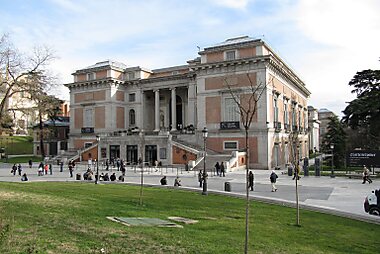
- Prado Museum holds Spain's national art collection, with rooms of Velázquez, Goya, and El Greco. It alone justifies a trip.
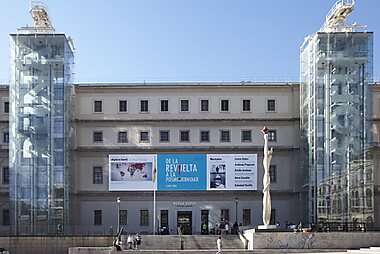
- Museo Nacional Centro de Arte Reina Sofía houses Picasso's Guernica, his response to the bombing of a Basque town during the Spanish Civil War.
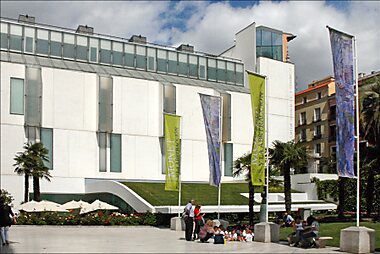
- Museo Thyssen-Bornemisza is a private collection spanning seven centuries of European painting. Together with the Prado and Reina Sofía it forms Madrid's "Golden Triangle of Art."
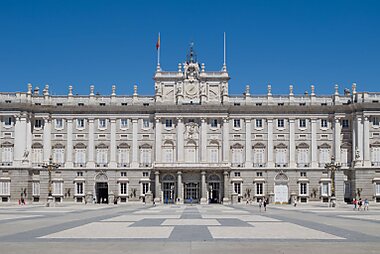
- Royal Palace of Madrid is the official residence of the Spanish royal family, though they no longer live there. Walk through the state rooms and armory, then cross the square outside.
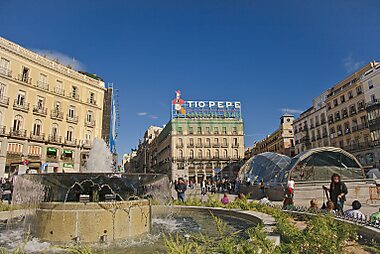
- Puerta del Sol marks kilometre zero for Spain's entire road network. Madrileños gather here on New Year's Eve.
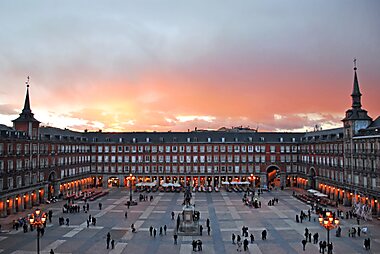
- Plaza Mayor is a 17th-century square lined with cafés and street performers, a short walk from Puerta del Sol.
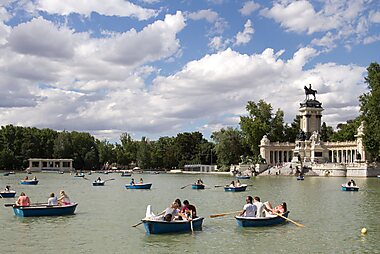
- El Retiro Park is Madrid's largest green space, with a rowable lake and a glass-and-iron palace built for a 19th-century exhibition. Locals use it every day, not just on weekends.
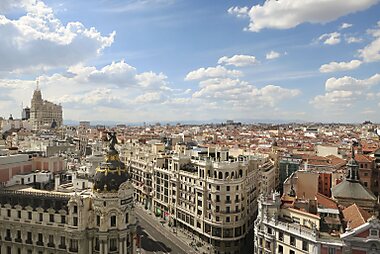
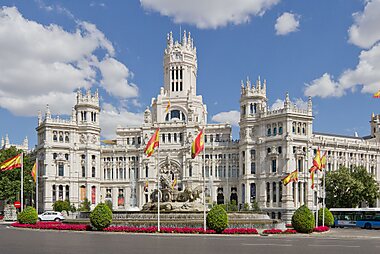
- Gran Vía is the city's grand early-20th-century avenue, lined with theatres and Beaux-Arts facades that light up at night.
Doporučené výběry


Audioprůvodci – Madrid
Prozkoumej město pěšky se samostatnou audio prohlídkou, která spustí vyprávění u každé zastávky hned, jak k ní dorazíš.


Poslouchej audioprůvodce pro město Madrid
1 procházka v aplikaci Audio průvodce Tripomatic


Co zažít
Madrid's rhythm runs late, and the best experiences here are things you do after dark or on a Sunday morning, not sights you photograph.
- Browse the stalls at Rastro Market on a Sunday morning, when the Rastro neighborhood turns into Madrid's oldest flea market — arrive early for the best finds and to beat the crowds.
- Watch the sun set over the Sierra de Guadarrama from the terrace at The Temple of Debod, an Egyptian temple gifted to Spain in 1968 and now a popular free viewpoint.
- Join a tapas crawl through the narrow bars of Cava Baja and La Latina, hopping between counters for a plate of jamón or a glass of vermouth at each stop rather than sitting down for a full meal.
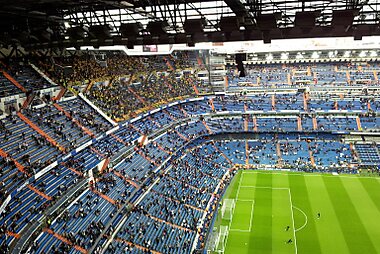
- Catch a home match at Santiago Bernabéu Stadium — even without match tickets, a stadium tour gives a sense of the atmosphere Real Madrid fans bring to a European night.
- See a flamenco show at one of the small tablaos near the city center; book ahead, since the best rooms hold only a few dozen seats.
Prohlídky a aktivity
Madrid – Mapa

 Otevřít interaktivní mapu
Jednodenní výlety
Madrid's location in the center of Spain puts several worthwhile day trips within easy reach by train.
- Toledo — about 30 minutes by high-speed train. A walled hill town that was Spain's capital before Madrid, with a huge Gothic cathedral and centuries of Christian, Muslim, and Jewish history layered into its streets.
- Segovia — about 30 minutes by high-speed train. Famous for its intact Roman aqueduct and a turreted Alcázar castle said to have inspired Walt Disney.
- Aranjuez — about 45 minutes by train. A small riverside town built around an 18th-century royal palace and formal gardens, once a spring retreat for the Spanish court.
- San Lorenzo de El Escorial — about 1 hour by train or bus. Home to El Escorial, the vast granite monastery-palace Philip II built as a royal mausoleum.
- Chinchón — about 1 hour by car or bus. A small wine town built around a circular, balconied plaza that still hosts bullfights during its annual fiesta.
Kam vyrazit na průzkum
Alcalá de Henares makes an easy half-day trip from central Madrid, about 35 minutes by train. This UNESCO World Heritage university town was the birthplace of Miguel de Cervantes, and its historic quarter of cloistered courtyards and porticoed streets is still walkable in an afternoon.
Jak se tam dostat
- By air: Adolfo Suárez Madrid–Barajas Airport is Spain's busiest, about 13 km northeast of the center. Metro line 8 runs to the city center in about 20–30 minutes; a fixed-fare taxi to the center costs around 30–35 €.
- By train: Estación de Atocha is the hub for southern and high-speed routes (Seville, Toledo, Barcelona), while Chamartín station in the north handles routes to northern Spain and France.
- By bus: Estación Sur de Autobuses, next to Méndez Álvaro metro station, is the main long-distance coach terminal, with connections across Spain and neighboring countries.
Doprava na místě
- Metro: Madrid's metro network has 13 lines reaching almost every corner of the city. Buy a rechargeable Tarjeta Multi card at any station vending machine and load it with a 10-trip pass or a tourist travel pass valid for unlimited rides over several days. See the Consorcio Regional de Transportes for routes and fares.
- Bus: The EMT bus network fills in where the metro doesn't reach, using the same Tarjeta Multi card.
- Taxi: Madrid's official white taxis are metered and easy to hail on the street; ride-hailing apps also operate widely.
- On foot: The historic center is compact and mostly flat near the main sights, though a few streets climb noticeably toward Gran Vía and the Royal Palace.
Řízení auta
- Is a car worth it? No — skip it for the city itself; the metro and walking cover everything in the center, and traffic and parking are more hassle than they're worth. A car only makes sense as a base for exploring the wider region.
- Parking: Street parking in the center is metered under the SER zone (pay by app or machine, generally free at night and on Sundays); underground car parks near the main sights cost roughly 25–30 € a day.
- Restrictions: Madrid Central, the low-emission zone covering the historic core, restricts access for older, more polluting vehicles — check your rental car's environmental sticker before driving in.
Jídlo a pití
Madrid's food culture is built around small plates eaten standing at a bar, not long sit-down meals. Look for cocido madrileño (a slow-cooked chickpea stew, often served in courses), bocadillo de calamares (a fried squid sandwich, a Plaza Mayor institution), and patatas bravas.
For a single distinctive stop, Botín holds the Guinness record for the world's oldest continuously operating restaurant. It still roasts suckling pig in a wood-fired oven dating to 1725. For everyday grazing, head to Mercado de San Miguel, a restored 1916 iron-and-glass market packed with tapas counters, or to the streets of La Latina and Cava Baja, where bars each specialize in one dish and locals move from door to door.
Bezpečnost a zdraví
Madrid is one of Europe's safer capitals for tourists, and violent crime against visitors is rare. The main risk is pickpocketing on the metro, at Puerta del Sol, and around crowded tourist sites — keep bags zipped and in front of you, especially on metro line 1 and around Sol.
Historie
Madrid's origins are modest: a 9th-century Muslim fortress called Mayrit gave the city its name and first walls. It stayed a minor market town for centuries. Philip II moved the royal court here in 1561, partly because Madrid sat close to his monastery-palace at El Escorial. Charles III, still called the "best mayor of Madrid," rebuilt the city in the late 18th century. He commissioned Puerta de Alcala as a ceremonial gateway and laid out the Paseo del Prado, whose museum later became the Prado.
The Royal Palace of Madrid rose on the site of a medieval fortress that burned down in 1734. Its neighbor, Almudena Cathedral, looks centuries older than it is. Construction only finished in 1993, after more than 100 years of stalled building. During the Spanish Civil War, Gran Vía took direct shelling as the front line ran through what is now a university campus at the city's edge. After Franco's death in 1975, the city became the center of la Movida Madrileña, an explosion of music, film, and nightlife that reshaped Spanish culture through the 1980s.
Fakta o zemi
Quick practical facts for Spain at a glance:
- Měna
- euro EUR € · Platby kartou · Široce přijímány
- Nouzová čísla
- 112
- Elektřina
- 230 V · 50 HzTyp C / Typ F
- Jazyky
- španělština
- Voda z kohoutku
- Pitná
- Strana jízdy
- Vpravo
- Předvolba
- +34


Madrid – Naplánuj si jednotlivé dny
Proměň místa z tohoto průvodce ve skutečný itinerář s chytrým plánováním tras, časovými odhady a vším, co potřebuješ pro bezstarostný výlet.




