



Benin
Benin is a narrow, French-speaking country in West Africa, stretching from a short Atlantic coast in the south to dry savanna in the north. It was the heart of the Kingdom of Dahomey, whose kings and famous women soldiers left palaces and legends behind. It is also the birthplace of Vodun (voodoo), which is part of daily life and has its own national holiday. The coast holds the most important memorials of the Atlantic slave trade in the region.
The country suits travellers interested in history, living traditions and village life, and who are comfortable with basic infrastructure. Most visits stay in the south: Cotonou, the Vodun town of Ouidah, the lake villages near Cotonou, the royal city of Abomey and the beaches of Grand-Popo. Governments advise against all travel to the Pendjari and W national parks and the border areas with Burkina Faso and Niger, and against all but essential travel to most of the rest of the north. Check current official advice before planning any route north.




Benin – Planning a Trip?
Build your day-by-day itinerary in the Tripomatic app.
Money & payments
Benin uses the West African CFA franc, shared with seven other countries and fixed to the euro, so prices are stable.
- Cash is needed for almost everything: markets, street food, zémidjans (motorbike taxis), shared taxis and small hotels. Carry small notes, because change is often short.
- Cards work mainly in larger hotels, some supermarkets and upscale restaurants in Cotonou. Outside the city, plan to pay cash.
- ATMs are found in Cotonou and the larger towns. Withdraw enough before visiting villages.
- Mobile money (MTN MoMo and Moov Money) is how many locals pay. You can use it too with a local SIM.
- Daily budget: a budget traveller eating street food and using shared transport can manage on about 20,000–35,000 CFA a day. A mid-range trip with comfortable hotels, restaurant meals and a private driver costs 70,000–130,000 CFA a day or more.


Tours & Activities
Benin — Map

Tipping
Tipping is not a strong custom in local eateries, but it is welcome for good service in places used to visitors. Guides at museums, palaces and Vodun sites expect a tip, and so do drivers hired for the day.
round up or 5–10 % in upscale restaurants; not expected at street stalls
at the end of a tour
small amount for porters and room staff
small change
Electricity
Benin uses Type C and E plugs at 220 V. Power cuts are less frequent than in the past, but a power bank is useful in rural areas.
Language
French is the official language, used in government, schools, signs and business. Local languages are the everyday language for most people: Fon is the most widely spoken in the south, Yoruba in the south-east, and Bariba and Dendi in the north.
English is spoken in some hotels and by some guides, but rarely elsewhere. A few words of French make a big difference, and greeting people before any request is important.
Staying connected
- SIM cards: MTN and Moov Africa sell prepaid SIM and data bundles in shops in all towns. Bring your passport, because SIM registration is required.
- Coverage: 4G works well in Cotonou and the larger towns but becomes patchy in rural areas.
Safety & emergencies
The UK government advises against all travel to Pendjari National Park, W National Park (Parc du W) and the hunting zones around them, the area between Parc du W and the border with Niger, and all areas within 5 km of the border with Burkina Faso. It also advises against all but essential travel to the rest of the Alibori and Atacora departments, and to the area between the RNIE 2 highway (Tchaourou to Malanville) and the border with Nigeria. The US advises people not to travel to the areas bordering Burkina Faso, Niger and northern Nigeria. The reason is the risk of terrorist attacks and kidnapping, including of tourists. Attacks elsewhere, including on beaches and at hotels in the south, cannot be ruled out.
In the south, the main risks are crime, the sea and the roads:
- Street crime: theft and mugging are common in Cotonou. Be alert in Dantokpa Market and avoid the area at night.
- Beaches: currents are very strong along the whole coast, and people drown every year. Do not swim without local advice, and do not walk on the beach alone.
- Roads: driving standards are poor. Avoid road travel outside towns after dark.
- Motorbike taxis: zémidjans are cheap and everywhere, but accidents are common, and robberies happen at night. Ask for a helmet and avoid them after dark.
- Photography: it is illegal to photograph military sites, government buildings and the airport.
- Demonstrations: avoid political gatherings and large crowds.
Health
- Yellow fever: vaccination is recommended for all travellers. Benin stopped checking vaccination certificates at its borders in September 2026, but it may bring checks back at any time. Carry your certificate anyway, as airlines and other countries on your route may ask for it.
- Malaria is present all year in the whole country. Take antimalarial tablets and use insect repellent and a mosquito net. Dengue is also present.
- Water: do not drink tap water. Bottled water is sold everywhere. Avoid ice and raw salads outside good hotels.
- Medical care is basic, and very limited outside Cotonou. Serious cases often need evacuation, so buy travel insurance that covers it.
- Pharmacies are common in towns and marked with a green cross. Bring any regular medicines with you. Fake medicines are sold at street stalls, so buy only in pharmacies.
- Vaccinations: check other recommended vaccines with a travel clinic at least 8 weeks before you leave.
Visas & entry
Most visitors from outside West Africa need a visa, including citizens of the UK, the EU and the USA. Citizens of ECOWAS countries can enter without a visa.
- E-visa: apply online at Benin e-Visa – official portal at least one week before you travel. You cannot get a visa on arrival. Options include a 30-day single-entry, a 30-day multiple-entry and a 90-day multiple-entry visa.
- What you need: a passport valid for at least 6 months after arrival, with a blank page for the entry stamp. Yellow fever vaccination is recommended; carry your certificate (see Health).
- Onward travel: you cannot get visas for Nigeria, Ghana or Togo in Benin. Arrange them before you leave home.
- Cash: you must declare cash over 5 million CFA when you enter or leave.
Visa and entry requirements change frequently. Verify current requirements with the official immigration authority or your country's embassy before travel.
Etiquette
- Greetings: always greet people before you ask a question or start a sale. Take time for the greeting, and shake hands with your right hand.
- Vodun: Vodun is a respected religion, not a show. At temples and ceremonies, follow your guide, take off your shoes when asked, and do not touch shrines or objects. Some sacred forests and shrines are closed to visitors or to photography.
- Photography: always ask before you photograph people, ceremonies, shrines or markets. Many people expect a small payment. At Vodun ceremonies, ask the priest or your guide first; some rituals and masked Egungun dancers must never be photographed.
- Dress: light, modest clothing is fine. Cover shoulders and knees in mosques and churches, and in the Muslim north.
- Bargaining: bargain in markets and with taxi and zémidjan drivers. Agree the price before the ride.
- Same-sex couples: same-sex relationships are legal, but not widely accepted. Public displays of affection are best avoided.
Holidays & opening hours
On public holidays, government offices and banks close, and many shops close or open shorter hours. Markets and street food usually continue. 10 January is the national Vodun holiday. The Vodun Days festival in Ouidah takes place around this date, with ceremonies, dances and big crowds, so book rooms early. Muslim festivals such as Tabaski are also public holidays, on dates that move each year.
Many offices and shops close for a long lunch break in the early afternoon. Markets and many small shops also open on Sunday.
Getting around
There are no passenger trains or regular domestic flights, so all travel is by road. Distances in the south are short: Cotonou to Ouidah or Porto-Novo takes about an hour.
- With a driver: hiring a car with a local driver is the easiest and safest way to visit several sites. Your hotel can arrange one.
- By bus: coach companies link Cotonou with the main towns. Choose a larger company, travel by day, and book a seat a day ahead.
- Shared taxis: shared cars and minibuses leave from stations when full. They are cheap but crowded and often in poor condition.
- Zémidjans: motorbike taxis, with drivers in yellow shirts in Cotonou, are the most common way to get around towns. Agree the price first, ask for a helmet, and avoid them at night.
- To the lake villages: boats (pirogues) to the stilt village of Ganvié leave from the jetty in Abomey-Calavi. Buy tickets at the official ticket office.
- Arriving: most international flights land at Cotonou's Cardinal Bernardin Gantin airport. See Aéroport de Cotonou.
Driving
Driving yourself is possible, but most visitors hire a car with a driver.
- Licence: bring an International Driving Permit together with your national licence.
- Road conditions: the main coastal road and the highway north are paved, but many side roads are dirt and difficult in the rainy season. Avoid driving outside towns after dark.
- Motorbikes: thousands of motorbikes weave through traffic, especially in Cotonou. Drive slowly and expect sudden turns.
- Checkpoints: police checkpoints are common. Keep your passport, licence and car papers ready, and stay polite.
- Tolls: toll booths on the main national roads charge a small fee; pay cash.
- Parking: use guarded car parks at hotels and supermarkets where possible.
- Fuel: stations are attended and usually take cash. Petrol is sold as "Super" and diesel as "Gasoil". Fuel sold in bottles at the roadside is often of poor quality; use proper stations.
- Electric vehicles: there is almost no public charging network, so EV travel is not practical.
Food & drink
Food in Benin is built around a starchy base served with a sauce. In the south, the staple is pâte, a smooth dough of maize flour, eaten with sauces of tomato, okra, leafy greens, fish or chicken. Amiwo is a red maize dough cooked in tomato and palm oil, served with chicken. In the north, people eat pounded yam (igname pilée) and wagasi, a soft cheese made by Fulani herders, often fried. Breakfast is often porridge (bouillie) or fried dough balls called yovo doko.
Street food is cheap and good: grilled fish and chicken, fried plantain (aloko), rice and beans (atassi), and crunchy peanut snacks called kluiklui. Most people eat at simple roadside eateries or buy from market stalls. Drinks include bissap (hibiscus juice), fresh palm wine, tchoukoutou (sorghum beer from the north) and sodabi, a strong spirit distilled from palm wine. The local lager is La Béninoise.
Where to explore
The coast
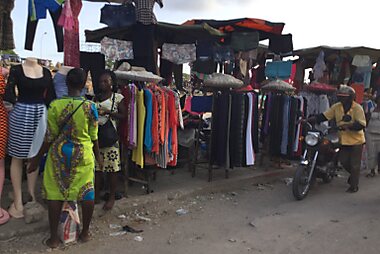
- Cotonou: the largest city and seat of government, with the huge Marché Dantokpa, the 30-metre L'Amazone honouring the women soldiers of Dahomey, and contemporary African art at Fondation Zinsou.
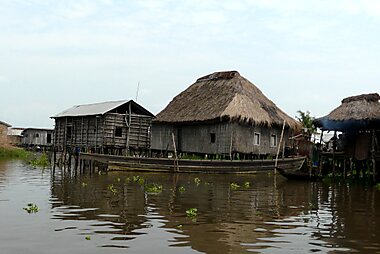
- Ganvié: a large village of houses on stilts in Lac Nokoué, reached by boat from Abomey-Calavi. Thousands of people live, fish and trade here from their boats.
- Porto-Novo: the official capital, with Afro-Brazilian houses, a colourful mosque built in the style of a Brazilian church, and royal and Vodun museums.
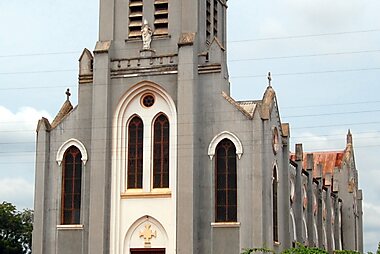
- Ouidah: the centre of Vodun and the main slave trade port. Walk Slave road Ouidah past Case de Zomaï, route des esclaves to the Door of No Return arch on the beach. The Python Temple stands opposite Basilique de l'Immaculée Conception, and Fondation Zinsou shows contemporary art in an old villa.
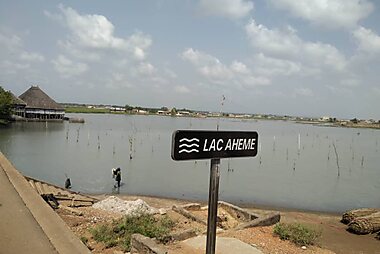
- Grand-Popo: a quiet beach town near the Togo border, with fishing villages, the Mono river mouth and boat trips on the lagoon. Lac Ahémé lies inland, with fishing villages on its shores.
The centre
- Abomey: capital of the Kingdom of Dahomey. The Royal Palaces of Abomey are a UNESCO World Heritage site, with bas-reliefs telling the kingdom's history. Palais du roi Akaba is one of them and has a craft centre. Nearby Bohicon is the transport hub.
- Dassa-Zoume: a town among granite hills, and a Catholic pilgrimage site.
The north
Most of the north is covered by official travel warnings. Check current advice before any trip.
- Natitingou and Tanguieta: towns in the Atacora hills, known for the fortified earth houses (tata somba) of the Betammaribe people and the Cascades de Tanougou. The whole Atacora department is under official warnings.
- Pendjari National Park and Parc W du Bénin: large wildlife parks with elephants, lions and buffalo, part of a UNESCO World Heritage site shared with Burkina Faso and Niger. Governments advise against all travel to both parks.
- Parakou and Djougou: the main towns of the centre-north. Parakou lies on the RNIE 2 highway, on the edge of an area where the UK advises against all but essential travel.
Benin – Plan Your Trip
Pick the places you want to see and Tripomatic turns them into a day-by-day route, with smart routing, time estimates, and everything you need for a perfect trip.




