



Casablanca
Casablanca is Morocco's largest city and its commercial capital. Many visitors know the name only from the 1942 film, though it was shot entirely in Hollywood and has almost nothing to do with the real place. The actual city is an Atlantic port with wide boulevards, a dense old quarter, and one of the world's largest mosques standing over the ocean. It suits travelers who want a fast-paced, modern introduction to Morocco before heading inland to the older imperial cities.
The city grew quickly in the early 20th century under French colonial rule, and that era left it with one of the world's largest collections of Art Deco architecture. Along with the mosque and the old medina, that architecture is the main reason to spend a day walking its downtown streets.

Casablanca – Planning a Trip?
Build your day-by-day itinerary in the Tripomatic app.


When to visit
Casablanca has a mild, Atlantic climate for most of the year, cooled by sea breezes even in summer. Winters are mild with more rain; spring and autumn are the driest and most comfortable for walking. Plan around Jazzablanca, a jazz festival held each year in early July that brings international and Moroccan acts to venues across the city.
Best time to visit: January, February, March, April, May, June, July, August, September, October, November, December
Top sights



Hassan II Mosque is Casablanca's defining landmark. Completed in 1993, it stands partly over the Atlantic Ocean, and its minaret is among the tallest in the world at 210 metres.
The Old Medina of Casablanca is the original walled heart of the city, largely rebuilt after a 1755 earthquake. Its narrow lanes hold small markets and workshops rather than major monuments, which makes it a good place to simply wander.
South of the medina, the Habous Quarter was developed by the French starting in the 1930s as an idealized version of a traditional Moroccan district. Its centerpiece is Mahkama du Pacha, an administrative palace with carved cedar ceilings and mosaic-tiled courtyards, standing beside the gates of the Palais Royal de Casablanca.
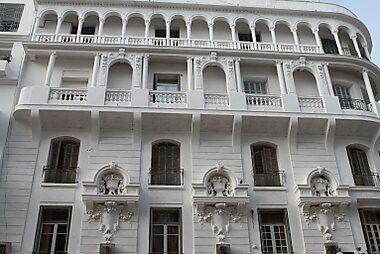
Mohammed V Square sits at the center of downtown, ringed by some of the city's best Art Deco Buildings, built during the French Protectorate era in the 1920s and 1930s.
Casablanca Cathedral is a former Catholic church known for its stark white concrete facade, an unusual example of Art Deco applied to religious architecture.
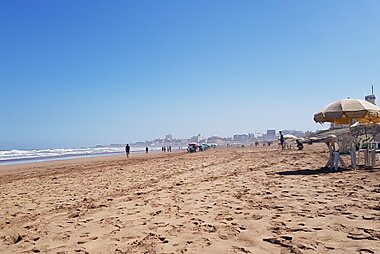
Along the coast, Ain Diab Beach is the most popular stretch of the Corniche, lined with beach clubs, pools, and restaurants facing the ocean.
Featured Lists


What to experience
- Watch the sunset from the Corniche, where the beach clubs around Ain Diab Beach shift from daytime pools to evening drinks.
- Catch a Raja or Wydad football match if the timing works out — the local derby is known as one of Africa's most passionate football rivalries.
- Browse the wholesale market at Derb Ghallef, where locals shop for fabric, electronics, and secondhand goods rather than souvenirs.
Tours & Activities
Casablanca — Map

 Open the interactive map
 Day trips
Casablanca sits close to several worthwhile day trips, from quiet coastal towns to Morocco's capital and its most famous imperial city.
- Mohammedia — about 20–25 minutes by train or car. A smaller port town with a long sandy beach, a historic kasbah, and a much more relaxed pace than Casablanca.
- El Jadida — about 1 hour by car or bus. A former Portuguese trading post with a 16th-century fortified old town and an underground cistern whose reflecting pool was used by Orson Welles to film scenes from Othello.
- Rabat — about 1 hour by train. Morocco's capital, with the unfinished Hassan Tower, the Kasbah of the Udayas, and a calmer, greener feel than Casablanca.
- Marrakesh — about 2.5 hours by train. Morocco's most famous city, worth the longer trip for its medina and souks if your schedule allows a long day, though an overnight stay suits it better.
Getting there
- By air: Mohammed V International Airport (CMN) is Casablanca's main gateway and Morocco's busiest airport, about 30 km southeast of downtown. A direct train runs to Casa-Voyageurs and Casa-Port stations in roughly 35–45 minutes; taxis take about the same time in normal traffic and cost more, but run at fixed rates from the official taxi desk.
- By train: Casablanca is Morocco's rail hub. Casa-Voyageurs is the main long-distance station, with frequent ONCF connections to Marrakesh, Fez, and Rabat, plus the Al Boraq high-speed line north to Tangier. Casa-Port, closer to downtown and the medina, mainly handles regional and airport trains.
- By bus: CTM and Supratours run long-distance coaches from Casablanca's main bus terminals to cities across Morocco, useful for routes with limited rail service.
Getting around
- Public transit: The Casablanca tram network covers the city center and several outer districts, with buses filling in the rest. Buy a rechargeable card at station kiosks before boarding — Casablanca Tramway.
- Taxi: Red "petit taxis" cover trips within the city and use a meter — insist on it. Grand taxis and ride-hailing apps cover longer or shared routes.
- On foot: Downtown, the Old Medina, and the Habous Quarter are each walkable on their own, but the city is spread out — getting between downtown and the Corniche means a taxi, bus, or tram.
Driving
- Is a car worth it?: Not for the city itself — traffic is heavy and downtown parking is limited. A car is most useful for day trips to Mohammedia, El Jadida, or Rabat.
- Parking: Guarded street parking, marked by an attendant in a vest, is common downtown; pay them directly, a few dirhams per hour. Hotels and malls such as Morocco Mall have gated car parks.
- Restrictions: None specific to tourists — no congestion charge or low-emission zone in the city center.
Food & drink
Casablanca's food scene runs from simple stalls to formal dining, reflecting its role as Morocco's business capital. Grilled sardines and other fresh seafood, sold along the port and the Corniche, are a local specialty worth seeking out.
For something with history attached, Rick's Cafe recreates the fictional bar from the 1942 film in a restored 1930s mansion, with live piano most evenings. Otherwise, the streets around the Habous Quarter cluster with good, casual Moroccan restaurants.
Safety & health
Casablanca is generally safe for tourists, and violent crime against visitors is rare. Watch for pickpocketing in crowded spots like the medina and around the train stations, and agree on a taxi fare or insist on the meter before you get in. Tap water is best avoided; stick to bottled or filtered water, as in the rest of Morocco.
History
Casablanca's name comes from Spanish and Portuguese traders, who called the fishing village "white house" for its whitewashed buildings; Portuguese forces destroyed the original settlement in 1468 and rebuilt it in the early 16th century. Much of today's Old Medina of Casablanca instead dates from a later rebuilding effort after a 1755 earthquake, ordered by the Moroccan Sultan Mohammed ben Abdallah.
The city as it looks today is mostly a 20th-century creation. When France made Casablanca its economic hub under the colonial Protectorate (1912–1956), planners laid out wide boulevards and let a generation of French and Moroccan architects build in the Art Deco and Mauresque styles, visible today around Mohammed V Square. That architectural legacy is now on Morocco's UNESCO World Heritage tentative list.
Casablanca gave its name to the famous 1942 film, though the movie itself was shot entirely in Hollywood and none of its scenes were filmed here.
Country facts
Quick practical facts for Morocco at a glance:
- Currency
- Moroccan Dirham MAD DH · Card payments · Commonly accepted
- Electricity
- 220 V · 50 HzType C / Type E
- Languages
- Arabic
- Tap water
- Drink with caution
- Driving side
- Right
- Calling code
- +212


Casablanca – Plan Your Days
Turn the places from this guide into a real itinerary, with smart routing, time estimates, and everything you need for a perfect trip.




