


Marrakesh
Marrakesh is Morocco's most visited city, a walled medina of pink-red buildings set against the snow-capped Atlas Mountains. Founded almost 1,000 years ago, it has been an imperial capital and a trading hub for Saharan caravans. Today it draws artists, designers, and travelers from around the world. Horse-drawn carriages share the wider boulevards with mopeds and taxis, while centuries-old palaces sit close to boutique hotels.
The fashion designer Yves Saint Laurent lived here for decades and helped shape the city's modern reputation for style and design. Marrakesh suits travelers who want dense sightseeing in a small area, along with shopping, spa culture, and easy day trips to the mountains and coast.

Marrakesh – Planning a Trip?
Build your day-by-day itinerary in the Tripomatic app.


When to visit
Spring and autumn are mild and the most comfortable seasons to visit. Summer afternoons get extremely hot, so plan sightseeing for morning and evening. Winter days are pleasant, but nights turn cold, especially inside the Medina's stone buildings.
Plan around the National Popular Arts Festival, usually held in July, when folk troupes from across Morocco perform music and dance at El Badi Palace.
Best time to visit: January, February, March, April, November, December
Top sights


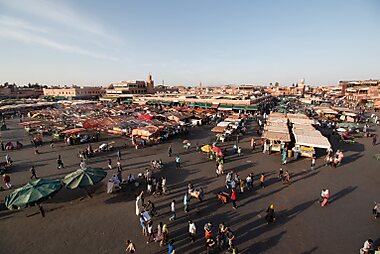

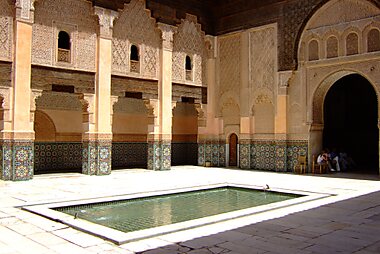
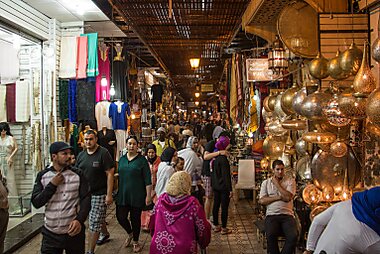
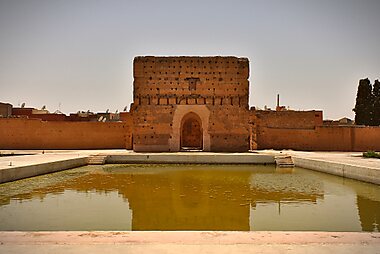

Jemaa El-Fna is the main square of the old city and changes character throughout the day. In the morning it has orange-juice stalls and henna artists; by night, food stalls, musicians, and storytellers fill the square.
Koutoubia Mosque has a 77-meter minaret that has served as a model for mosque towers across Morocco and Spain since the 12th century. Its sandstone walls turn orange at sunset.
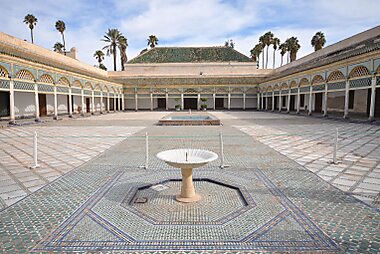
Bahia Palace was built in the 19th century for a powerful vizier. Its rooms have painted ceilings and carved cedar wood, arranged around courtyards planted with orange trees.
Ben Youssef Madrasa was once North Africa's largest Islamic school. Its courtyard, covered in carved stucco and tile, is one of the best examples of Moroccan craftsmanship still standing.
Saadian Tombs stayed hidden behind a sealed wall for centuries until it was rediscovered in 1917. The marble mausoleum holds the tombs of Saadian sultans and their families.
El Badi Palace is now mostly ruins, but its size still shows the wealth of the Saadian dynasty that built it. Storks nest on the walls each spring.
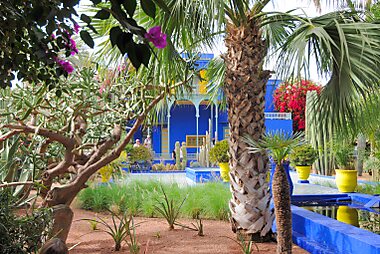
Majorelle Garden is a garden of cobalt-blue buildings, cacti, and bamboo created by the French painter Jacques Majorelle. The designer Yves Saint Laurent later owned it and is honored with a small museum on the grounds.
Marrakech Souks spread through the streets north of Jemaa el-Fna. Covered alleys sell leather goods, lanterns, spices, and carpets, organized loosely by trade.
Featured Lists

Marrakesh: The Ultimate Essentials
Marrakesh’s historical core features architectural landmarks ranging from the 12th-century Almoravid Koubba to the 19th-century Bahia Palace. This selection covers the UNESCO-listed Jemaa El-Fna square and the labyrinthine souks, alongside the Ben Youssef Madrasa, once the largest Islamic school in North Africa. Cultural insights are found within the Dar Menebhi Palace’s art collection and the House of Photography's historical archives. The itinerary is rounded out by the city’s ancient defensive ramparts and the dual botanical traditions of Le Jardin Secret’s exotic and Islamic gardens.
10 places

What to experience
Marrakesh rewards travelers who slow down and take part in local rituals, not just sightseeing.
- Spend an hour in a traditional hammam, where an attendant scrubs you down with black soap and a rough mitt after a steam session. Many riads offer this alongside independent bathhouses.
- Watch leather being tanned and dyed by hand at The Tanneries of Marrakech, using methods largely unchanged for centuries. Workers hand visitors a sprig of mint to offset the smell.
- Take a horse-drawn carriage ride along the city ramparts in the late afternoon, when the light turns the walls a deep red.
Tours & Activities
Marrakesh — Map

 Open the interactive map
 Day trips
Several worthwhile destinations sit within a few hours of Marrakesh, from mountain villages to the Atlantic coast.
- Ourika River — about 1 hour by car or shared taxi. Berber villages, walnut groves, and a waterfall hike at Setti Fatma make this the easiest escape from the city heat.
- Imlil and the High Atlas foothills — about 1.5-2 hours by car. The gateway village for hiking Mount Toubkal, North Africa's highest peak, with cooler air and mountain views.
- Essaouira — about 2.5-3 hours by bus or car. A walled Atlantic port town with a UNESCO-listed medina, fresh seafood, and steady sea breezes.
- Ouzoud Falls — about 2.5-3 hours by car. Morocco's tallest waterfalls, with Barbary macaques living in the surrounding gorge.
Getting there
- By air: Marrakesh Menara Airport handles international and domestic flights, with frequent connections to Europe. It sits about 6 km from the city center; a taxi takes 15-20 minutes, and city buses also run the route.
- By train: The ONCF national rail network connects Marrakesh to Casablanca (about 2 hours 45 minutes), Rabat (about 4 hours), and Tangier and Fez further north. Trains arrive at Marrakesh's central train station.
- By bus: CTM and Supratours run long-distance coaches from cities across Morocco, including towns not served by rail, such as Essaouira and Agadir.
Getting around
- Public transit: City buses run by Supratours cover Marrakesh's main routes. Buy tickets with cash from the driver; a rechargeable card is also available for frequent use.
- Taxi / ride-hailing: Beige petit taxis handle trips within the city; insist the driver uses the meter or agree on a price before you get in. Careem operates in Marrakesh as the main ride-hailing app.
- On foot: The Medina's narrow lanes are closed to cars, so walking is the only way to see most of it. The layout is a maze, so allow extra time to find your way.
Driving
- Is a car worth it?: No, for the city itself. The Medina is largely closed to cars, and everything worth seeing sits within walking or short taxi distance. Rent a car only if you plan to explore the Atlas Mountains or coast independently.
- Parking: Guarded lots (marked by an attendant, or gardien) sit just outside the Medina's main gates; expect a small cash fee per hour or day.
- Restrictions: The Medina's core is closed to private cars entirely; only mopeds, bicycles, and donkey carts move through its lanes.
Food & drink
Marrakesh cooking centers on slow-cooked tagines, often flavored with preserved lemon, olives, or dried fruit, and couscous served on Fridays. Street food is a big part of eating here: grilled meats, snail soup, and fresh orange juice are all easy to find.
The food stalls at Jemaa El-Fna are the most famous place to eat, especially after dark when dozens of stands set up grills and communal tables. For something quieter, the spice souks near Rahba Kedima sell saffron, argan oil, and dried fruit that make good souvenirs and ingredients.
Safety & health
Marrakesh is generally safe for tourists, and violent crime against visitors is rare. The most common problems are petty scams: unofficial guides who latch onto tourists near the Medina gates, henna artists who charge far more than agreed, and shopkeepers who quote inflated prices expecting negotiation. Agree on a price before accepting any service, including photos with snake charmers or trained monkeys.
Tap water is best avoided; drink bottled or filtered water instead. Keep bags zipped and closed in crowded areas like Jemaa El-Fna and the souks, where pickpocketing can happen.
History
Marrakesh was founded around 1070 by the Almoravid dynasty as a base for controlling trade routes across the Sahara. It grew into an imperial capital and gave its name to the country itself. The Almohad dynasty, who conquered the city in 1147, built Koutoubia Mosque as a symbol of their new rule.
The city reached its peak under the Saadian dynasty in the 16th century. Sultan Ahmad al-Mansur used gold from trans-Saharan trade to build El Badi Palace, and his family was later buried in the Saadian Tombs, which stayed hidden behind a sealed wall until French colonial surveyors rediscovered it in 1917.
The Mellah, the historic Jewish quarter, was established in 1558 and was one of the first of its kind in Morocco. France ruled Marrakesh as part of its protectorate from 1912 until Moroccan independence in 1956; the Medina was named a UNESCO World Heritage Site in 1985.
Country facts
Quick practical facts for Morocco at a glance:
- Currency
- Moroccan Dirham MAD DH · Card payments · Commonly accepted
- Electricity
- 220 V · 50 HzType C / Type E
- Languages
- Arabic
- Tap water
- Drink with caution
- Driving side
- Right
- Calling code
- +212


Marrakesh – Plan Your Days
Turn the places from this guide into a real itinerary, with smart routing, time estimates, and everything you need for a perfect trip.