


Como
Como sits at the southern tip of Lake Como, where the lake meets a compact walled city. Inside the old Roman street grid you find a marble cathedral, Romanesque churches and quiet squares. Outside the walls, a lakefront promenade leads past villas and gardens, and wooded hills rise straight from the water.
The city works well as a base. Trains reach Milan in under an hour, and boats and buses leave from the waterfront for the lake villages. Como was the home of Alessandro Volta, the inventor of the electric battery, and of both Pliny the Elder and Pliny the Younger. It has been a centre of silk weaving for centuries, and silk is still made and sold here.

Como – Planning a Trip?
Build your day-by-day itinerary in the Tripomatic app.


When to visit
September and October are the best months: days are still warm, the lake is calm and the summer crowds have thinned. May is warm. June to August is hot and humid, with frequent afternoon thunderstorms. Winter is cool and grey, and some boat services run less often.
The biggest annual event is the Città dei Balocchi Christmas festival, which runs from late November into early January. Light projections, an ice rink, markets and concerts fill the old town and the lakefront.
Best time to visit: September, October
Top sights
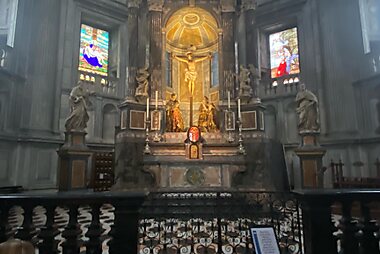



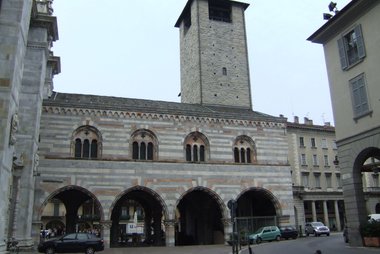
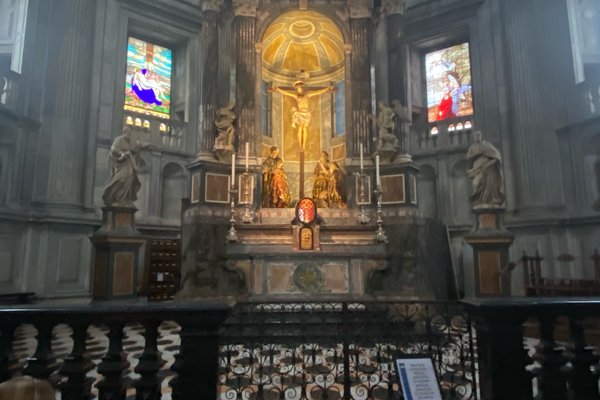
Duomo di Como took more than 350 years to build, from 1396 to 1770. The result mixes Gothic, Renaissance and Baroque styles. Look for the statues of the two Plinys beside the main door, then step inside to see the tapestries and the high dome.
Next door, Broletto was Como's town hall from 1215. Its facade is striped in white, grey and red marble.
The Como-Brunate Funicular has climbed from the lakefront to Brunate since 1894. The ride takes about seven minutes, and the terraces at the top look straight down over the city and the lake.
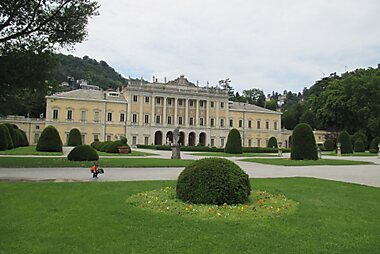
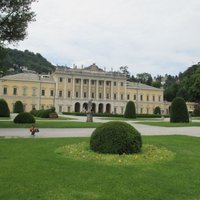
Villa Olmo is a neoclassical villa built between 1797 and 1812, now owned by the city. Its lakeside garden is free to enter, and the villa itself opens for exhibitions.
Lino Gelpi Promenade is the lakeside path that links the city centre with Villa Olmo. It is flat and shaded in places, with views across the water to Brunate.
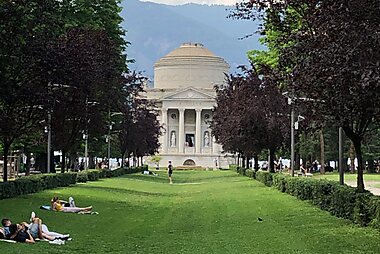
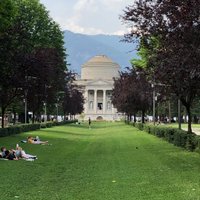
Tempio Voltiano is a small domed museum on the lakefront, opened in 1928. It holds Alessandro Volta's original instruments, including early versions of his battery.
Basilica di Sant'Abbondio is a Romanesque church consecrated in 1095, a short walk south of the walls. Its two bell towers and its 14th-century apse frescoes make it the city's finest old church.
ex Casa del Fascio is a key building of Italian Rationalism, designed by Giuseppe Terragni and finished in 1936. It is still used by the Guardia di Finanza, so you see it from the square behind the cathedral.
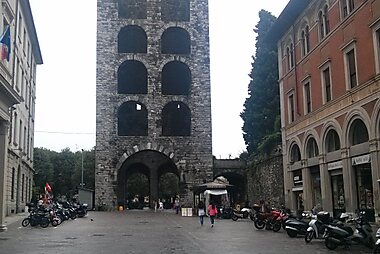
Within the walls, Basilica di San Fedele is a Romanesque church in a small square, and Porta Torre is the 40-metre gate tower of 1192 that once guarded the road to Milan.
Featured Lists
What to experience
Some of the best moments in Como happen on the water or above it.
- Take a boat along the lake: even a short trip to Cernobbio and back shows the villas from the water, which is how they were built to be seen.
- Walk to the end of the breakwater: at the end of the Diga Foranea pier stands The Life Electric, a steel sculpture by Daniel Libeskind in honour of Volta. The view back to the city is one of the best in Como.
- Join the evening passeggiata: in the early evening, local people walk the lakefront between Piazza Cavour and Villa Olmo, then stop for an aperitivo. Join them for an hour.
- Skate at the Christmas festival: from late November to early January, the Città dei Balocchi festival brings an ice rink, light shows and market stalls to the old town and the lakefront.
- Hike to Castello Baradello: a steep path climbs from the south of the city to Castello del Baradello, a tower rebuilt by Frederick Barbarossa in 1158, with wide views over Como and the plain.
Tours & Activities
Como — Map

Day trips
Boats, buses and trains from Como reach most of the lake and the nearby cities in an hour or less.
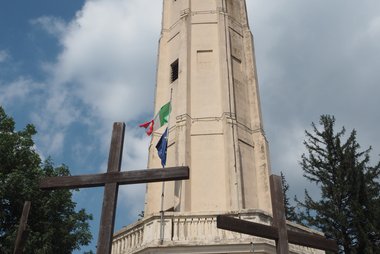
- Brunate is 7 minutes up by funicular. Walk about 30 minutes further to Faro Voltiano, a lighthouse built in 1927 for the centenary of Volta's death, with views over the lake and the Alps.
- Cernobbio is the first village up the western shore, about 15 to 20 minutes by bus or boat. It is known for its lakefront and for the grand Villa d'Este hotel.
- Bellagio sits on the point where the lake divides into its three arms. It takes about 45 minutes by fast boat or about 1 hour by the C130 bus, and longer by slow boat.
- Tremezzina, with the gardens of Villa Carlotta, and Menaggio are on the western shore. The C110 bus takes about an hour to Menaggio.
- Varenna is a pretty village on the eastern shore. Take the boat to Bellagio and then the short ferry across the lake; allow about 1 hour 15 minutes or more each way.
- Lugano, the Swiss lakeside city, is about 40 minutes away by direct train from Como San Giovanni. Bring your passport or ID card.
- Milan is about 40 minutes by train from Como San Giovanni, easily done as a day trip.
Where to explore
Como is the gateway to the lake and an easy base for the rest of Lombardy.
Getting there
- By air: Milan Malpensa is the most practical airport. Take the Malpensa Express to Saronno (about 18 minutes) and change to a Trenord train to Como Lago. Allow 1 to 1.5 hours in total. From Milan Linate, take metro M4 to San Babila, change to M1 for Cadorna, and take a Trenord train to Como Lago.
- By train from Milan: trains from Milano Centrale reach Como San Giovanni in about 40 minutes, roughly every hour. Trenord trains from Milano Cadorna reach Como Lago, by the lakefront, in about 50 to 60 minutes, about every 30 minutes. Trenord
- By train from Switzerland: regional TILO trains and EuroCity trains link Como San Giovanni with Chiasso and Lugano, about 40 minutes to Lugano.
- Stations: Como San Giovanni is about a 15-minute walk from the lake, down the hill. Como Lago is right by the waterfront.
Getting around
- On foot: the walled old town and the lakefront are compact and flat. Most sights are within a 15-minute walk of Piazza Cavour.
- City buses: ASF Autolinee runs the city and lake buses. Tap a contactless bank card or phone on the green validator when you board. A city ticket costs €2 for 90 minutes. ASF Autolinee – pay on board
- Lake buses: the C110 runs up the western shore to Menaggio, and the C130 goes to Bellagio. Buses leave from the bus station by Como Lago and from Como San Giovanni.
- Boats: ferries and hydrofoils leave from the pier in front of Piazza Cavour. On most boats you can tap a contactless bank card or phone on the validator on board, with no extra fee. Tell the crew first, and tap out when you leave the boat. Fast boats and reduced fares need a ticket from the office. Navigazione Laghi
- Funicular: the Como-Brunate Funicular leaves from Piazza Alcide De Gasperi, at the eastern end of the lakefront.
Driving
- Is a car worth it?: not for the city. Trains, boats and buses cover the city and the lake well. The narrow lakeside roads are slow and crowded in summer, and parking in the lake villages is scarce.
- Parking: the walled centre is a restricted traffic zone (ZTL) watched by cameras. Leave the car in one of the large paid car parks just outside the walls, or at your hotel if it offers parking.
- Restrictions: do not drive into the ZTL unless your hotel registers your number plate. Fines arrive by post, even for rental cars.
Food & drink
Como's food comes from the lake and the hills. Look for missoltini (salted and dried shad, usually grilled and served with polenta), perch fillets fried in butter and sage with risotto, and polenta with local cheeses in the colder months.
The best area to eat is the old town inside the walls. The streets around Piazza San Fedele and Via Vittorio Emanuele II have many small restaurants, cafés and wine bars. Lakefront restaurants have the views, but often charge more for less. Aperitivo hour, from about 6 to 8 pm, is popular in the bars around the cathedral.
Safety & health
Como is a safe city. The main risks are pickpockets on crowded boats, at the funicular and at the stations in summer, so keep valuables in a closed bag.
The lakefront by Piazza Cavour can flood after very heavy rain. Paths to Brunate and Castello Baradello are steep; wear proper shoes. The lake water is cold and has boat traffic, so swim only at the official lidos.
History
The Romans moved Como to its present site in the 1st century BC and named it Novum Comum. The street grid of the old town still follows the Roman plan. You can see the remains of the Roman baths at Terme Romane, which sit under a multi-storey car park.
In the Middle Ages, Como was an independent city and a rival of Milan. After a ten-year war, Milan destroyed the city in 1127. Emperor Frederick Barbarossa then helped Como rebuild. The town added new walls and the gate tower Porta Torre, and Barbarossa rebuilt the hilltop Castello del Baradello. Broletto was built in 1215 as the seat of the free city's government.
From 1335, Como came under Milan's rule. In the 1400s the new cathedral rose next to the old town hall. In the 18th and 19th centuries, silk and science shaped the city. Alessandro Volta was born here in 1745 and invented the electric battery. Como's silk mills grew into one of the world's leading silk industries. In the 1930s, architect Giuseppe Terragni gave the city some of Italy's most important modern buildings.
Country facts
Quick practical facts for Italy at a glance:
- Currency
- Euro EUR € · Card payments · Widely accepted
- Emergency numbers
- 112
- Electricity
- 230 V · 50 HzType C / Type F / Type L
- Languages
- Italian
- Tap water
- Safe to drink
- Driving side
- Right
- Calling code
- +39
Como – Plan Your Days
Turn the places from this guide into a real itinerary, with smart routing, time estimates, and everything you need for a perfect trip.


Related destinations




Data: © OpenStreetMap contributors, Wikidata, Wikipedia, Tripomatic, Official websites, geoBoundaries (CC BY 4.0). Tours by GetYourGuide. We earn commission from bookings. Travel guide generated with AI.