



Genoa
Genoa was one of the great sea powers of the Mediterranean, and it still feels like a working port city. Its medieval old town is one of the largest in Europe, a maze of narrow lanes called caruggi that run down to the harbour. Above them stand the marble palaces of the city's banking families, now a UNESCO World Heritage Site.
Genoa suits travelers who like history, art and good food without big crowds. The city climbs steep hills, so lifts and funiculars are part of daily life. It is the birthplace of pesto and focaccia, and the fishing villages and beaches of the Riviera are a short train ride away. Christopher Columbus and the violinist Niccolò Paganini were both born here.
Download this guide as a PDFPrintable tourist mapPublic holidays in Italy

Genoa – Planning a Trip?
Build your day-by-day itinerary in the Tripomatic app.


When to visit
May, June and September are the best months, with warm days and calm seas. July and August are hot and humid, but good for swimming. October and November bring the heaviest rain, sometimes with sudden storms and floods. Winter is mild and quiet, a good time for museums.
The biggest yearly event is the Genoa International Boat Show (Salone Nautico), held in late September or early October. It is one of the largest boat shows in Europe, and hotels fill up and prices rise during it.
Best time to visit: May, June, September
Top sights
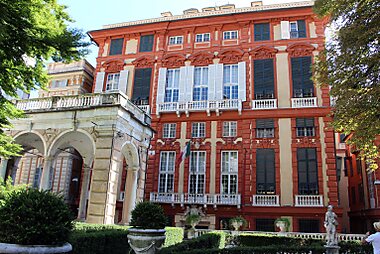
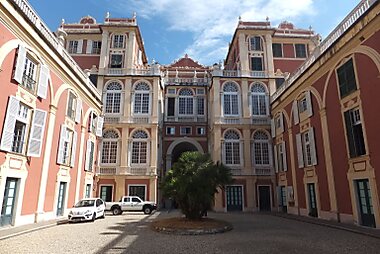
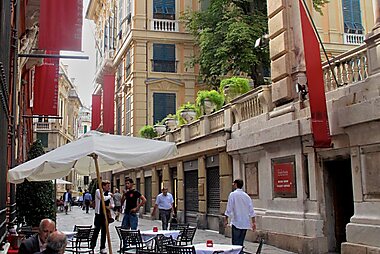
Via Garibaldi is the most beautiful street in Genoa, lined with 16th-century palaces built by the city's richest families. It is the heart of the UNESCO-listed Strade Nuove and Palazzi dei Rolli.
Palazzo Rosso, Palazzo Bianco and Palazzo Tursi face each other on this street and form the Strada Nuova Museums. One ticket covers all three. Inside are paintings by Van Dyck, Rubens and Caravaggio, and Palazzo Tursi, the city hall, keeps a violin that belonged to Paganini.
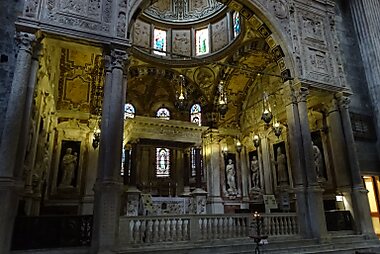
Cattedrale di San Lorenzo has a striped black-and-white marble front and a rich treasury below. Inside you can see a British naval shell that hit the church in 1941 and did not explode.
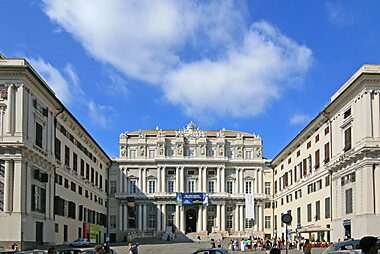
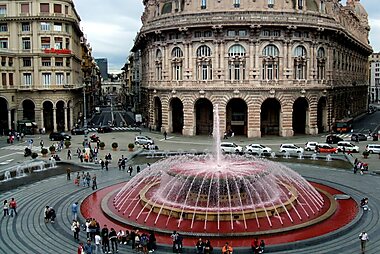
Palazzo Ducale was the seat of the Doges of Genoa and now hosts big art exhibitions. It stands next to Piazza De Ferrari, the city's main square, with its large bronze fountain.
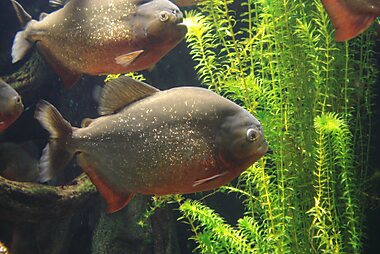
In the old harbour, rebuilt by Renzo Piano for Expo 1992, Aquarium of Genoa is the largest aquarium in Italy, with dolphins, sharks, seals and penguins.
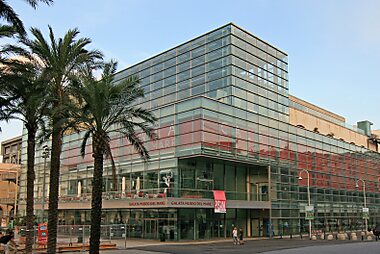
Galata Museo del Mare is the largest maritime museum in the Mediterranean. Highlights are a full-size 17th-century galley, an exhibition on Italian emigration and a real submarine moored outside.
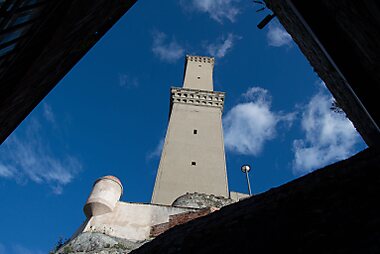
Lanterna di Genova is the symbol of the city and the tallest lighthouse in the Mediterranean, 77 metres high on a rock above the port. It usually opens from Friday to Sunday. Visitors are usually taken there by a shuttle bus from Piazzale San Benigno. A small museum sits at its base, and you can climb 172 steps to the first terrace.
Cimitero Monumentale di Staglieno is one of the largest cemeteries in Europe and an open-air museum of marble sculpture. Giuseppe Mazzini and the singer Fabrizio De André are buried here.
Featured Lists


What to experience
Genoa's best moments come from its hills, its harbour and its old merchant life.
- Ride the lifts and funiculars: take the Castelletto lift up to the Spianata Castelletto terrace for a wide view over the roofs and the port. The Zecca–Righi funicular climbs higher, and from Righi paths lead to the old forts on the hills.
- Rolli Days: on a few weekends each year, many of the private Rolli palaces open their doors to the public, often with free guided visits.
- Spin above the port: the Bigo cabin rises about 40 metres while turning a full circle over Porto Antico.
- Sunset at the sea: walk the Corso Italia promenade to Boccadasse with an ice cream, or follow the cliff path in Nervi in the evening light.
- Whale watching: in summer, boats leave the old port to look for whales and dolphins in the protected Pelagos Sanctuary offshore.
Tours & Activities
Genoa — Map

 Open the interactive map
Day trips
Genoa sits in the middle of the Ligurian coast, so trains make it easy to reach the Riviera. Here are the best options, from closest to farthest.
- Sanctuary in the hills (≈35 min by car, about 1 h by bus): Santuario di Nostra Signora della Guardia stands on a mountain top above the Polcevera valley, with views over the coast.
- Riviera villages (≈30–45 min by train): Camogli is a colourful fishing town, and Santa Margherita Ligure is an elegant resort. From there, a short bus or boat ride takes you to Portofino. Boats also reach the abbey of San Fruttuoso, which you cannot reach by road.
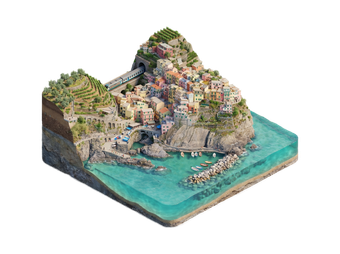
- Cinque Terre (≈1.5 h by train): the five cliff villages of Cinque Terre are a UNESCO World Heritage Site, linked by train and hiking paths. Go early to avoid the crowds.
- Western Riviera (≈2 h by train): Sanremo is a flower town with a casino and a long seafront.
Where to explore
Genoa is the capital of Liguria, a narrow strip of coast between the mountains and the sea.
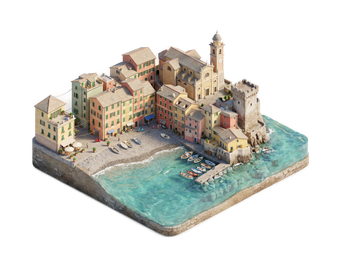
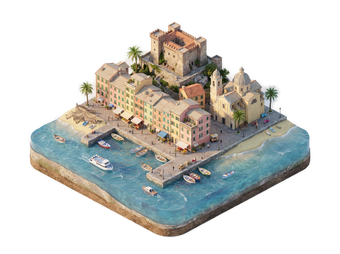
- East along the coast: Camogli, Santa Margherita Ligure and Portofino sit on the Portofino promontory. Farther east, Punta Manara is a headland with walking paths, and Cinque Terre is Liguria's most famous stretch of coast.
- West along the coast: Sanremo is the main town of the Riviera of Flowers.
- Big cities nearby: Milan and Turin are each about 1.5–2 hours away by train.
Getting there
- By air: Genoa Cristoforo Colombo Airport is about 6 km west of the centre, right on the sea. The Volabus airport bus runs to Principe and Brignole stations in about 30 minutes. You can pay on board with a contactless bank card, which buys a 24-hour AMT ticket that also covers city transport. Many travelers also fly to Milan and continue by train. Genoa Airport
- By train: Genoa has two main stations, Piazza Principe in the west and Brignole in the east. Direct trains reach Milan and Turin in about 1.5–2 hours, and run along the coast to Pisa, Rome and the French border. Trenitalia
- By ferry: Ships leave the ferry terminal near Principe station for Sardinia, Corsica, Sicily, Spain and North Africa.
Getting around
- Tickets: One AMT ticket is valid for 110 minutes on city buses, the metro, the funiculars and the public lifts. Buy it in the AMT app, at metro machines or at tobacconists, and validate it at the start of your trip. You can also tap a contactless bank card at ILA ticket points at main stops, but regular city buses have no card readers on board. AMT Genova
- Metro: One line runs from Brin through Principe and De Ferrari to Brignole. It is useful for crossing the centre quickly.
- Lifts and funiculars: Public lifts and funiculars climb the steep hills. The Castelletto Levante Elevator and the Zecca–Righi funicular are the most useful for visitors and give good views.
- Trains: Local trains are the fastest way to the seaside districts. Nervi, in the east, has the Parchi di Nervi and a cliff-top promenade. Pegli, in the west, has the romantic gardens of Villa Durazzo Pallavicini.
- On foot: The old town is compact and best seen on foot, but many streets are steep or have long stairways. The narrow lanes are often too tight for any traffic.
- Cycling: Hills and heavy traffic make cycling hard. The flat seafront of Corso Italia is the exception.
Driving
- Is a car worth it?: No for the city. Streets are narrow, steep and busy, and trains reach the Riviera faster than the coastal roads. A car helps only for the inland hills.
- Parking: Paid street parking (Blu Area) covers the centre; pay at machines or with a parking app. Large car parks near Porto Antico and the stations are easier for a short stay.
- Restrictions: The historic centre is a limited traffic zone (ZTL) watched by cameras. Do not drive into it unless your hotel registers your car.
Food & drink
Genoa is the home of pesto alla genovese, made with basil, pine nuts, garlic, cheese and olive oil. Try it with trofie or trenette pasta. Other local dishes are focaccia (soft, oily flatbread eaten for breakfast too), farinata (a thin chickpea pancake), pansoti (filled pasta with walnut sauce) and fried fish. Focaccia dipped in a morning cappuccino is a local habit.
The best eating is in the old town. Small bakeries, friggitorie (fried food shops) and old trattorias fill the lanes behind the Sottoripa arcades near the port. The Mercato Orientale, a large covered market on Via XX Settembre, is the place for local produce and street food.
Safety & health
Genoa is generally safe for tourists. Pickpockets work on crowded buses, at the stations and around Porto Antico, so keep bags closed.
Some lanes of the old town, especially the area west of Via San Luca towards Prè and the port, can feel rough late at night. After dark, stay on the busier streets. Tap water is safe to drink. In autumn, heavy rain can cause sudden floods, so follow local weather warnings.
History
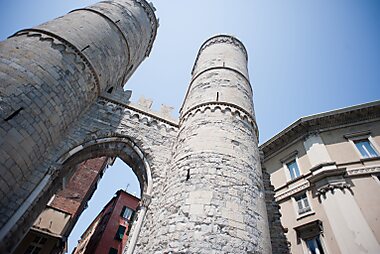
Genoa grew rich as an independent sea republic. In the Middle Ages its ships and merchants traded across the Mediterranean and the Black Sea. The city walls of 1155 still stand at Porta Soprana, a twin-towered gate near the house where Christopher Columbus is said to have grown up.
Trade turned the Genoese into Europe's bankers. The Bank of Saint George, one of the world's first banks, worked from Palazzo San Giorgio by the port. In 1576 the republic created the Rolli, official lists of the best private palaces, whose owners had to host visiting kings and ambassadors. Many of these palaces line Via Garibaldi today.
The republic ended in 1797, and Genoa later became part of the Kingdom of Sardinia and then Italy. The city was heavily bombed in the Second World War. In 1992 the city marked 500 years since Columbus's voyage with an Expo that turned the old docks into Porto Antico.
Country facts
Quick practical facts for Italy at a glance:
- Currency
- Euro EUR € · Card payments · Widely accepted
- Emergency numbers
- 112
- Electricity
- 230 V · 50 HzType C / Type F / Type L
- Languages
- Italian
- Tap water
- Safe to drink
- Driving side
- Right
- Calling code
- +39


Genoa – Plan Your Days
Turn the places from this guide into a real itinerary, with smart routing, time estimates, and everything you need for a perfect trip.


Related destinations


Data: © OpenStreetMap contributors, Wikidata, Wikipedia, Tripomatic, Official websites, geoBoundaries (CC BY 4.0). Tours by GetYourGuide. We earn commission from bookings. Travel guide generated with AI.
Plan your trip with Tripomatic
- AI-Powered PlanningLet AI build your itinerary, answer travel questions, and file your booking documents into your trip.
- Travel AlertsOfficial advisories, severe weather, strikes, and natural hazards for the places on each day of your trip.
- Public Holidays & EventsSee holidays, festivals, and closures on the days of your trip, and what they mean for your plans.
- Cost EstimationAI-powered trip cost breakdowns so you know what to budget before you go.
- Tours & TicketsBook tours, skip-the-line tickets, and activities directly in your plan.