


Turin
Turin was the capital of the House of Savoy for centuries and became the first capital of united Italy in 1861. The city still shows this royal past in its straight Baroque streets, grand squares and long arcades. It is calmer and less crowded than Milan, Venice or Florence, but it has some of Italy's best museums.
Turin suits travelers who like museums, architecture, coffee and food. It is the home of Fiat and the Juventus football club, and it is the place where vermouth and the gianduiotto chocolate were born. On clear days the snowy Alps rise behind the city, and the Langhe wine hills are about an hour away.

Turin – Planning a Trip?
Build your day-by-day itinerary in the Tripomatic app.


When to visit
Spring and autumn are the best seasons, with mild days for walking and clear views of the Alps. Summer is hot and humid, and many locals leave in August, so some shops and restaurants close. Winter is cold and often foggy, but the city's indoor museums and cafés make it a good season for a short break.
The biggest yearly event is the ATP Finals tennis tournament in November, when the world's top eight players compete and hotels fill up early. In May the Salone del Libro, Italy's largest book fair, also draws big crowds.
Best time to visit: September, October
Top sights


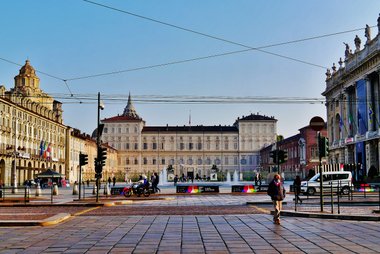


Egyptian Museum is the oldest museum in the world devoted only to ancient Egypt, founded in 1824. It is the most important Egyptian collection outside Cairo. Allow at least three hours, and book ahead at weekends.
Mole Antonelliana is the symbol of Turin, a 167-metre tower first planned as a synagogue. Inside, National Cinema Museum fills the hall with film sets and posters, and a glass lift rises to a viewing terrace with views of the Alps.
Royal Palace of Turin was the main home of the Savoy kings. One ticket also covers the Royal Armoury, the Galleria Sabauda of old master paintings and Guarini's Chapel of the Holy Shroud, which reopened in 2018 after a fire. The Royal Gardens behind the palace are free to enter.
Piazza Castello is the heart of the city. In the middle of the square, Palazzo Madama was built over a Roman gate. It has a Baroque front by Filippo Juvarra and holds the city museum of ancient art.
Cathedral of St John the Baptist keeps the famous Shroud of Turin, which is shown to the public only on rare occasions.
Piazza San Carlo is the city's elegant main square, with twin Baroque churches and historic cafés under the arcades.
Valentino Park runs along the Po and holds the Valentino Castle, a Savoy residence, and the Borgo Medievale, a copy of a medieval village built for an 1884 exhibition.
Basilica of Superga stands on a hill above the city and holds the tombs of the Savoy family. It has one of the widest views over Turin and the Alps.
The National Automobile Museum, south of the centre, tells the story of the car in a city shaped by Fiat.
Featured Lists


Historic Churches of Turin
Turin’s religious landscape spans centuries, featuring architectural styles from the 17th-century Baroque of the hilltop Basilica of Superga to the modern industrial-inspired Santo Volto. The collection includes the Neoclassic Gran Madre di Dio on the Po riverbanks and historic neighborhood sanctuaries like the Madonna del Pilone. These sites serve as both spiritual centers and historical landmarks, reflecting the city’s evolution through various artistic eras and the enduring influence of the Catholic Church in the Piedmont region.
20 places
Monuments and Artworks of Turin
Turin's urban landscape is defined by its collection of public art and historical commemorations. This list features iconic landmarks like the Fontana Monumentale dei Dodici Mesi in Valentino Park and the towering monument to Vittorio Emanuele II. From 19th-century bronze statues of Italian unification heroes to modern memorials honoring workers and local communities, these sites reflect the city's military history, political evolution, and architectural diversity.
19 places
Torino's Parks and Gardens
Torino’s green spaces range from the expansive Parco della Rimembranza on the hills to specialized venues like Parco Arte Vivente, a contemporary art center. Large urban parks like Parco Pietro Colletta offer over 400,000 square meters of space, while Parco Rignon provides accessible paths in the Santa Rita district. These gardens reflect the city's urban planning history, featuring diverse landscapes from riverside stretches along the Sangone to neighborhood gardens like Luigi Chignoli.
11 placesWhat to experience
Turin has its own rituals, built around café life, the river and the hills.
- Bicerin in its birthplace: try this layered drink of espresso, hot chocolate and milk at Caffe Al Bicerin, a tiny café that has served it since the 18th century.
- Sunset from Monte dei Cappuccini: cross the Po and climb to Monte dei Cappuccini for the classic view of the city with the Alps behind.
- Luci d'Artista: from late autumn into winter, light installations by contemporary artists hang over the streets and squares of the centre.
- A summer evening on the Murazzi: the old riverside arches below Piazza Vittorio Veneto fill with bars and people on warm nights.
Tours & Activities
Turin — Map

Day trips
Turin is a good base for royal palaces, mountain abbeys and Piedmont's wine country. Here are the best options, from closest to farthest.
- Palazzina di Caccia di Stupinigi (≈30 min by car, longer by bus): an elegant Savoy hunting lodge by Filippo Juvarra, with a bronze stag on its roof.
- Venaria Reale (≈30–40 min by bus or car): the Palace of Venaria is a vast Baroque royal residence, with huge gardens and the bright Galleria Grande.
- Sacra di San Michele (≈1 h by car, or train to Sant'Ambrogio di Torino and a steep walk): a medieval abbey on a rocky peak above the Susa Valley. It is the symbol of Piedmont and helped inspire The Name of the Rose.
- Wine country (≈1–1.5 h by car or train): Alba and the Langhe hills are a UNESCO World Heritage Site. Alba is famous for white truffles in autumn, and Barolo gives its name to one of Italy's great red wines.
- A big-city day (≈1 h by high-speed train): Milan is Italy's fashion and business capital.
- The Alps (≈1.5–2 h by car): Sestriere is a ski resort that hosted events of the 2006 Winter Olympics, good for skiing in winter and hiking in summer.
Where to explore
Turin is the capital of Piedmont, and many of the region's best places are easy to add to a stay.
- Wine country: Alba and Barolo lie in the Langhe hills to the south-east, known for truffles and red wine.
- Mountains: Sestriere is the main ski resort west of the city, and Aosta is a Roman town in the Alps to the north.
- Other cities: Milan is about an hour away by fast train, and Genoa on the coast is about two hours by train.
Getting there
- By air: Turin Airport (Caselle) is about 16 km north of the city. A train runs to Porta Susa station in about 30 minutes, and buses run to Porta Nuova and Porta Susa in about 45–50 minutes. Many travelers also fly into Milan Malpensa Airport and continue by bus or train.
- By train: Turin has two main stations, Porta Nuova and Porta Susa. High-speed Frecciarossa and Italo trains reach Milan in about 1 hour and continue to Bologna, Florence and Rome. Direct trains also run to Lyon and Paris through the Alps. Trenitalia
- By bus: Long-distance coaches stop at the bus terminal on Corso Vittorio Emanuele II and connect Turin with other Italian cities and with France.
Getting around
- Metro: One driverless metro line links Porta Susa, Porta Nuova and Lingotto. Every station has a gate where you can tap a contactless bank card or phone to pay; one tap covers one metro entry. A single ticket is valid for 100 minutes on the whole urban network.
- Trams and buses: GTT runs a dense network of trams and buses. Contactless payment is accepted on many GTT lines; otherwise, buy a ticket from tobacconists, newsstands, machines or the GTT app before you board. GTT
- On foot: The centre is flat, compact and built on a grid. About 18 km of arcades let you walk in the shade or out of the rain.
- Cycling: Bike lanes follow the Po and cross the large parks. Busy main roads make cycling in the centre less relaxing.
- Superga: A historic rack tramway climbs from Sassi to the basilica in about 18 minutes. It does not run every day, so check the timetable first.
Driving
- Is a car worth it?: No for the city itself; the centre is walkable and well served by trams and the metro. A car is useful for the Langhe wine hills and the Alps.
- Parking: Paid street parking (blue zones) covers the centre and nearby streets, at about €1.20–2.80 per hour. Pay at machines, with a parking app or with vouchers from tobacconists. Underground car parks are a simpler choice for a hotel stay.
- Restrictions: The central ZTL (limited traffic zone) is closed to most cars Monday to Friday, 7:30–10:30, and cameras issue fines. Some central streets are for public transport only at other times too.
Food & drink
Piedmont has one of Italy's richest kitchens. In Turin look for agnolotti del plin (small filled pasta), vitello tonnato (cold veal with tuna sauce), bagna càuda (a hot garlic and anchovy dip) in winter, and bollito misto (mixed boiled meats). Grissini, the thin breadsticks, were born here. The city is also famous for chocolate, especially the gianduiotto, made with hazelnuts.
For good eating, start at Porta Palazzo Market, a huge open-air market at Piazza della Repubblica with stalls for fruit, cheese and street food. The Quadrilatero Romano, the old streets around Via Sant'Agostino, is full of trattorias and wine bars. The historic cafés around Piazza San Carlo and along Via Po are the place for coffee and pastries.
Safety & health
Turin is a safe city for tourists. The main risk is pickpocketing on crowded trams, in busy markets and around Porta Nuova station. Keep bags closed and valuables out of reach in these places.
Some areas near the stations and parts of the riverbank are quiet and less pleasant late at night, so use main streets after dark. Tap water is safe to drink, and the city's green public fountains (torèt) give free drinking water.
History
Turin began as the Roman town of Augusta Taurinorum. The old street grid still follows the Roman plan, and you can see the Roman city gate at Porta Palatina.
In 1563 Duke Emanuele Filiberto made Turin the capital of the Savoy state. The dukes, and later kings, built the palaces and Baroque streets around Piazza Castello. In 1706 a French army besieged the city for 117 days but failed to take it. Duke Victor Amadeus II thanked the Virgin Mary for the victory by building the Basilica of Superga on the hill above.
Turin led the unification of Italy and was its first capital from 1861 to 1865. The parliament of the Kingdom of Sardinia met in Palazzo Carignano, which now holds the national Museum of the Risorgimento. In 1899 Fiat was founded here, and the city became Italy's car capital. Today the old Lingotto factory, with a test track on its roof, is a shopping and exhibition centre, and the city hosted the 2006 Winter Olympics.
Country facts
Quick practical facts for Italy at a glance:
- Currency
- Euro EUR € · Card payments · Widely accepted
- Emergency numbers
- 112
- Electricity
- 230 V · 50 HzType C / Type F / Type L
- Languages
- Italian
- Tap water
- Safe to drink
- Driving side
- Right
- Calling code
- +39


Turin – Plan Your Days
Turn the places from this guide into a real itinerary, with smart routing, time estimates, and everything you need for a perfect trip.


Related destinations


Data: © OpenStreetMap contributors, Wikidata, Wikipedia, Tripomatic, Official websites, geoBoundaries (CC BY 4.0). Tours by GetYourGuide. We earn commission from bookings. Travel guide generated with AI.