



Gherdëina - Grödnertal - Val Gardena
Val Gardena sits in the Dolomites of South Tyrol, in northern Italy. Ladin speakers call it Gherdëina; German speakers call it Grödnertal. The valley holds three villages — Ortisei, Santa Cristina, and Selva di Val Gardena — surrounded by some of the most photographed peaks in the Alps. The Dolomites here are a UNESCO World Heritage site.
The valley works well for skiers in winter and hikers in summer, with cable cars that turn steep mountain terrain into an easy day out for families too. It also keeps a centuries-old wood-carving tradition alive, and Ladin, a language older than Italian or German in this valley, is still spoken and taught in local schools. Luis Trenker, the filmmaker, mountaineer, and architect, was born in Ortisei and remains the valley's best-known son.

Gherdëina - Grödnertal - Val Gardena – Planning a Trip?
Build your day-by-day itinerary in the Tripomatic app.


When to visit
Winter (December to March) is cold and reliably snowy, built around skiing. Summer (June to September) is mild and sunny, best for hiking. Spring and late autumn are quiet shoulder seasons when many cable cars and hotels close.
Plan around Sella Ronda Bike Day in June, when the four mountain passes around the valley close to cars for a day and fill with cyclists instead — one of the best times to experience the high passes without traffic.
Summer days are warm and sunny with a real chance of afternoon thunderstorms; pack a rain layer even in July and August. Winter nights drop well below freezing, so dress for genuine cold, not just "chilly."
Top sights
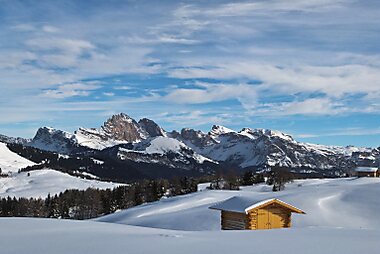


Seceda is one of the most photographed viewpoints in the Dolomites, a jagged ridge at 2,519 m reached by cable car from Ortisei. The panorama over the Odle peaks is why most visitors ride up.
Alpe di Siusi - Seiser Alm is the largest high-altitude Alpine meadow in Europe, a rolling, mostly car-free plateau reached by cable car from Ortisei. It's easy walking in summer and open for sledging and cross-country skiing in winter.
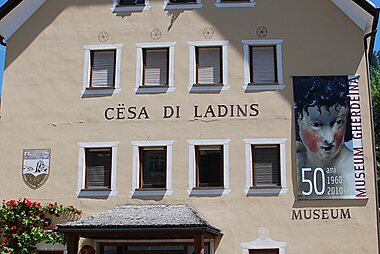
Museum Gherdëina covers the Ladin culture and history of the valley, including the wood-carving craft the region is famous for.
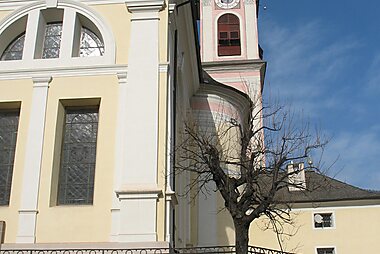
Ortisei Parish Church anchors the center of Ortisei, its onion-domed bell tower visible from much of the valley floor.
Passeggiata Luis Trenker is a gentle walking promenade named after the Ortisei-born filmmaker and mountaineer, with open mountain views the whole way.
Chiesa di San Giacomo is one of the valley's oldest churches, a quiet spot away from the main streets that few visitors seek out.
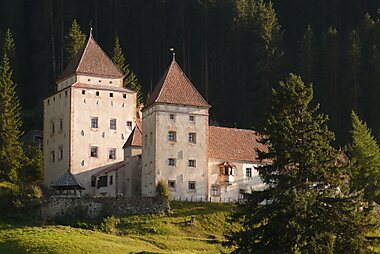
Castel Gardena - Fischburg is a 17th-century castle near Selva di Val Gardena that once served as a count's summer and hunting lodge.
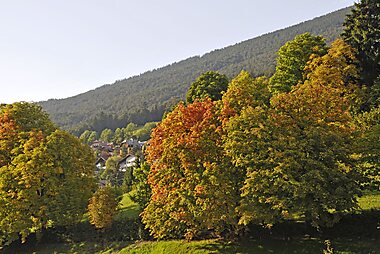
Tervela is a short walk from the villages, a good easy stop if you want a look at moving water and green woods between bigger outings.
Featured Lists


What to experience
- Ski or ride the Sella Ronda in winter, a circuit of four mountain passes linking Val Gardena to three neighboring valleys, doable in a single day on a lift pass.
- Walk, snowshoe, or cross-country ski through Vallunga, a flat, car-free side valley near Selva.
- Watch a woodcarver shape a sculpture in one of Ortisei's small workshops, a craft this valley has practiced for centuries.
- Look out for a Ladin festival with traditional costume in summer, when the valley celebrates its own culture rather than its tourist season.
Tours & Activities
Gherdëina - Grödnertal - Val Gardena — Map

 Open the interactive map
 Day trips
Val Gardena sits close to several other South Tyrol highlights, and one mountain pass drive alone is worth a day.
- Bressanone — ≈35 min by car or bus. A historic town with a pastel-colored old town and a centuries-old cathedral.
- Corvara in Badia — ≈35–40 min by car over the Gardena Pass. The main village of Alta Badia, another Ladin valley, with one of the best mountain-pass drives in the Dolomites along the way.
- Bolzano — ≈45 min by car or bus. South Tyrol's capital, home to the Ötzi the Iceman mummy at the South Tyrol Museum of Archaeology.
- Braies — ≈1–1.5 hours by car. Home to Lake Braies, an emerald-green alpine lake ringed by cliffs; arrive early, since the small parking area fills fast in summer.
- Tre Cime di Lavaredo — ≈1.5–2 hours by car. Three sheer rock towers and one of the most recognizable views in the Dolomites, worth the longer drive if you have a full day.
Where to explore
Val Gardena is made up of three villages, each with a slightly different character.
- Ortisei is the largest and the main gateway, with cable cars up to Seceda and the Alpe di Siusi, plus most of the shops and museums.
- Santa Cristina sits in the middle of the valley, quieter than its neighbors and a good base if you want easy access both ways.
- Selva di Val Gardena is the highest and farthest up the valley, closest to the Sella Ronda passes and the Sella and Langkofel mountain groups.
Getting there
- By air: Innsbruck and Verona are the closest airports with regular scheduled flights, each roughly 1.5–2.5 hours away by car or transfer bus; Venice and Munich have more frequent connections but add another hour or so of travel. Bolzano's own airport has very limited scheduled service.
- By train: there's no railway in the valley itself. Take a train to Chiusa or Ponte Gardena on the Bolzano–Bressanone line, then a local bus up into the valley, about 20–30 minutes.
- By bus: SAD regional buses run from the train stations at Bolzano and Bressanone directly to Ortisei, Santa Cristina, and Selva di Val Gardena.
Getting around
- Public transit: the valley bus (SAD) connects Ortisei, Santa Cristina, and Selva di Val Gardena frequently throughout the day. Buy single tickets on board or get a Val Gardena guest card from your accommodation, which often includes free bus travel.
- Cable cars and lifts: a dense network of cable cars, gondolas, and chairlifts links the villages to the ski slopes and hiking trails above; the winter ski pass and some summer guest cards cover a number of them.
- Taxi: limited outside hotel transfers; most visitors rely on the bus or cable cars instead.
- On foot / cycling: village centers are compact and easy to walk, especially Ortisei's pedestrian main street. A paved cycle path runs the length of the valley floor connecting all three villages.
Driving
- Is a car worth it?: not essential within the valley — buses and cable cars cover the villages and slopes — but useful for day trips and for driving the mountain passes yourself.
- Parking: paid car parks sit at the edges of each village; central streets are largely closed to non-resident traffic in peak season.
- Restrictions: the four passes around the valley close to motor vehicles for a day each June for Sella Ronda Bike Day; check the date before planning a drive that week.
Food & drink
Val Gardena's kitchens mix South Tyrolean and Ladin cooking: canederli (bread dumplings) in broth, speck, polenta, and turtres, a Ladin fried pastry stuffed with spinach or sauerkraut. Mountain huts (rifugi) along the hiking and ski trails serve simple, hearty versions of the same food and are often part of the experience of a day outside.
For a sit-down meal, look around Via Rezia in Ortisei, the main pedestrian street, where most of the valley's restaurants cluster.
Safety & health
Val Gardena is a very safe destination with little crime beyond watching your belongings in busy cable car queues. The real risks are the mountains themselves: weather changes fast at altitude, so carry warm and waterproof layers even in summer, and stay on marked trails and pistes. Skiing and hiking off-piste or off-trail carries avalanche and fall risk; check local conditions before heading out that way.
History
The valley has been Ladin-speaking for longer than it's been part of Italy or Austria — Ladin is a Rhaeto-Romance language, older here than German or Italian, and it's still taught in local schools alongside them. Wood carving grew out of long, snowbound winters, when farming families carved religious figures and toys to sell; by the 19th century, Gröden woodcarvings were being exported as far as the United States, a trade Museum Gherdëina traces in detail.
Castel Gardena - Fischburg, built in 1641, recalls a different era, when the valley's counts used it as a summer and hunting retreat rather than a year-round home. The mountains above the valley were also a front line in the First World War, when Austro-Hungarian and Italian troops fought for the high passes; some of the fortifications are still visible today for those who hike up to them.
Country facts
Quick practical facts for Italy at a glance:
- Currency
- Euro EUR € · Card payments · Widely accepted
- Emergency numbers
- 112
- Electricity
- 230 V · 50 HzType C / Type F / Type L
- Languages
- Italian
- Tap water
- Safe to drink
- Driving side
- Right
- Calling code
- +39


Gherdëina - Grödnertal - Val Gardena – Plan Your Days
Turn the places from this guide into a real itinerary, with smart routing, time estimates, and everything you need for a perfect trip.


Related destinations


Data: © OpenStreetMap contributors, Wikidata, Wikipedia, Tripomatic, Official websites. Tours by GetYourGuide. We earn commission from bookings. Travel guide generated with AI.