



Pardubice Region
The Pardubice Region lies in eastern Bohemia, one to two hours from Prague by train. It sees far fewer visitors than nearby regions, and that is part of its appeal. Instead of one big city, it offers a scatter of small historic towns, Renaissance chateaux, a UNESCO-listed horse stud, and the low wooded hills of the Iron Mountains — easy to piece together into a quiet, unhurried few days.
Pardubice, the regional capital, has been nicknamed ‘Perníkov’ (Gingerbread Town) for centuries of spiced honey gingerbread baking. Litomyšl was the birthplace of composer Bedřich Smetana, and Polička that of composer Bohuslav Martinů — a small region with an outsized place in Czech music history.

Pardubice Region – Planning a Trip?
Build your day-by-day itinerary in the Tripomatic app.


When to visit
Spring and autumn are mild and pleasant, summer is warm with occasional afternoon storms, and winter is cold with regular frost and some snow.
Plan around the Velká pardubická, the Grand Pardubice Steeplechase, held on the second Sunday of October at the Pardubice racecourse. First run in 1874, it is one of the toughest cross-country horse races in the world, and the whole town turns out for it.
Best time to visit: August
June to September is the most reliable stretch for exploring the region's towns and castles on foot.
Top sights
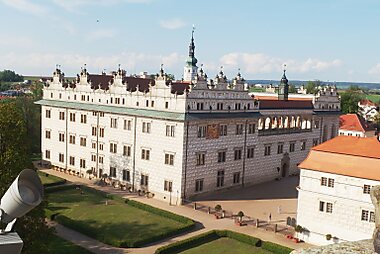


Litomyšl Castle is the region's grandest sight, a Renaissance arcaded chateau built from 1568 for the Pernstein family and inscribed as a UNESCO World Heritage Site in 1999. Its theater, tucked in the west wing, still has its original stage machinery and scenery intact.
Next to the chateau, Smetana's Birthplace preserves the brewery apartment where composer Bedřich Smetana was born in 1824, filled with his letters, scores, and personal belongings.
Kladruby National Stud is a working stud farm founded in 1579 by Emperor Rudolf II, among the oldest in Europe still breeding its original horse — the rare black and grey Kladruby horse, bred for imperial ceremonial carriages.
In central Pardubice, Zelená Brána is a 60-metre Renaissance gate tower, one of the few surviving pieces of the town's old fortifications; climb it for a view over the old town's rooftops.
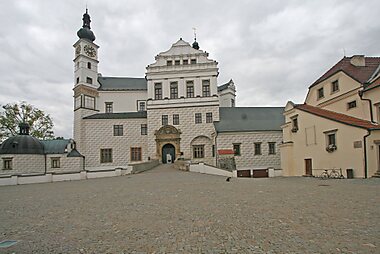
A short walk away, Pardubice Castle is a fortified Renaissance chateau rebuilt by nobleman Vilém II of Pernštejn around 1500, now home to the East Bohemian Museum's collections on regional history and archaeology.
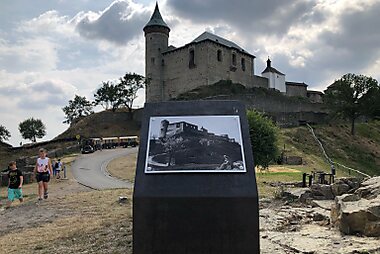
On a hilltop just outside the city, Kunětická Hora Castle is a Gothic castle burned by Swedish troops during the Thirty Years' War and rebuilt through the 20th century; its silhouette is visible for miles around and is the region's best-known landmark.
Featured Lists

What to experience
- Watch the Velká pardubická steeplechase in October, one of the toughest cross-country horse races in the world, when the whole town turns out for race day.
- Decorate your own gingerbread at Kingdom of Gingerbread in Pardubice, continuing the town's centuries-old nickname ‘Perníkov.’
- Watch a carriage-driving or dressage demonstration with the rare Kladruby horses at Kladruby National Stud.
- Cycle a flat stretch of the marked Elbe river route that runs through Pardubice and out into the surrounding countryside.
Tours & Activities
Pardubice Region — Map

Day trips
Beyond the sights above, these are worth a day out, listed roughly from closest to farthest.
- Slatiňany Chateau, about 20 minutes from Pardubice, is a chateau with a large English park and a museum devoted to the Kladruber horse, tying into the region's horse-breeding tradition.
- The Železné hory (Iron Mountains), roughly 30–45 minutes south of Pardubice, are a protected landscape of low wooded hills named for centuries of historic iron-ore mining, with marked hiking trails, the hilltop Rychmburk Castle, and the Seč reservoir near Seč, popular for swimming and boating in summer.
- Hradec Králové, about 35 minutes by train, is a compact city whose early-20th-century townscape was shaped by architect Josef Gočár, with Art Nouveau and Functionalist buildings along its riverside promenades.
- Kutná Hora, about an hour away in the neighboring region, is a UNESCO World Heritage silver-mining town, with a soaring Gothic cathedral and a chapel decorated entirely in human bones — a flagship day trip worth the longer drive.
Getting there
- By air: the nearest major airport is Václav Havel Airport Prague (PRG), about 90 km away; direct trains from Prague's main station reach Pardubice in a little over an hour.
- By train: Pardubice is a major rail junction with direct connections to Prague, Brno, and cities across the region, plus regional lines to Hradec Králové and Litomyšl.
- By bus: long-distance coaches connect Pardubice with Prague and other major Czech cities, though the train is faster and more frequent on this route.
Getting around
- Public transit: Pardubice's trolleybus and bus network (DPMP) covers the city center and suburbs. Buy a ticket from the driver, a ticket machine, or the operator's app, or tap a contactless bank card directly on board. Pardubice public transport (DPMP)
- Taxi / ride-hailing: Bolt operates in Pardubice and Hradec Králové; coverage is thin in smaller towns.
- On foot / cycling: Pardubice's old town and chateau area are compact and walkable. The flat Elbe river valley is popular for cycling, with a marked long-distance cycle route running through the city.
Driving
- Is a car worth it?: not needed for Pardubice itself, but useful for reaching smaller chateaux, the Železné hory, and rural villages that trains and buses cover poorly.
- Parking: the historic center has metered on-street parking and several pay car parks; cheaper park-and-ride options sit at the edge of town.
- Restrictions: none beyond the pedestrian-only streets of the old town.
Food & drink
Pardubice earned its old nickname ‘Perníkov’ — Gingerbread Town — from a gingerbread-baking guild established in the 16th century; Pardubický perník has held EU-protected geographical status since 2008, so look for the label when buying. Bakeries around Pernštýnské náměstí, the main square, still sell it fresh.
Away from gingerbread, expect the same hearty Czech cooking found across the country — roast pork, dumplings, and goulash — usually in simple pubs rather than fine dining.
Safety & health
The Pardubice Region is very safe for travelers, including at night in its towns. There is little crime beyond routine caution around bags and pockets in crowds, such as race day in Pardubice each October or the Smetanova Litomyšl opera festival each summer.
History
Pardubice's old town took its Renaissance shape under Vilém II of Pernštejn, a powerful nobleman who acquired the town in 1491 and rebuilt both Pardubice Castle and the fortifications that once included Zelená Brána.
In Litomyšl, composer Bedřich Smetana was born in 1824 at Litomyšl Castle, where his father worked as brewer to the ruling count; the birth apartment survives today as Smetana's Birthplace.
The region's darkest chapter came on 24 June 1942, when occupying forces destroyed the village of Ležáky Memorial and shot its adult population, in reprisal for the assassination of Reinhard Heydrich, the acting Reich Protector of Bohemia and Moravia. The site is preserved today as a memorial.
Country facts
Quick practical facts for the Czech Republic at a glance:
- Currency
- Czech Koruna CZK Kč · Card payments · Commonly accepted
- Emergency numbers
- 112
- Electricity
- 230 V · 50 HzType C / Type E
- Languages
- Czech
- Tap water
- Safe to drink
- Driving side
- Right
- Calling code
- +420
Pardubice Region – Plan Your Trip
Pick the places you want to see and Tripomatic turns them into a day-by-day route, with smart routing, time estimates, and everything you need for a perfect trip.




