



Lednice
Lednice is a small South Moravian village built almost entirely around one attraction: a fairy-tale chateau set inside one of Europe's largest landscaped parks. Together with neighboring Valtice, it forms the Lednice-Valtice Cultural Landscape, a UNESCO World Heritage Site since 1996 that the House of Liechtenstein shaped over two centuries into a single designed landscape of palaces, garden follies, and artificial lakes.
The village itself is tiny, with fewer than 2,500 residents, but it draws crowds who come to tour the chateau, cycle or walk through the park to its follies, and taste wine from the surrounding vineyards. It suits travelers who want striking architecture set in open countryside rather than a dense historic town center, and it pairs naturally with a stop in Valtice or the wider Moravian wine region.

Lednice – Planning a Trip?
Build your day-by-day itinerary in the Tripomatic app.


When to visit
Summers here are hot and mostly dry, the best time for walking the park or taking a boat out to the minaret. Spring and early autumn are mild and quieter, and winter is cold with occasional snow and few visitors outside the Christmas season. The regional wine harvest, or vinobraní, runs through September and October, when cellars across the area open for tastings — a good time to combine a chateau visit with wine touring.
Best time to visit: May, June, August, September
Top sights
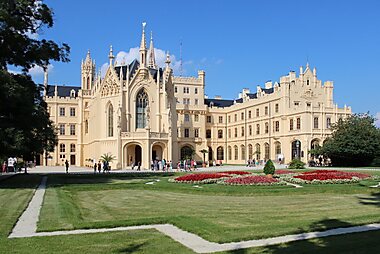




Lednice Château is the village's centerpiece, a Neo-Gothic palace rebuilt between 1846 and 1858 under architect Georg Wingelmüller for Prince Alois II of Liechtenstein, in the spirit of English Gothic architecture, with lavishly carved wooden interiors.
The palace opens directly onto Zámecká zahrada, an English-style landscape park with roots in the 16th century, scattered with romantic follies, an artificial cave, and a castle pond with 15 islands.
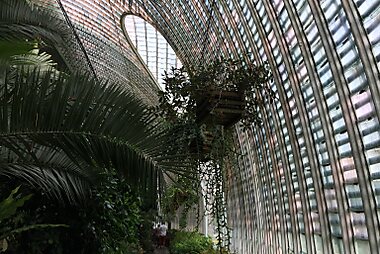
Inside the park, Greenhouse is a cast-iron and glass palm house built in the 1840s to house the Liechtensteins' plant collections — one of the finest surviving Victorian-era greenhouses in Central Europe.
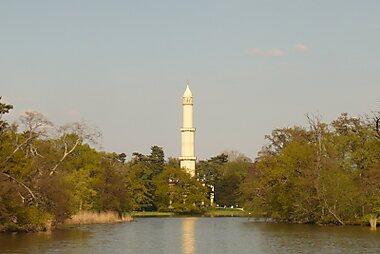
A walk or short boat ride across the ponds leads to the Minaret, a 60-meter tower built in the early 1800s and often cited as the tallest minaret-style structure outside the Islamic world; climb it for views over the whole landscape.
Janův hrad is a deliberately built "ruined" Gothic Revival castle, constructed between 1801 and 1808 to look centuries older than it is and used as a hunting lodge and gamekeeper's house.
On the edge of the ponds, Rybniční zámeček was a hunting lodge for the Liechtenstein princes, built between 1814 and 1816 and known for its reflection on the water's surface.
Near the chateau, Zámecká jízdárna is a Baroque riding hall attributed to architect Johann Bernhard Fischer von Erlach, now used as a concert and festival venue.
Featured Lists


Castles and Palaces
The Lednice-Valtice Cultural Landscape features a collection of architectural landmarks commissioned by the House of Liechtenstein. This selection includes the Neo-Gothic Lednice Château and several romantic follies integrated into the parkland. Notable structures include the Classicist Rybniční zámeček, the Hraniční zámeček marking the historic Moravian-Austrian border, and Janohrad, an artificial ruin used as a hunting lodge. The complex also contains the monumental Baroque riding hall designed by architect Johann Bernhard Fischer von Erlach.
5 places
What to experience
- Cycle the marked wine routes between Lednice and Valtice, stopping at small family-run cellars for tastings along the way.
- Join a Moravian wine tasting in one of the cellars around the village or in nearby Valtice — this region produces some of the country's best white wines.
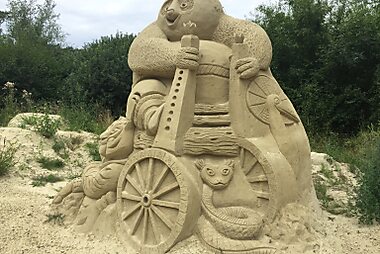
- Let kids loose at Sand World, with its sand sculptures recreating local landmarks and a sandy play area.
- In summer, take a boat ride across the chateau ponds toward the minaret, a slow, scenic alternative to walking the shoreline path.
Tours & Activities
Lednice — Map

 Open the interactive map
 Day trips
Lednice sits at the heart of Moravian wine country, with plenty to see nearby.
- Valtice — around 10 minutes by bike or car, Lednice's UNESCO twin: a Baroque chateau, historic wine cellars, and the region's main wine school.
- Mikulov — about 25 minutes by car, a hilltop wine town with its own castle, a well-preserved Jewish quarter, and views from the Holy Hill above town.
- Pálava — around 25-30 minutes by car, a small limestone ridge with hiking trails, vineyards, and views over the Nové Mlýny reservoirs.
- Brno — about an hour by car or train, Moravia's capital, with Špilberk Castle and the UNESCO-listed Villa Tugendhat.
- Vienna — roughly 1 hour 15 minutes by car, across the border in Austria — a full flagship day out if you have the time.
Where to explore
Lednice shares its UNESCO status with neighboring Valtice, a short bike ride away and the other half of the Lednice-Valtice Cultural Landscape — together the two towns and the parkland between them form a single protected estate. For a base with more wine cellars and hillside views, Mikulov is the region's main wine-tourism hub, a half-hour drive to the west.
Getting there
- By air: Vienna Airport (VIE) in Austria is the closest major international gateway, about 70 km away — roughly an hour by car. Brno-Tuřany Airport (BRQ) is nearer, around 50 km, but has only a handful of scheduled routes.
- By train: Lednice has its own small station, about 1 km from the chateau, on the branch line to Břeclav, the region's main rail junction on the Vienna-Prague/Brno line — around 15 minutes away.
- By bus: regional buses connect Lednice to Břeclav, Valtice, and Mikulov; the bus stop is close to the chateau.
Getting around
- Public transit: South Moravia's integrated network, IDS JMK, covers regional buses to nearby towns; buy tickets from the driver or through the IDS JMK app.
- On foot: the village center, chateau, and main park are all within easy walking distance of each other.
- Cycling: marked routes link Lednice to Valtice and the wider wine region; several shops in the village rent bikes by the day.
Driving
- Is a car worth it?: not for Lednice itself — the chateau, park, and village center are all walkable — but a car (or bike) helps for reaching Valtice, Mikulov, and the wider wine region in a single day.
- Parking: pay parking lots sit near the chateau entrance and along the approach roads; the village center itself has limited street parking.
- Restrictions: none beyond normal Czech road rules — no congestion charge or low-emission zone here.
Food & drink
Lednice sits in the heart of Moravia's wine country, and the area's white wines — Ryzlink rýnský, Veltlínské zelené, and other regional varieties — are a big part of why people linger over a meal here. Small cellars around the village and in nearby Valtice pair tastings with simple regional food.
For meals, look to the restaurants and wine bars around the main square near the chateau entrance rather than seeking out one destination restaurant — this is a village built for grazing between sights, not fine dining.
Safety & health
Lednice is a safe, low-crime destination with no particular hazards for travelers. The main practical issue is crowding rather than crime: parking and the chateau's ticket queues can back up on summer weekends, so arrive early or book tickets in advance during peak season.
History
The House of Liechtenstein held the Lednice estate from the 13th century until it was nationalized after the Second World War in 1945 — an unusually long, unbroken stretch of ownership by one family. A modest earlier château stood here for generations before Prince Alois II of Liechtenstein commissioned the dramatic Neo-Gothic rebuild of Lednice Château between 1846 and 1858.
At the same time, the Liechtensteins turned the surrounding land into an English-style landscape park, filling it with follies meant to be discovered on a walk or a ride through the grounds rather than seen all at once — an artificial ruin, a Moorish-style minaret, garden pavilions. That whole designed landscape, shared with neighboring Valtice, was recognized as a UNESCO World Heritage Site in 1996 for the scale and coherence of its 18th- and 19th-century landscape architecture.
After 1945 the chateau passed into state ownership and opened to the public; it remains one of the most visited monuments in the Czech Republic today.
Country facts
Quick practical facts for the Czech Republic at a glance:
- Currency
- Czech Koruna CZK Kč · Card payments · Commonly accepted
- Emergency numbers
- 112
- Electricity
- 230 V · 50 HzType C / Type E
- Languages
- Czech
- Tap water
- Safe to drink
- Driving side
- Right
- Calling code
- +420


Lednice – Plan Your Days
Turn the places from this guide into a real itinerary, with smart routing, time estimates, and everything you need for a perfect trip.




