


Mikulov
Mikulov sits at the southern tip of Moravia, close to the Austrian border. Pale limestone hills and rows of vineyards surround a small historic town built on a rocky outcrop. A Baroque palace crowns the highest point, and the winding lanes below still carry traces of one of Central Europe's most significant Jewish communities.
Mikulov is often called the center of Moravian wine country. Family-run wine cellars line the streets, and the surrounding villages produce some of the country's best whites. It suits a traveler who wants two or three easy days — walking the compact old town, tasting wine in a cellar, and using the town as a base for day trips into the vineyards and hills nearby.

Mikulov – Planning a Trip?
Build your day-by-day itinerary in the Tripomatic app.
When to visit
Spring and early autumn are the most pleasant times to visit, mild enough for walking the vineyards and the old town. Summer is warm and busy with wine-terrace crowds; winter is cold and quiet, better for cellar visits than sightseeing outdoors. Time a trip around the Pálava Wine Harvest (Pálavské vinobraní) in early September, when a costumed parade takes over the streets and local wineries compete for medals — book accommodation well ahead.
Best time to visit: May, June, July, August, September
October is prime season for tasting new wine straight from the press.
Top sights
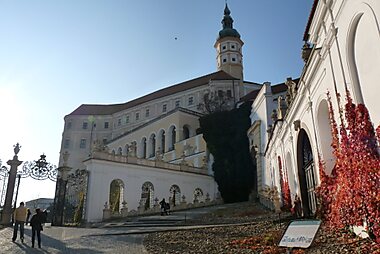
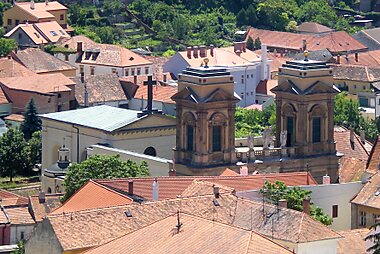

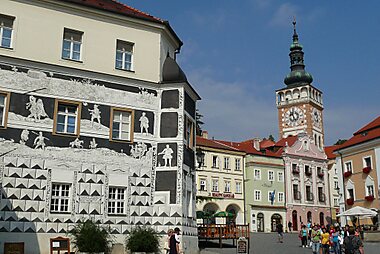

Mikulov Castle rises straight out of a limestone outcrop above the old town and is the first thing you see arriving in Mikulov. Rebuilt in Baroque style after an 18th-century fire, it now houses a regional museum with exhibits on local history and the area's wine-making tradition.
At the foot of the castle, Mikulov Main Square is lined with pastel Renaissance and Baroque townhouses, cafe terraces and wine bars — a good place to start exploring on foot.
Just off the square, Dietrichstein Tomb holds the crypt of the noble family who ruled Mikulov for almost 400 years. The chapel above it was modeled on the Holy House of Loreto, and the vault below holds dozens of family members' coffins.
Upper Synagogue, built around 1550, is the only surviving synagogue of the Polish type in Moravia. It anchors the historic Jewish quarter and now houses a museum on the region's Jewish history.
On the wooded hillside above town, Jewish Cemetery Mikulov is one of the largest and best-preserved Jewish cemeteries in Central Europe. It holds around 4,000 gravestones, some dating from the early 17th century, including a section reserved for the region's rabbis.
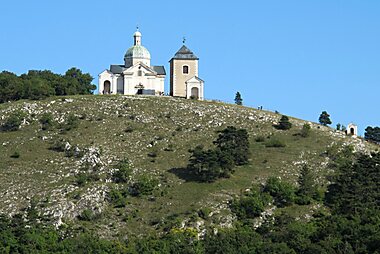
Holy Hill, a limestone knoll topped by a pilgrimage church, is reached by a short climb along a Stations-of-the-Cross path. The view over the town's rooftops and the surrounding vineyards is worth the effort.
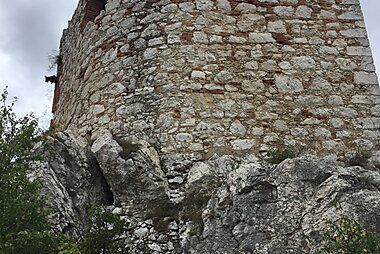
Kozí hrádek, the ruins of a late-Gothic fortification on a rocky spur beside the castle, gives another good vantage point over the town.
Turold Cave is the largest cave system cut into Jurassic limestone in the country, set inside a former quarry on the edge of town. Guided tours pass unusual coral-like rock formations and a winter roost for several bat species.
Featured Lists


Viewpoints and Monuments
A compact collection of viewpoints, monuments and memorials around Mikulov highlighting geological features and historic sites: limestone formations and cliffs, a flooded limestone quarry with interpretive signage, the late-Gothic Kozí hrádek fortress remains, the hilltop St. Šebestián church on Svatý kopeček, 19th-century Prussian cemetery (1866) and several local war and freedom monuments.
9 places
Wineries and Wine Shops
This selection highlights wineries, dedicated wine shops and nearby regional restaurants clustered around Mikulov and the Pálava foothills. Many venues stock Moravian and local vineyard labels, offer in‑shop tastings or cellar sales, and provide guidance on nearby vineyard routes. Several restaurants on the list serve regional cuisine paired with local wines; some businesses operate in historic buildings typical for the area.
8 placesAudio Guides – Mikulov
Explore on foot with a self-guided audio tour that narrates each stop as you reach it.


Hear Mikulov's audio tours
1 walk in Audio Guides by Tripomatic


What to experience
- Descend into one of the town's centuries-old wine cellars cut into the limestone hillside for a tasting — many of the small, family-run cellars welcome walk-ins outside peak season.
- Cycle the vineyard trails toward Valtice, stopping at small cellars along the way for a glass of the local dry whites.
- During the autumn harvest, try burčák, young half-fermented wine sold only for a few weeks each year straight from the press.
- Climb Holy Hill for sunset, when the view stretches over the vineyards toward Austria.
Tours & Activities
Mikulov — Map

 Open the interactive map
 Day trips
Mikulov makes a good base for exploring South Moravia's vineyards — flat cycling paths link several of the following in under half an hour.
- Valtice — about 15 minutes by car or 30 minutes by bike. This is the wine capital of the region, with its own Baroque chateau and dozens of tasting cellars around the main square.
- Pálava — about 15 minutes by car to the trailheads. Marked hiking routes climb limestone ridges above the Nové Mlýny reservoirs, with steppe wildflowers in spring and wide views over the vineyards.
- Lednice — about 25 minutes by car. Its Neo-Gothic chateau and English landscape park form, together with Valtice, a UNESCO World Heritage cultural landscape; a marked path links the two towns through the parkland.
- Brno — about 50 minutes by car or bus. Moravia's capital has a livelier restaurant and museum scene, plus its own historic centre and the modernist Villa Tugendhat.
- Vienna — about 1 hour by car or bus across the Austrian border, for a day of major museums and imperial architecture.
Getting there
- By air: The closest major airport is Vienna International Airport (VIE) across the border in Austria, about 1 hour by car or roughly 1 hour 35 minutes by bus. Brno–Tuřany (BRQ) is nearer but has only limited seasonal charter flights. Most international travelers connect through Prague, about 3 hours away by car or train via Brno.
- By train: Mikulov na Moravě station has regional trains to Břeclav, where you change for the main line to Brno (around 1 hour 35 minutes total) and onward to Prague or Vienna.
- By bus: Direct regional buses run roughly hourly to Brno (about 1 hour 10 minutes), and a few times a week to Vienna.
Getting around
- On foot: The old town is small and entirely walkable, about 15 minutes end to end. Reaching the castle, Holy Hill or the Jewish cemetery involves a short uphill climb.
- Public transit: Not needed within Mikulov itself. Regional buses and trains to nearby towns run on the South Moravian integrated network; buy tickets via the IDS JMK app or at ticket machines.
- Cycling: A popular way to see the wine country — marked routes connect Mikulov to Valtice, Lednice and the surrounding vineyards, mostly flat and well signed. Bikes can be rented in town.
Driving
- Car needed?: Not for Mikulov itself — the old town is walkable — but useful for reaching Valtice, Lednice and the Pálava hills at your own pace, especially if you plan to visit several wine cellars in one day.
- Parking: A few paid car parks ring the old town, including one near the main square and one below the castle; pay by the hour at a machine or via app. Street parking further from the centre is often free.
- Restrictions: None beyond normal town-centre traffic calming — no congestion charge or low-emission zone.
Food & drink
Mikulov's food culture is built around wine, not fine dining. Local restaurants serve hearty regional staples — roast pork with dumplings and cabbage, goulash, grilled meats — designed to go alongside a glass of the region's dry whites rather than stand on their own.
The best evenings here happen in a wine cellar, not a restaurant: many of the small family cellars (vinné sklípky) around town and in the villages toward Valtice pair a simple platter of cold cuts and cheese with a flight of the estate's own wine. Ask at the tourist information office on the main square for a current list of cellars open to visitors.
Safety & health
Mikulov is a very safe town, with little more than the usual pickpocket risk in crowds during the wine festival weekend. Tap water is safe to drink everywhere.
Wine cellars are the main thing to pace yourself around: Czech law has a strict zero-tolerance limit for alcohol while driving, so plan a designated driver, a taxi, or an overnight stay within walking distance of the cellars you visit.
History
Mikulov's castle began as a 13th-century border fortress, held by the Liechtenstein family for three centuries. In 1403, while it was still a Liechtenstein stronghold, King Wenceslas IV took refuge here after escaping captivity in Vienna in disguise — an episode still reenacted every autumn during the town's wine festival, when a costumed procession rides out toward Vienna and returns with the "king."
In 1575, Emperor Rudolf II granted the estate to the Dietrichstein family, who rebuilt Mikulov Castle into the Renaissance and later Baroque palace seen today and ruled the town for the next 370 years. Their mausoleum survives as Dietrichstein Tomb on the main square.
For much of that time, Mikulov — then known by its German name, Nikolsburg — was the most important center of Jewish life in Moravia and seat of the region's chief rabbi. Upper Synagogue and Jewish Cemetery Mikulov on the hillside above town are what remains of a community destroyed in the Holocaust.
Country facts
Quick practical facts for the Czech Republic at a glance:
- Currency
- Czech Koruna CZK Kč · Card payments · Commonly accepted
- Emergency numbers
- 112
- Electricity
- 230 V · 50 HzType C / Type E
- Languages
- Czech
- Tap water
- Safe to drink
- Driving side
- Right
- Calling code
- +420


Mikulov – Plan Your Days
Turn the places from this guide into a real itinerary, with smart routing, time estimates, and everything you need for a perfect trip.




