


Chisinau
Chisinau is Moldova's capital and largest city. Wide Soviet-era boulevards mix with parks and pale limestone buildings, which gave the city its old nickname, the White City.
Most visitors spend two or three days here. The center is easy to explore on foot, with a cluster of museums, monuments, and green parks. Chisinau also works well as a base for day trips to Moldova's underground wineries and cliffside monasteries.

Chisinau – Planning a Trip?
Build your day-by-day itinerary in the Tripomatic app.


When to visit
Spring and autumn are mild and the easiest seasons for sightseeing. Summers get hot, often above 30°C in July and August. Winters are cold and grey, with occasional snow.
Plan around National Wine Day, held on the first weekend of October. Wineries from across the country set up free tastings on Great National Assembly Square, a good way to taste Moldova's wine culture without leaving the city.
Best time to visit: May, June, September
Top sights


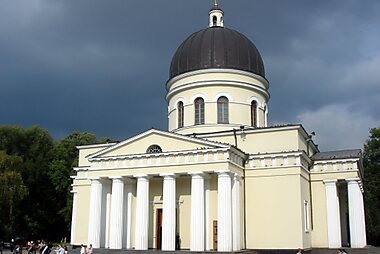

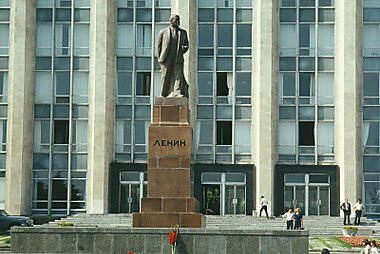
Great National Assembly Square is the historic and ceremonial heart of the city. Government House, the cathedral, and several monuments all sit around this open square.
Triumphal Arch was built in 1841 to commemorate a Russian victory over the Ottomans. It also works as a bell tower for the cathedral next door and doubles as a clock tower.
Metropolitan Cathedral of Christ's Nativity is the main cathedral of the Moldovan Orthodox Church, built in the 1830s. Soviet authorities closed it for decades and used it as an exhibition hall before it reopened for worship.
Stephen the Great Monument shows Moldova's medieval ruler, whom the country reveres as a founding figure and an Orthodox saint. It stands at the entrance to Stephen the Great and Saint Central Park, the oldest park in Moldova, where the Alley of Classics honors the country's writers with a row of busts.
National Museum of History of Moldova covers Moldova's history from prehistory to the Soviet era.
National Museum of Ethnography and Natural History is Moldova's oldest museum, founded in 1889. Its striking Moorish-style building holds a complete skeleton of a Deinotherium, an extinct relative of the elephant.
Valea Morilor Park is the city's largest park, built around a lake with a granite staircase and cascading fountains. It is a popular spot for an evening walk.
Featured Lists


What to experience
- Give or receive a mărțișor on March 1: small red-and-white string trinkets exchanged to welcome spring, sold at stalls across the city for the week before.
- Attend a concert at Organ Hall, a former bank building known for its acoustics and a large pipe organ.
- Watch a performance at Moldova National Opera Ballet, Moldova's national opera and ballet company.
- Rent a paddleboat on the lake at Valea Morilor Park on a warm afternoon.
Tours & Activities
Chisinau — Map

 Open the interactive map
 Day trips
Chisinau makes an easy base for day trips, from underground wine cities just outside town to cliffside monasteries further out.
- Cricova Winery is about 20 minutes north by car or minibus. An underground town of wine cellars with streets named after grape varieties, some 80 meters below ground.
- Milestii Mici Winery is about 25 minutes south. It holds the world's largest wine collection, in over 55 kilometers of tunnels carved from old limestone mines.
- Old Orhei is about 1 to 1.5 hours by car or bus. A cave monastery and ruined fortress cut into a limestone gorge above the Răut River, with hiking trails through the surrounding countryside.
- Saharna Monastery and Țipova Monastery are about 2 hours north, near Rezina. Two Orthodox cave monasteries carved into cliffs above the Dniester River, both reachable in the same day if you have a car.
- Bender is about an hour east by car, plus time at the border. It has a 16th-century Ottoman fortress, and it sits inside Transnistria, a breakaway region not recognized internationally. Bring your passport, expect a registration check, and carry cash, since cards are not reliably accepted there.
Getting there
- By air: Chisinau International Airport (KIV) is Moldova's only international airport, about 14 km south of the center. Book a ride through a taxi app rather than hailing one at the curb, where prices are less predictable; the trip takes about 20–30 minutes.
- By train: Moldova's rail network is slow and limited for travelers. A few direct trains run to Bucharest and Iași in Romania and to Odesa and Kyiv in Ukraine, but journeys take far longer than the equivalent bus.
- By bus: Long-distance coaches are the most practical overland option, with regular connections to Bucharest, Iași, Kyiv, and other regional cities.
Getting around
- Public transit: Buses, trolleybuses, and minibuses (rutiere) cover the city. Pay the driver or conductor in cash as you board; contactless card payment is not yet standard on Chisinau's public transit.
- Taxi and ride-hailing: Yandex Go and Bolt both operate in Chisinau and are the easiest way to get a fair price; street taxis sometimes quote tourists a higher fare.
- On foot and by bike: The center is compact and walkable, with wide, tree-lined boulevards. Dedicated cycling infrastructure is limited, so cycling works better in the parks than on main roads.
Driving
- Is a car worth it?: Not for the city itself; the center is small and walkable. A car helps for reaching the wineries and monasteries outside town, where bus schedules are infrequent.
- Parking: On-street parking in the center is metered; pay through the local parking app or by the SMS code posted on the sign. Several paid car parks sit near the main square.
- Rental: Renting a car is straightforward and inexpensive by regional standards, but confirm your rental company allows cross-border trips before heading into Transnistria.
Food & drink
For a sit-down meal, look to the restaurants and wine bars clustered around the city center. Most build their wine lists entirely around Moldovan producers, a good way to try wine from around the country.
Central Market is the place to see where Chisinau actually shops: a block-sized market selling local cheese, honey, and produce. It is worth an hour even if you are not buying anything.
Safety & health
Chisinau is a safe city for tourists, with low rates of violent crime. Watch for pickpockets in crowded markets and on public transit, as in any capital city.
The most common tourist scam is an overpriced taxi ride from the airport or a street hail; book through a ride-hailing app instead of flagging a cab. Only change money at banks or licensed exchange offices, never with people offering rates on the street.
If your day trip takes you into Transnistria, carry your passport and expect a registration check at the border; the region operates outside Moldovan control.
History
Chisinau's name first appears in a document from 1436, as a small settlement on the Bâc River. It grew under Moldavia's medieval princes, including Stephen the Great, whom Stephen the Great Monument honors today. The Russian Empire annexed the region, then called Bessarabia, in 1812. It rebuilt Chisinau as a provincial capital, laying out the wide, orderly streets still visible in the center today. The poet Alexander Pushkin lived here in exile from 1820 to 1823, and Alexander Pushkin Historic House Museum preserves the house where he stayed. In 1841, the Russian administration raised Triumphal Arch to mark a victory over the Ottoman Empire.
World War II and a major 1940 earthquake destroyed much of the old city. The Soviet Union rebuilt it in the monumental style still visible in its boulevards and apartment blocks today. Memorial to Victims of Stalinist Repression and Eternity Memorial Complex commemorate two sides of that period: Stalin-era deportations to Siberia, and the Soviet dead of the war. Moldova declared independence from the USSR in 1991.
Country facts
Quick practical facts for Moldova at a glance:
- Currency
- Moldovan Leu MDL L · Card payments · Commonly accepted
- Emergency numbers
- 112
- Electricity
- 220 V · 50 HzType C / Type F
- Languages
- Romanian
- Tap water
- Drink with caution
- Driving side
- Right
- Calling code
- +373


Chisinau – Plan Your Days
Turn the places from this guide into a real itinerary, with smart routing, time estimates, and everything you need for a perfect trip.