


Edinburgh
Edinburgh is Scotland's capital and its most visited city. Its skyline is dominated by a castle on an extinct volcanic rock, with a medieval Old Town of narrow closes on one side and an elegant 18th-century New Town on the other. Together they form a single UNESCO World Heritage Site.
This is a city built for walking. Its center is compact, its history is visible everywhere, and hills within the city give sweeping views without leaving town. Come in August and the city fills up for the world's largest arts festival; visit any other month for a quieter, still atmospheric capital. The writers Robert Louis Stevenson and Arthur Conan Doyle were both born here.

Edinburgh – Planning a Trip?
Build your day-by-day itinerary in the Tripomatic app.
When to visit
Summers are cool and rarely hot. Winters are cold with short days, but the city has a lively Christmas market and a famous New Year celebration. Spring and autumn are quieter, with fewer crowds and lower prices.
Plan around the Edinburgh Festival Fringe, the world's largest arts festival, held every August. The whole city fills with performances and street shows, but accommodation prices rise sharply, so book well ahead.
Rain is possible in any month, so pack a waterproof layer rather than relying on the forecast.
Top sights
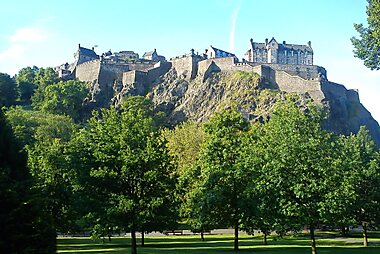

Edinburgh Castle sits on an extinct volcanic rock above the city and has been a royal fortress for over 900 years. Inside are the Scottish crown jewels and the Stone of Destiny, used in the coronation of Scottish and British monarchs.
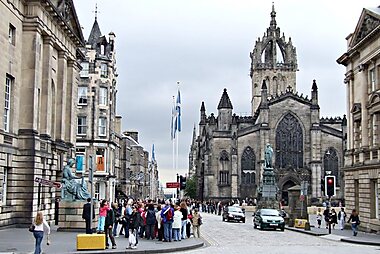
Royal Mile runs from the castle down to the palace, linking the Old Town's historic closes, kirks, and pubs in one walkable stretch.
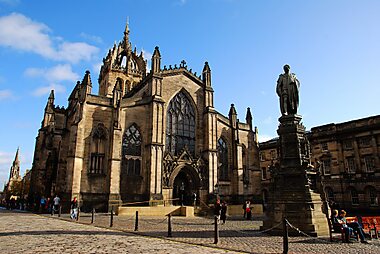
St Giles' Cathedral is the city's main medieval church, recognizable by its crown-shaped spire, and the resting place of several key figures in Scottish history.
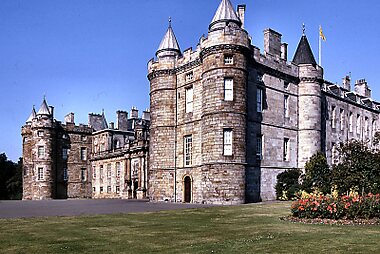
At the foot of the Royal Mile, Palace of Holyroodhouse is the official Scottish residence of the British monarch, built next to the ruins of a 12th-century abbey.
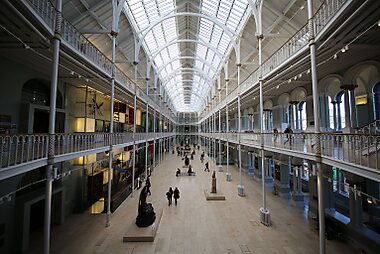
National Museum of Scotland covers Scottish history and world culture under one roof, and entry is free.
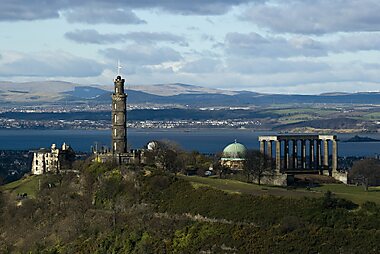
Climb Calton Hill for unfinished Greek-style monuments and one of the best skyline views in the city, especially at sunset.
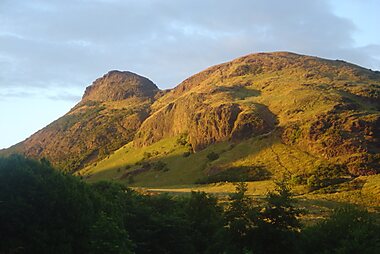
For a longer climb, Arthur's Seat is an extinct volcano inside the city, with a summit trail that takes most walkers one to two hours round trip.
Camera Obscura & Illusions combines a Victorian rooftop camera obscura with hands-on optical illusions, a good rainy-day option right by the castle.
Featured Lists

Edinburgh Essentials
Edinburgh’s Old and New Towns, both UNESCO World Heritage sites, offer a dense concentration of historical landmarks. This selection covers the city's royal heritage from the 12th-century Edinburgh Castle to the Palace of Holyroodhouse, connected by the medieval Royal Mile. It includes architectural highlights like the Victorian Gothic Scott Monument and St Giles’ Cathedral, alongside natural features such as the volcanic peak of Arthur’s Seat and Calton Hill’s monuments. For cultural depth, the list features the Scottish National Gallery, the underground history of Mary King’s Close, and the former royal yacht, HMY Britannia.
12 places

Edinburgh's Hidden Gems
Beyond the crowded Royal Mile, Edinburgh holds secluded sites like the hand-carved sandstone chambers of Gilmerton Cove and the Victorian interiors of Bennets Bar. This collection features the Royal Observatory on Blackford Hill and contemporary installations at Jupiter Artland. Nature seekers can explore the Water of Leith Walkway or Dr Neil’s Garden by Duddingston Loch, while history enthusiasts can find the William Henry Miller Monument and Muschat’s cairn, a landmark immortalized in Sir Walter Scott’s literature.
9 places


Audio Guides – Edinburgh
Explore on foot with a self-guided audio tour that narrates each stop as you reach it.


Hear Edinburgh's audio tours
1 walk in Audio Guides by Tripomatic


What to experience
A few things worth building time for, beyond the big sights:
- Watch the One O'Clock Gun fire from Edinburgh Castle every day except Sunday, a working naval time signal that has fired since 1861.
- Descend into the sealed 17th-century streets at The Real Mary King's Close, hidden beneath the Old Town on a guided tour.
- Taste and compare single malts on a guided tasting flight at The Scotch Whisky Experience.
- Follow the Water of Leith walkway past St Bernard's Well, an 18th-century mineral-spring folly, on a quiet path away from the crowds.
- Join the street party for Hogmanay, Edinburgh's multi-day New Year celebration, one of the largest in the world.
Tours & Activities
Edinburgh — Map

 Open the interactive map
 Day trips
Edinburgh sits close to castles, coastline, and countryside worth a full day. A few of the best, closest first:
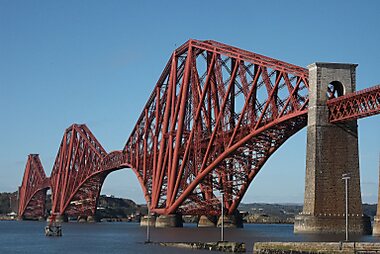
- South Queensferry, about 30 minutes by train — home to the Forth Bridge, a Victorian railway bridge and UNESCO World Heritage Site, plus a small harbor town to wander.
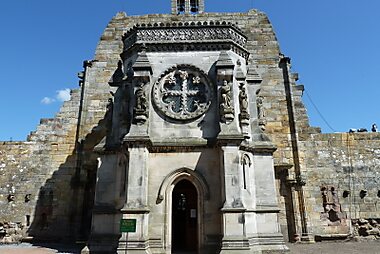
- Rosslyn Chapel, about 40 minutes by bus or car — an ornately carved 15th-century chapel made famous by The Da Vinci Code.
- North Berwick, about 30 minutes by train — a seaside town with a beach, a ruined castle, and boat trips to see the huge gannet colony on the Bass Rock and puffins on nearby islands in summer.
- Stirling, about 50 minutes by train — a historic castle town that controlled the main crossing point between the Scottish Highlands and Lowlands for centuries.
- St Andrews, about 1.5 hours by train and bus — the home of golf, with a ruined cathedral and a windswept coastline.
- Loch Lomond, about 1.5 to 2 hours by car or organized tour — Scotland's largest loch, ringed by hills and a good introduction to the Highlands without a multi-day trip.
Where to explore
Glasgow is Scotland's largest city, under an hour away by train, with a different character: grittier, more industrial heritage, and strong art and music scenes. Many visitors combine the two cities in one trip.
Getting there
- By air: Edinburgh Airport is the main gateway, about 13 km west of the center. The Airlink express bus takes about 30 minutes to the city center; the tram takes about 35 minutes and calls at stops through the west end. Edinburgh Airport
- By train: Edinburgh Waverley station is in the city center, with frequent direct trains from London (about 4.5 hours), Glasgow (under an hour), and other major British cities. National Rail
- By bus: Edinburgh Bus Station, on St Andrew Square in the New Town, has long-distance coach links across Scotland and to English cities, generally slower and cheaper than the train.
Getting around
- Public transit: Lothian Buses run frequent routes across the city; tap a contactless bank card or phone directly on the reader as you board, no ticket machine or app needed. A single tram line connects the airport to the city center and Leith. Lothian Buses
- Taxi / ride-hailing: Black cabs are common and can be hailed on the street; Uber also operates.
- On foot: The Old Town and New Town are both walkable, though the Old Town's hills and cobbles make for a slower pace.
Driving
- Which side: Traffic drives on the left, opposite to most of mainland Europe and North America.
- Is a car worth it?: No, skip it within the city. Public transit and walking cover the center easily, and traffic and parking are limited. A car only helps for reaching day trips at your own pace.
- Parking: Metered street parking and multi-story car parks operate in the center; pay by app or meter, and expect an hourly rate.
- Restrictions: A low emission zone covers the city center; older, more polluting vehicles may be charged or restricted.
Food & drink
Edinburgh's food scene mixes traditional Scottish dishes, such as haggis, cullen skink, and fish and chips, with a strong modern Scottish and international restaurant scene.
For a concentrated stretch of restaurants and pubs, head to the Grassmarket, a historic square below the castle, or to the Leith waterfront, where old dockside warehouses now hold some of the city's best restaurants, including several with Michelin stars.
Safety & health
Edinburgh is a safe city for tourists by international standards. The main risks are pickpocketing and bag-snatching in crowded areas like the Royal Mile and around Waverley Station, especially during the August festivals, so keep bags zipped and in front of you.
Late at night, stick to well-lit streets around the Old Town and Grassmarket, as in any large city. Tap water is safe to drink everywhere.
History
Edinburgh Castle has been besieged more than any castle in Britain, changing hands repeatedly between Scottish and English forces during centuries of border wars. Below it, the Old Town grew upward rather than outward, squeezed onto a narrow ridge between the castle and Palace of Holyroodhouse, producing the tall tenements and hidden closes that still define the streetscape.
By the 18th century, the crowded and unsanitary Old Town pushed wealthier residents across the valley to build the New Town: a planned grid of Georgian townhouses, including Georgian House, that still stands largely intact today as one of Europe's best-preserved examples of neoclassical city planning.
Country facts
Quick practical facts for the United Kingdom at a glance:
- Currency
- British Pound GBP £ · Card payments · Widely accepted
- Emergency numbers
- 999 Police · Ambulance · Fire brigade
- Electricity
- 230 V · 50 HzType G
- Languages
- English
- Tap water
- Safe to drink
- Driving side
- Left
- Calling code
- +44


Edinburgh – Plan Your Days
Turn the places from this guide into a real itinerary, with smart routing, time estimates, and everything you need for a perfect trip.




