


Ubeda
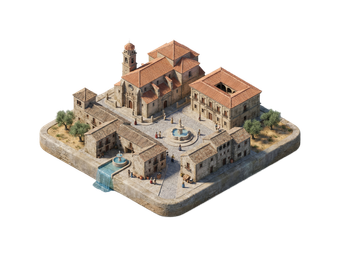
Úbeda is a hill town in the province of Jaén, in eastern Andalusia, surrounded by olive groves. Together with nearby Baeza, it is a UNESCO World Heritage Site for its Renaissance architecture, which was built in the 16th century by wealthy noble families.
The old town is compact and made of golden stone, with palaces, churches and squares close together. It is a calm place that rewards a slow walk, and a base for the Sierra de Cazorla natural park.

Ubeda – Planning a Trip?
Build your day-by-day itinerary in the Tripomatic app.


When to visit
Spring and autumn are the best seasons, with mild weather. Summers are very hot, and winters can be cold. Holy Week (Semana Santa) has long processions. The Fiestas de San Miguel in late September are the town's main festival.
Best time to visit: April, May, September, October
Top sights
- Úbeda City Centre is the heart of the old town, with the Plaza Vázquez de Molina, the main monumental square.
- Palacio Juan Vázquez de Molina is a Renaissance palace on the main square, built in the 16th century and used as the town hall.
- The Sacra Capilla del Salvador del Mundo is a chapel with a grand Renaissance façade, one of the best examples of Spanish Renaissance architecture.
- The Hospital de Santiago is a large 16th-century hospital, now a cultural center, with a patio.
- The Iglesia de San Pablo is a church with Gothic and Renaissance elements, on a small square.
- The Sinagoga del Agua is a rediscovered synagogue with a water cistern, in the Jewish quarter.
- The Casa de las Torres is a Renaissance palace with towers and a decorated portal.
- The old walls and gates, such as the Puerta de Santa Lucía, and the viewpoints at the edge of town look over the olive groves.
Featured Lists


What to experience
- Walk the Plaza Vázquez de Molina at sunset, when the stone glows.
- Visit the chapel, the hospital and the synagogue.
- Shop for the local ceramics, a craft of the town.
- Take a day trip to Cazorla.
- Sample olive oil from the local mills.
Tours & Activities
Ubeda — Map

Day trips
- Baeza (about 9 km): the sister town in the UNESCO listing, with a cathedral and plazas.
- Sierra de Cazorla, Segura y las Villas (about 50 km): Spain's largest protected natural area, with forests and walking trails.
- Granada (about 120 km): the Alhambra and a university city.
- Córdoba (about 140 km): a mosque-cathedral and old Jewish quarter.
Where to explore
Getting there
- By train: The nearest station is Linares-Baeza, about 25 km away, with trains to Madrid and Córdoba. Book on Renfe. A bus or taxi links the station and the town.
- By bus: Buses run from Jaén, Granada, Córdoba and Madrid.
- By air: Granada, Córdoba and Jaén have no major airports nearby. Granada airport is about 130 km away, and Madrid about 330 km.
- By car: The A-316 and A-32 roads.
Getting around
- On foot: The monumental area is compact and mostly flat. The lanes can be steep and cobbled.
- Taxi and local bus: Available, and useful for Baeza and the station.
Driving
- Is a car worth it?: Useful for Cazorla and the olive-oil estates. The old town is on foot.
- Parking: Paid car parks are at the edge of the old town.
- Roads: Roads are good and uncrowded.
Food & drink
Jaén province is the world's largest producer of olive oil, and aceite de oliva is central to the food. Try ajo de harina, andrajos (a stew with flatbread), pipirrana (a salad), lomo de orza (marinated pork) and espinacas con garbanzos. Many tapas bars give a free tapa with a drink.
Safety & health
Úbeda is a safe town. Summer heat can be extreme, so visit in the morning and evening. Cobbled lanes can be slippery when wet.
History
Úbeda was reconquered from the Moors in 1233. In the 16th century, nobles and clergy built palaces and churches in the Renaissance style, notably under the influence of Andrés de Vandelvira, the architect of the Sacra Capilla and the Hospital de Santiago.
Decline followed in the 17th century, which helped preserve the buildings. In 2003, Úbeda and Baeza were added to the UNESCO World Heritage List.
Country facts
Quick practical facts for Spain at a glance:
- Currency
- Euro EUR € · Card payments · Widely accepted
- Emergency numbers
- 112
- Electricity
- 230 V · 50 HzType C / Type F
- Languages
- Spanish
- Tap water
- Safe to drink
- Driving side
- Right
- Calling code
- +34


Ubeda – Plan Your Days
Turn the places from this guide into a real itinerary, with smart routing, time estimates, and everything you need for a perfect trip.


Related destinations


Data: © OpenStreetMap contributors, Wikidata, Wikipedia, Tripomatic, Official websites. Tours by GetYourGuide. We earn commission from bookings. Travel guide generated with AI.