


Rothenburg ob der Tauber
Rothenburg ob der Tauber is a small walled town in Franconia, in northern Bavaria. It has timber-framed houses, cobbled lanes and a medieval wall that you can walk on. It is a well-known stop on the Romantic Road.
The town suits a short trip of one or two nights. Day visitors arrive in large numbers, so early morning and evening are quieter. Many people stay overnight to see the lanes without the crowds.
Download this guide as a PDFPrintable tourist mapPublic holidays in Germany

Rothenburg ob der Tauber – Planning a Trip?
Build your day-by-day itinerary in the Tripomatic app.


When to visit
Late spring and early autumn are mild and good for walking the wall. Summer is warm, with some rain. Winter is cold, but the town is popular in Advent.
The Reiterlesmarkt, the Christmas market, runs on the Marktplatz in the weeks before Christmas. It gives a reason to visit in winter.
Best time to visit: June, July, August, September
Top sights
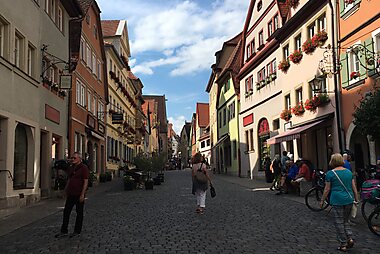

- Plönlein is a small square where two streets meet. It has a fountain, a half-timbered house and two towers.
- Marktplatz is the main square. The market, the Christmas market and the town hall all stand here.
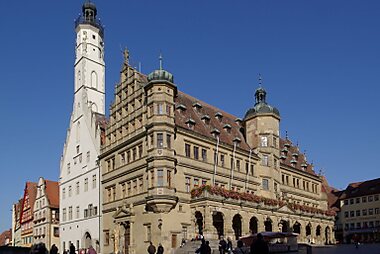
- Rathaus combines a Gothic and a Renaissance building. Climb the tower for a view over the roofs and the Tauber valley.
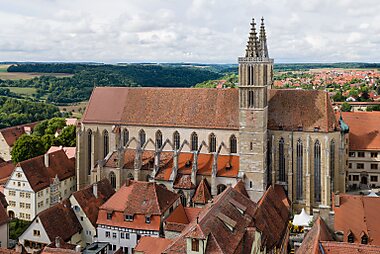
- St. Jakob is the main church. It holds the carved Holy Blood altar by Tilman Riemenschneider.
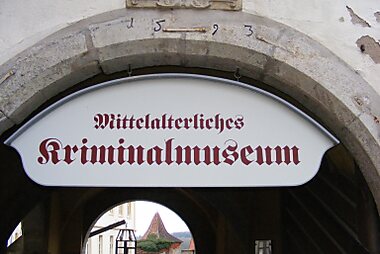
- Mittelalterliches Kriminalmuseum shows the history of law and punishment in Europe. It has instruments of torture and old court records.
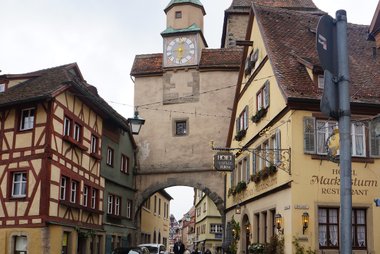
- Markusturm is a tower in the old town wall. Walk along the wall from here to see the town from above.
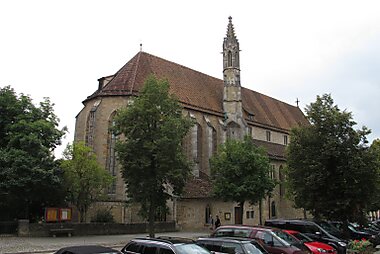
- Franziskanerkirche is a former Franciscan church in the old town.
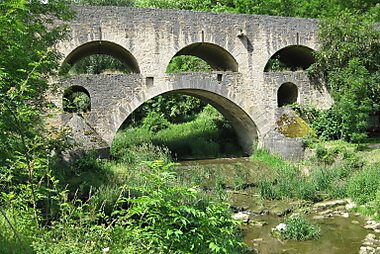
- Doppelbrücke is a two-level stone bridge in the Tauber valley below the town. A short walk down from the old town leads to it.
Featured Lists

Rothenburg ob der Tauber Essentials
Rothenburg ob der Tauber preserves its 13th-century layout within a complete circuit of walkable town walls. This selection features the iconic Plönlein fork, the Gothic and Renaissance Rathaus, and St. Jakob Church, home to Tilman Riemenschneider’s Holy Blood Altar. Beyond the architecture, the list includes the Medieval Crime and Justice Museum’s legal artifacts and the year-round Christmas traditions at Käthe Wohlfahrt, representing the town’s deep historical and cultural significance.
12 places

Historic Squares & Gates
Rothenburg ob der Tauber's medieval layout is defined by its central administrative hub and defensive perimeter. This collection features the Rathaus, a blend of Gothic and Renaissance architecture on the Market Square, and the Burggarten, situated on the site of a 12th-century Hohenstaufen castle. The list also highlights the city's preserved fortifications, including the 14th-century Burgtorturm and the Siebersturm, which marks the southern entrance to the iconic Plönlein district.
6 placesWhat to experience
- Join a night watchman tour in the evening. A guide in costume tells the history of the town by lantern light.
- Visit the German Christmas Museum and the Christmas shops nearby. They are open all year, so you can feel the Christmas mood in summer too.
- Walk the town wall at sunset. You can step onto the wall at several points.
Tours & Activities
Rothenburg ob der Tauber — Map

 Open the interactive map
Day trips
Rothenburg works well as a base for the Romantic Road. Most trips need a train change or a car.
- Würzburg is a baroque city on the Main river. It has a UNESCO-listed palace and a hilltop fortress.
- Nuremberg has a large old town and an imperial castle. It also has museums on the Nazi period.
- Dinkelsbühl is another walled town on the Romantic Road. It is smaller and quieter than Rothenburg.
- Creglingen is a village in the Tauber valley. Its church holds a carved altar by Tilman Riemenschneider.
Getting there
- By air: Nuremberg and Frankfurt are the closest large airports. Munich is farther. From each airport, continue by train or car.
- By train: Rothenburg has a small station on a branch line. Most routes from Würzburg, Nuremberg and other cities change at Steinach. Book through Deutsche Bahn.
- By car: The Romantic Road passes through town. Park outside the walls and walk in.
Getting around
- Walking: The old town is small, and the main sights are close together. The cobbles are uneven and some streets are steep.
- Bike: The Tauber valley below the town has cycle paths. The climb back to the old town is steep.
- Visitor information: See Rothenburg Tourismus Service for tours, events and getting there.
Driving
- Is a car worth it? Not for the town itself, because the old town is small. A car helps for the Romantic Road and the villages in the Tauber valley.
- Parking: Use the car parks outside the town wall. Walk into the old town from there.
Food & drink
Franconian food is hearty. Look for roast pork, sausages, dumplings and local wines and beers. Many inns serve these in the old town.
Rothenburg is known for the Schneeball. This is a ball of crisp pastry strips, dusted with sugar or covered in chocolate. Bakeries along the main lanes sell them. For a meal, look around the Marktplatz and the lanes leading off it.
Safety & health
- Pickpockets work in the crowded lanes on busy days. Keep bags closed.
- Cobbles and steps are uneven. Wear sturdy shoes.
History
Rothenburg became a free imperial city in 1274. It answered only to the emperor, not to a local lord. It stayed free until 1803, when it became part of Bavaria.
In 1631, during the Thirty Years' War, the army of General Tilly took the town. The Meistertrunk legend tells that the mayor saved the town by drinking a huge glass of wine.
The town lost its wealth after the war. It then changed little for two centuries, and the old houses and walls survived. In the 19th century, artists and writers began to visit.
On 31 March 1945, bombs hit the town and destroyed many houses. After the war, the town rebuilt the old town in its medieval style.
Country facts
Quick practical facts for Germany at a glance:
- Currency
- Euro EUR € · Card payments · Commonly accepted
- Emergency numbers
- 112 Ambulance · Fire brigade
- Electricity
- 230 V · 50 HzType C / Type F
- Languages
- German
- Tap water
- Safe to drink
- Driving side
- Right
- Calling code
- +49


Rothenburg ob der Tauber – Plan Your Days
Turn the places from this guide into a real itinerary, with smart routing, time estimates, and everything you need for a perfect trip.


Related destinations
Other Destinations
Data: © OpenStreetMap contributors, Wikidata, Wikipedia, Tripomatic, Official websites. Tours by GetYourGuide. We earn commission from bookings. Travel guide generated with AI.
Plan your trip with Tripomatic
- AI-Powered PlanningGet a ready-made day in one tap, let AI spread your shortlist across your trip, or plan everything by chatting.
- Travel AlertsOfficial advisories, severe weather, strikes, and natural hazards for the places on each day of your trip.
- Public Holidays & EventsSee holidays, festivals, and closures on the days of your trip, and what they mean for your plans.
- Cost EstimationAI-powered trip cost breakdowns so you know what to budget before you go.
- Tours & TicketsBook tours, skip-the-line tickets, and activities directly in your plan.