

Znojmo
Znojmo sits on a rocky bluff above the Dyje river, on the border with Austria. The old town's medieval streets, church towers, and a ring of surviving walls look out over a deep river gorge that marks the edge of Podyjí National Park. Below the streets lies one of Europe's largest networks of underground passages, carved through the rock over centuries.
The town is the unofficial capital of Czech wine country. Vineyards cover the hills around it, and Znojmo is also known across the country for its pickled cucumbers, a local specialty since the 19th century. It suits travelers who want a compact historic center, wine tasting, and hiking trails into a river canyon, all within a short walk or drive of each other.

Znojmo – Planning a Trip?
Build your day-by-day itinerary in the Tripomatic app.
When to visit
Spring and autumn are mild and pleasant for walking the old town and the vineyards. Summer gets warm and dry, good for outdoor cafes and river trails. Winter is cold, with a small Christmas market on the main square.
Time a visit for the Znojmo Historical Wine Festival in mid-September, one of the largest wine and folklore festivals in the Czech Republic. It fills the old town with a costumed parade, music, and open-air wine tasting.
Best time to visit: June, July, August, September
Summer afternoons get hot quickly, and evenings cool fast near the river; winter nights are reliably below freezing, so pack layers even for a short winter trip.
Top sights



Znojmo Castle rises above the Dyje river on the site of a stronghold first fortified in the 11th century, later rebuilt in Baroque style. Its rooms now hold the Znojmo Museum, with exhibits on the town's history and regional art.
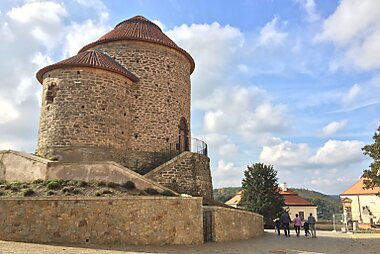
Inside the castle grounds, Rotunda of Saint Catherine is a small Romanesque chapel from the 11th century. Its interior holds one of the oldest fresco cycles in the Czech lands, painted to honor the ruling Přemyslid dynasty.
Below the streets, Znojmo Underground is a network of medieval cellars and corridors stretching nearly 27 kilometers. Guided routes lead through storage vaults, a historic water system, and a Cold War-era shelter.
At 66.5 meters, Radniční věž is the tallest structure in the old town. Climb the spiral stairs to a gallery with panoramic views over the rooftops and the river gorge.
sv. Mikuláš is a late Gothic parish church built around 1500. Inside, look for the Gothic frescoes and a Baroque pulpit carved in the shape of a globe.
Just outside the center, Loucký klášter is a Premonstratensian monastery founded in 1190. Today it houses the Znovín Znojmo winery, with a wine museum, tasting room, and a Baroque basilica open to visitors.
Vlkova věž is a 13th-century tower that once guarded the town's southern gate toward Vienna. It now doubles as a viewpoint and a small wine information center.
On a hilltop northeast of town, Hradiště sv. Hypolita preserves the remains of a Great Moravian hillfort and an 11th-century church. A small museum and a short trail cover the site's archaeology.
Featured Lists

Audio Guides – Znojmo
Explore on foot with a self-guided audio tour that narrates each stop as you reach it.


Hear Znojmo's audio tours
1 walk in Audio Guides by Tripomatic


What to experience
Znojmo's rituals are tied to its identity as a wine and cucumber town.
- Taste burčák, the year's young, still-fermenting wine, straight from a cellar during the grape harvest in September and October.
- Browse the wooden barrels of pickled cucumbers sold at stalls on the main square, a local specialty and a point of civic pride since the 19th century.
- During the Znojmo Historical Wine Festival in September, join the crowds watching the costumed procession that reenacts scenes from the town's medieval history.
Tours & Activities
Znojmo — Map

 Open the interactive map
 Day trips
Znojmo sits close to the Austrian border, in the middle of the country's best-known wine region. These destinations make good day trips by car, bus, or train.
- Podyjí National Park (10-15 min by car or bike): trails follow the Dyje river through a deep, forested canyon with viewpoints over the water. Some trailheads start at the edge of town.
- Vranov nad Dyjí (about 30 min by car or bus): a small village below a dramatic chateau perched on a rock above a reservoir on the Dyje river.
- Mikulov (about 45 min by car or bus): a wine town below its own hilltop chateau, with a well-preserved Jewish quarter and cellar tastings.
- Lednice and Valtice (about 1 hour by car): twin towns at the heart of a UNESCO World Heritage cultural landscape, with two grand chateaux linked by parkland and cycling paths.
- Vienna, Austria (about 1 hour by car, or by train): a full day of museums, palaces, and coffeehouses just across the border.
Where to explore
Brno is the region's capital, with a wider mix of museums, nightlife, and functionalist architecture that a smaller wine town cannot offer. Mikulov is Znojmo's closest rival for wine tourism, with its own chateau and cellar culture. Podyjí National Park borders the town directly and is the natural extension of any stay here, with hiking trails through the Dyje river canyon.
Getting there
- By air: Vienna International Airport (VIE) in Austria is the nearest major airport, about 90 km away, roughly 1.5 hours by car. Brno-Tuřany Airport (BRQ) is closer but has only limited seasonal flights, and Prague's airport is about 2.5 hours away by car.
- By train: Regional trains connect Znojmo directly to Brno (about 1.5 hours), with onward connections to Prague, and across the border to Vienna on the ÖBB regional line (about 1.5-2 hours).
- By bus: Long-distance coaches also link Znojmo to Brno, Prague, and Vienna.
Getting around
- The old town is compact, walkable, and hilly near the castle and the gorge — comfortable shoes help on the cobblestones.
- Local buses cover the newer districts and the train station, but most visitors will not need them to see the old town.
- Znojmo sits on the Moravian wine trails, a network of signed cycling routes through the vineyards; bikes can be rented in town for day rides into the countryside.
Driving
- A car is not needed for the old town itself, which is small and hilly, but it is the easiest way to reach hiking trailheads, nearby vineyards, and smaller villages outside town, where buses run infrequently.
- Paid car parks ring the old town, including one near the castle; the historic core's narrow streets are largely closed to through traffic.
- Czech motorways require an electronic vignette, but the drive from Vienna or Brno to Znojmo uses ordinary roads, so a vignette usually is not needed just to reach the town itself.
Food & drink
Znojmo gave its name to znojemská, a classic Czech dish of pork or beef in a tangy sauce with pickled gherkins, found on menus across the country but born here. The town is also known nationally for its pickled cucumbers, a local specialty sold at market stalls and served as a side dish everywhere.
For wine, look for dry whites from the surrounding vineyards, especially Ryzlink rýnský and Veltlínské zelené. Wine bars and cellars cluster around the main square and the lanes below the castle; many pour local vintages by the glass alongside a plate of cheese or cold cuts.
Safety & health
Znojmo is a very safe town for travelers, with a lower crime rate than Prague or Brno. The main risks are ordinary ones: watch personal belongings in crowds during the September wine festival, and take care on steep, cobbled lanes near the castle and the gorge, especially after rain.
History
Long before the medieval town existed, a Great Moravian hillfort stood on the hill now called Hradiště sv. Hypolita, guarding a crossing of the Dyje river. The story of Znojmo itself begins with the Přemyslid margraves, who built a stronghold on the bluff above the river; parts of it survive today inside Znojmo Castle.
In 1134, Duke Konrád II commissioned the frescoes inside Rotunda of Saint Catherine to mark his marriage and to assert his branch of the Přemyslid dynasty's claim to rule. The paintings are one of the oldest surviving fresco cycles in the Czech lands.
As a border town facing Austria, Znojmo built extensive fortifications, including Vlkova věž and the Znojmo Underground beneath the streets, carved out from the late 14th century onward for storage, water supply, and defense. Nearby, the Loucký klášter, founded in 1190, grew into one of the region's most important centers of learning before its later conversion to a winery.
Country facts
Quick practical facts for the Czech Republic at a glance:
- Currency
- Czech Koruna CZK Kč · Card payments · Commonly accepted
- Emergency numbers
- 112
- Electricity
- 230 V · 50 HzType C / Type E
- Languages
- Czech
- Tap water
- Safe to drink
- Driving side
- Right
- Calling code
- +420


Znojmo – Plan Your Days
Turn the places from this guide into a real itinerary, with smart routing, time estimates, and everything you need for a perfect trip.